1. Project Overview
| Dimension | Information |
|---|---|
| Projects | HKUDS/RAG-Anything |
| Positioning | All-in-One Multimodal Document Processing RAG system |
| Technical basis | Based on LightRAG, integrated MinerU / Docling / PaddleOCR and other analytical capabilities |
| Main Language | Python |
| Open Source License | MIT |
| Created | 2025-06-06 |
| Recently pushed | 2026-06-15 |
| GitHub Hot | 2026-06-30 Query: About 21.7k stars, 2.5k forks, 106 open issues |
| Package installation | 'pip install raganything' |
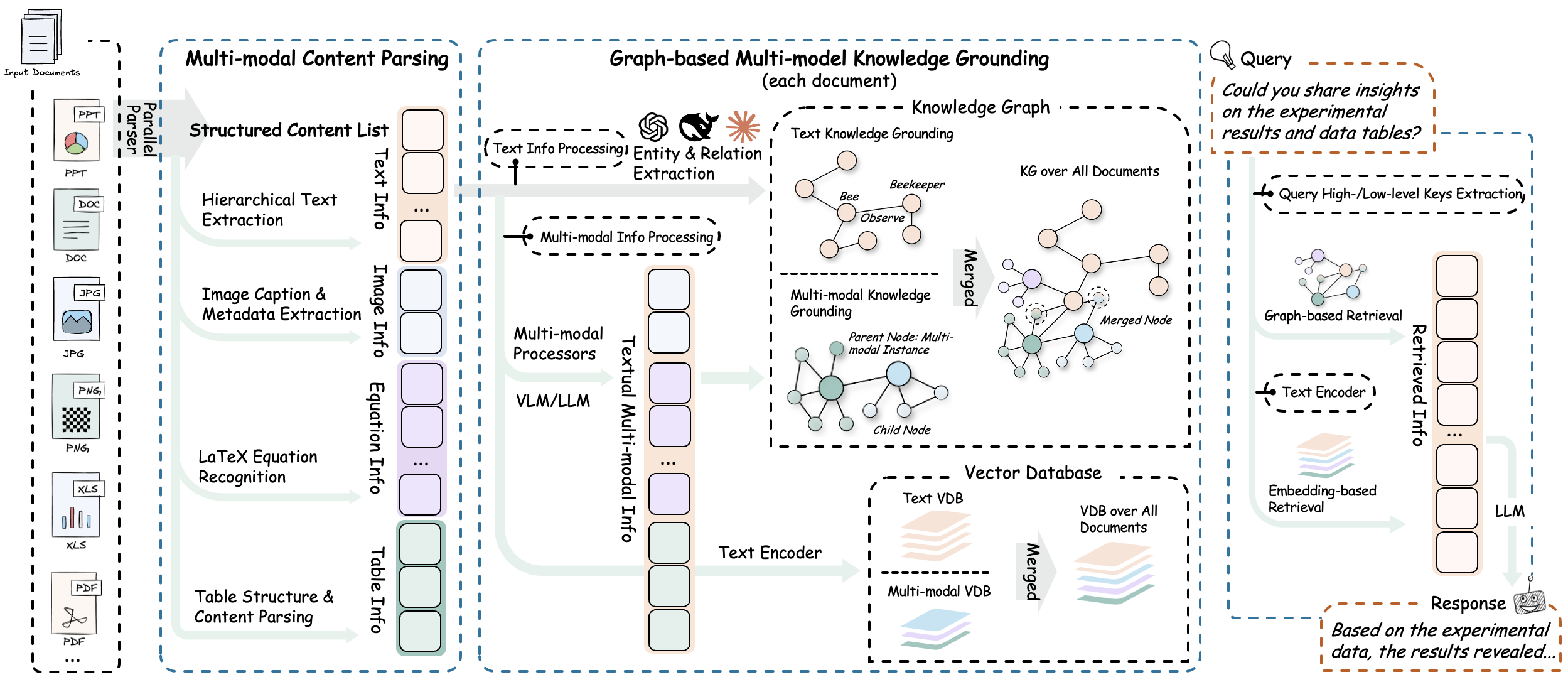
RAG-Anything try to solve a key shortcoming of traditional RAG: real-life enterprise documents are usually not pure text, but a mixture of paragraphs, pictures, charts, tables, formulas and complex layouts. The traditional "extract text-> cut chunk -> vector retrieval" scheme will lose a lot of structural relations. RAG-Anything, on the other hand, splits documents into different modalities and organizes them using multimodal knowledge graphs and hybrid searches.
Official architecture diagram:
2. What does it mostly do?
| Capabilities | Descriptions | Value to Customers |
|---|---|---|
| multi-format document parsing | supports PDF, Office, pictures, text, etc. | enterprise history data need not be manually converted into clean text first |
| Multi-modal content processing | Processing text, pictures, tables, formulas, common content separately | Can answer information in charts, formulas, tables |
| Multimodal Knowledge Graph | Extract entities and cross-modal relationships, retain document hierarchy | Expressing "which chapter the chart belongs to" better than a simple vector library |
| Hybrid retrieval | Combining vector retrieval and graph structure relationships | Easier recall of relevant contexts for complex problems |
| Insert content_list directly | Can connect external parser products, skip built-in parsing | Suitable for integration with customer's existing OCR/layout parsing system |
| Configurable parser | MinerU, Docling, PaddleOCR, etc. | Different document types can choose a more appropriate parsing route |
| VLM enhanced query | Visual model analysis can be introduced when the document contains pictures | Suitable for drawing, screenshot, flowchart, report interpretation |
3. Applicable Scenario
| Scene | Fit | Example |
|---|---|---|
| Questions and answers on complex enterprise documents | High | Product manuals, rules and regulations, bidding documents, operation guides |
| Analysis of Financial/Advisory Reports | High | Annual Reports, Research Reports, Tables, Charts, Appendices Mixed Information |
| Research Paper Assistant | Gao | Formulas, Experimental Tables, Illustrations, References in Papers |
| Industrial Knowledge Base | Medium and High | Equipment Manual, Maintenance Diagram, Flow Chart, Parameter Table |
| Legal/Contract Knowledge Base | Medium | Scan of Contract Text Schedule, Additional Attention to Authority and Accuracy |
| Simple FAQ Questions and Answers | Medium and Low | Plain Text FAQ Lighter with Ordinary RAG |
The best pre-sales entry is: "What is really difficult for customers is not the question and answer, but the reliable transformation of complex documents into searchable, traceable and referable knowledge structures."
4. Not quite the scene
| Unsuitable point | Cause |
|---|---|
| Only deal with plain text Markdown/FAQ | Ordinary RAG is simpler and cheaper |
| High real-time and low latency requirements | Multimodal analysis, VLM analysis, and knowledge graph construction will increase time consumption |
| Document permissions are very complex, but there is no permission system. | The project itself is a framework, and enterprise-level permission isolation needs to be completed by the application layer. |
| Auditable for 100% compliance with the answer | Still do citation, manual review, profiling and anti-hallucination policies |
| Document scan quality is very poor | OCR/layout analysis quality becomes a bottleneck |
5. Architecture and Workflow
A typical link of RAG-Anything can be summarized:
- Document analysis: Use MinerU, Docling or PaddleOCR to disassemble PDF/Office/pictures into structured content.
- Content classification: divide the content into text, image, table, equation, generic content and other types.
- Modal processing: pictures go visual analysis, tables go structured interpretation, formulas retain LaTeX and semantic description.
- Map construction: Extract entities and establish relationships between text and charts, chapters and elements, tables and indicators.
- Hybrid retrieval: When querying, combine vector similarity and graph relationship to return a more complete context.
- LLM generation: Generate answers with recall context, which can be combined with multimodal information.
The pre-sales highlight of this architecture is that it does not simply OCR images into text, but attempts to preserve "the relationship between elements". This point is critical for complex customer documentation.
How to use #6.
Installation:
pip install raganything
pip install 'raganything[all]'
Office documents require additional installation LibreOffice:
brew install --cask libreofficeSource installation:
git clone https://github.com/HKUDS/RAG-Anything.git
cd RAG-Anything
uv sync
uv run python examples/raganything_example.py --help
Minimum use of ideas:
from raganything import RAGAnything, RAGAnythingConfig

config = RAGAnythingConfig(
    working_dir="./rag_storage",
    parser="mineru",
    parse_method="auto",
    enable_image_processing=True,
    enable_table_processing=True,
    enable_equation_processing=True,
)
The official example requires configuring the LLM, visual model, and embedding functions, and then calling process_document_complete or directly inserting content_list '. content_list is valuable for system integration, because enterprises can first use their own OCR/analysis services to get structured content, and then hand it over to RAG-Anything for multimodal RAG.
7. What can I say before sales
One-sentence positioning:
"RAG-Anything is a multimodal RAG framework for complex enterprise documents, which can integrate PDF, Office, pictures, tables and formulas into knowledge base retrieval and question-and-answer."
Value Mapping:
| Customer Pain Points | Speech |
|---|---|
| There are a large number of tables and pictures in the document, which cannot be answered by ordinary knowledge base | RAG-Anything treats tables, pictures and formulas as first-class content |
| Structure lost after traditional OCR | It retains chapter hierarchy, element relationships, and cross-modal associations |
| Various document formats are mixed | Support PDF, Office, Picture, TXT/MD and other format routes |
| Existing document parsing system | Can be accessed directly through content_list without completely overturning the existing architecture |
| Hope to improve the interpretability of questions and answers. Metadata such as graphs and page_idx can help cite the original location. |
8. Demo/PoC Suggestions
It is recommended to use real customer documents instead of public demo documents. PoC is divided into three types of materials:
| Materials | Test Questions |
|---|---|
| Financial Report/Research Report with Chart | "What is the trend of an indicator? Which year in the chart has changed the most?" |
| Product Manual/Equipment Manual | "What should I do when an error code appears? On which page is the relevant illustration?" |
| Paper with Formula/Technical White Paper | "What is the meaning of the variables in the formula? What does the experimental table show?" |
PoC indicators:
| Indicator | Description |
|---|---|
| parsing success rate | whether the document can completely disassemble text, tables, pictures and formulas |
| Chart Q & A Accuracy | Corrected answers to chart/table questions |
| Reference Traceability | Whether page number, chapter, element can be located |
| Build Time | Document Parsing and Receipt Time Per Hundred Pages |
| Query latency | Average response time of hybrid queries |
| Amount of manual correction | Proportion of table/formula/OCR requiring manual correction |
9. Frequently Asked Customer Questions
| What is the difference between it and ordinary vector database? | Vector database is mainly responsible for similarity retrieval; RAG-Anything is more concerned with complex document analysis, multi-modal content understanding and graph relationship organization. | |||||||||||||||||||||||||||||||||||||||||||||||||||||||||||||||||||||||||||||||||||||||||||
| Can you process scanned PDF? | Can be processed through the OCR route, but the effect depends on the scan quality, language, layout, and parser capabilities. | |||||||||||||||||||||||||||||||||||||||||||||||||||||||||||||||||||||||||||||||||||||||||||
| Do I have to use OpenAI? | Official examples use OpenAI-style functions, but frameworks can pass in custom LLM, visual models, and embedding functions. | |||||||||||||||||||||||||||||||||||||||||||||||||||||||||||||||||||||||||||||||||||||||||||
| Can it be deployed privately? | Yes, but you need to prepare the local model, OCR/resolution environment, storage, queues, permissions, and service encapsulation. | |||||||||||||||||||||||||||||||||||||||||||||||||||||||||||||||||||||||||||||||||||||||||||
| Is it possible to guarantee that the answer is not an illusion? | cannot be guaranteed by the framework alone. References, confidence levels, evaluation sets, rejection strategies, and manual review processes are required. |
10. Risks and Considerations
- Analytical quality determines the upper limit: complex tables, spread tables, scanned copies, and handwritten content will significantly affect the effect.
- Multi-modal cost is high: VLM analysis of images, charts may bring additional costs and delays.
- Engineering integration still requires investment: permissions, auditing, tenant isolation, incremental updates, and failure retries are not out-of-the-box enterprise systems.
- Evaluation is critical: a standard problem set must be built for the customer's business, otherwise it is difficult to judge whether it is really better than ordinary RAG.
- License friendly: MIT is friendly to business integration, but still needs to confirm the authorization of the model, parser and data to which it is connected.
11. My Pre-Sales Judgment
RAG-Anything is a direction worthy of long-term pre-sales attention in this batch of projects. It goes to the real pain point of the enterprise knowledge base: documents are not clean text, but a mixture of complex typography and multimodal information. Ordinary RAG is easy to "see tables and pictures" in such scenarios. The value of RAG-Anything lies in providing a more complete processing chain.
It is recommended to use it for the program explanation and PoC of "complex document intelligent question and answer", "multimodal knowledge base" and "R & D/financial/manufacturing document assistant. Don't just demonstrate plain text Q & A, that doesn't show the difference. What really impresses customers is to take a real document with charts, formulas and appendices and let the system answer questions that ordinary RAG cannot answer well.
12. REFERENCE
-GitHub: https://github.com/HKUDS/RAG-Anything
-Thesis: https://arxiv.org/abs/2510.12323
-PyPI: https://pypi.org/project/raganything/
-LightRAG: https://github.com/HKUDS/LightRAG
-MinerU: https://github.com/opendatalab/MinerU