1. Project Overview
| Dimension | Information |
|---|---|
| Project name | WrenAI / Wren AI |
| GitHub | Canner/WrenAI |
| Official Document | docs.getwren. AI |
| Official Website | getwren. AI |
| Locate | Open-source GenBI: Generated BI engine and open context layer for AI agents |
| Main Languages | Python, Rust |
| Latest GitHub Release | 'wren-v0.13.1, 'Posted on 2026-07-21 |
| PyPI Package | wrenai, current version 0.13.1,Python 3.11 |
| GitHub Activity | As of 2026-07-25, about 16.6k stars, 1.9k forks, 368 open issues, the latest push is 2026-07-24 |
| Open Source Protocol | Multi-license: 'core/', 'sdk/', 'skills/', 'examples/', root file Apache-2.0;'docs/**'is CC BY 4.0; Warehouse preset AGPL-3.0 text but current license map does not list AGPL module |
| Important Positioning Changes | Since 2026-05-07, Wren Engine has been merged into this warehouse 'core/'; The old Docker chat BI product has been migrated to' legacy/v1', called Wren GenBI Classic, which has been sunset |
2. What does it mostly do?
WrenAI solves a core problem of enterprise data analysis agents: large models can see database schema, but schema is not equal to business semantics. When real customers ask "active customers this month", "refund revenue" and "project Lighthouse conversion rate", the database often only contains various tables, fields, enumerated values and historical names, and lacks business definitions, standard calibers, approved join paths and historical success queries. Let the LLM guess the SQL directly, and it is easy to produce results that look reasonable but are actually wrong.
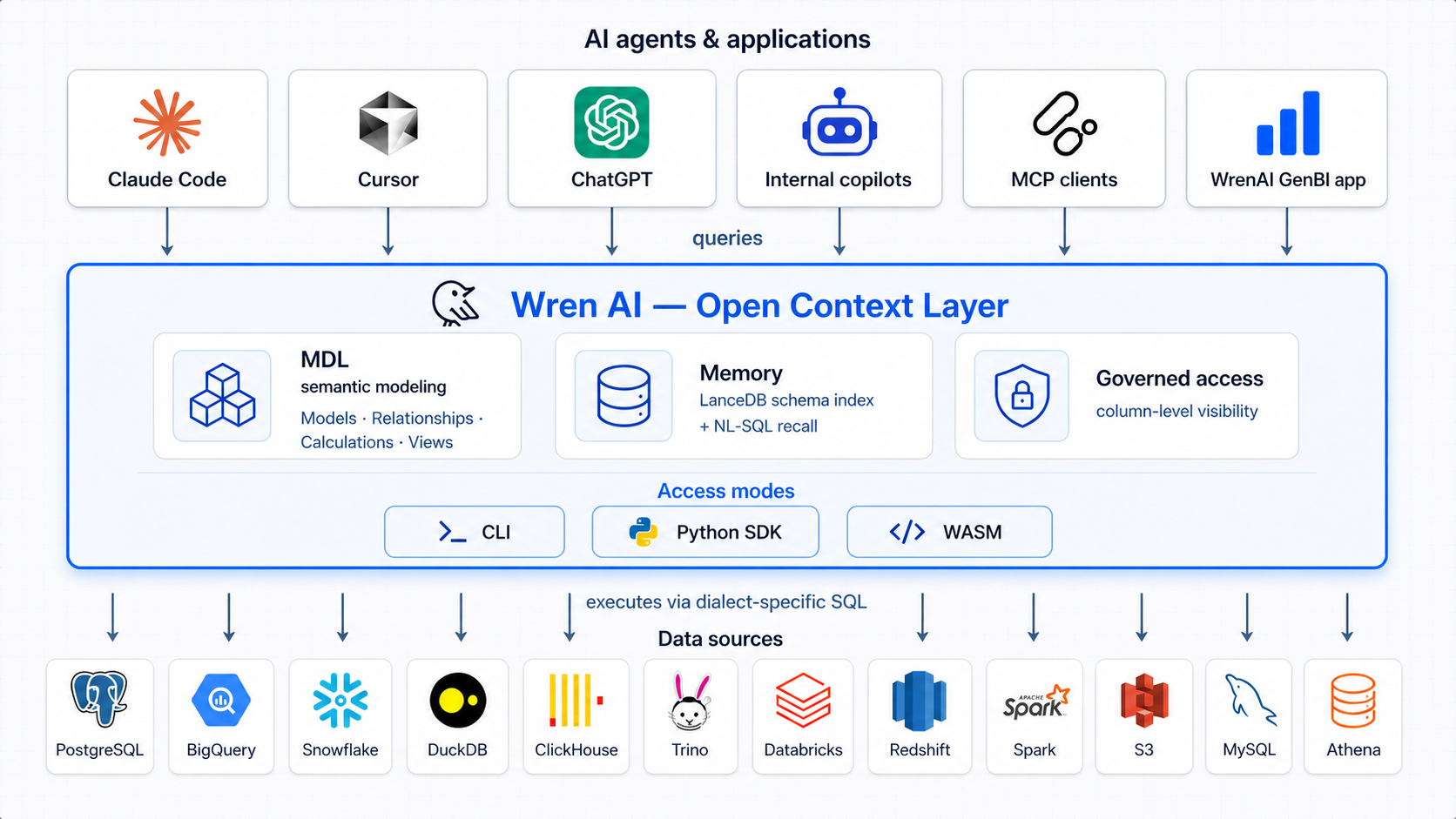
WrenAI's approach is to put an open context layer between the data source and the AI agent. This context layer uses MDL, business rules, memory, checksum and connector, so that Agent does not directly touch the original table, but generates SQL and Dashboard through modeled, audited, reusable business semantics.
It can be understood:
It mainly provides three things:
| Capabilities | Descriptions | Value to Customers |
|---|---|---|
| Generate | Turn business questions into governed SQL, charts and answers | Lower the threshold for business personnel to check numbers and improve data analysis efficiency |
| Deploy | Turn an analysis result into a shareable browser-side Dashboard and deploy it to Vercel or Cloudflare Pages | From a one-time question and answer to a reusable data application |
| Know | Use MDL, 'knowledge/', and memory to save business definitions, rules, and historical success queries | Let the Agent gradually understand the business scope of the enterprise and reduce illusion |
3. Differences Classic the old version of Wren GenBI
This point is very important. Many customers may think that WrenAI is an out-of-the-box chat BI Web product, but the current main line is no longer in this form.
| Version/Form | Current Status | Suitable to be understood as |
|---|---|---|
| WrenAI's current mainline | In maintenance, CLI SDK core skills GenBI dashboard | Open source GenBI engine and context layer for AI agents |
| Wren GenBI Classic | located' legacy/v1', officially called sunset, no longer provides new features or security fixes | old Docker chat BI products, new projects are not recommended as the main line |
| Wren AI Commercial | Official Commercial Managed Version | You can follow the hosted classic-like experience in the maintenance |
Before sales, it is suggested to explain directly: if the customer wants to "deploy a complete Web BI SaaS immediately", the current open source main line is not the best answer; If the customer wants "to let Agent access enterprise data, generate SQL and generate Dashboard credibly", WrenAI's position is very clear.
4. Core Concepts
4.1 GenBI
GenBI is not simply "AI generating charts" in the context of WrenAI ". It is the agent based on the trusted context to complete the link from the problem, SQL, chart to Dashboard.
Typical process:
- The user asks the Agent a question, such as "Show this year's revenue trend by month and distinguish the refund status".
- The Agent uses Wren's skill to get the workflow.
- Wren memory Recalls relevant models, fields, business rules, and historical SQL.
- Agent writes SQL based on MDL model instead of directly guessing the original table.
- Wren dry-plan Expand and validate SQL.
- Wren executes the query and returns the results.
- Agent can further generate Dashboard app and publish it through Vercel or Cloudflare Pages.
4.2 Context Layer Context Layer
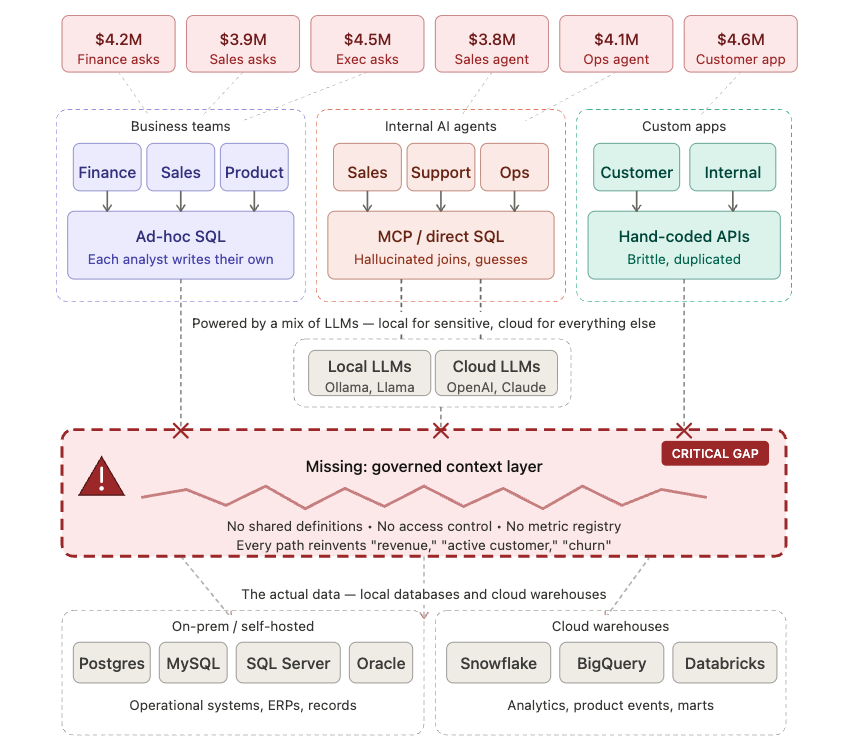
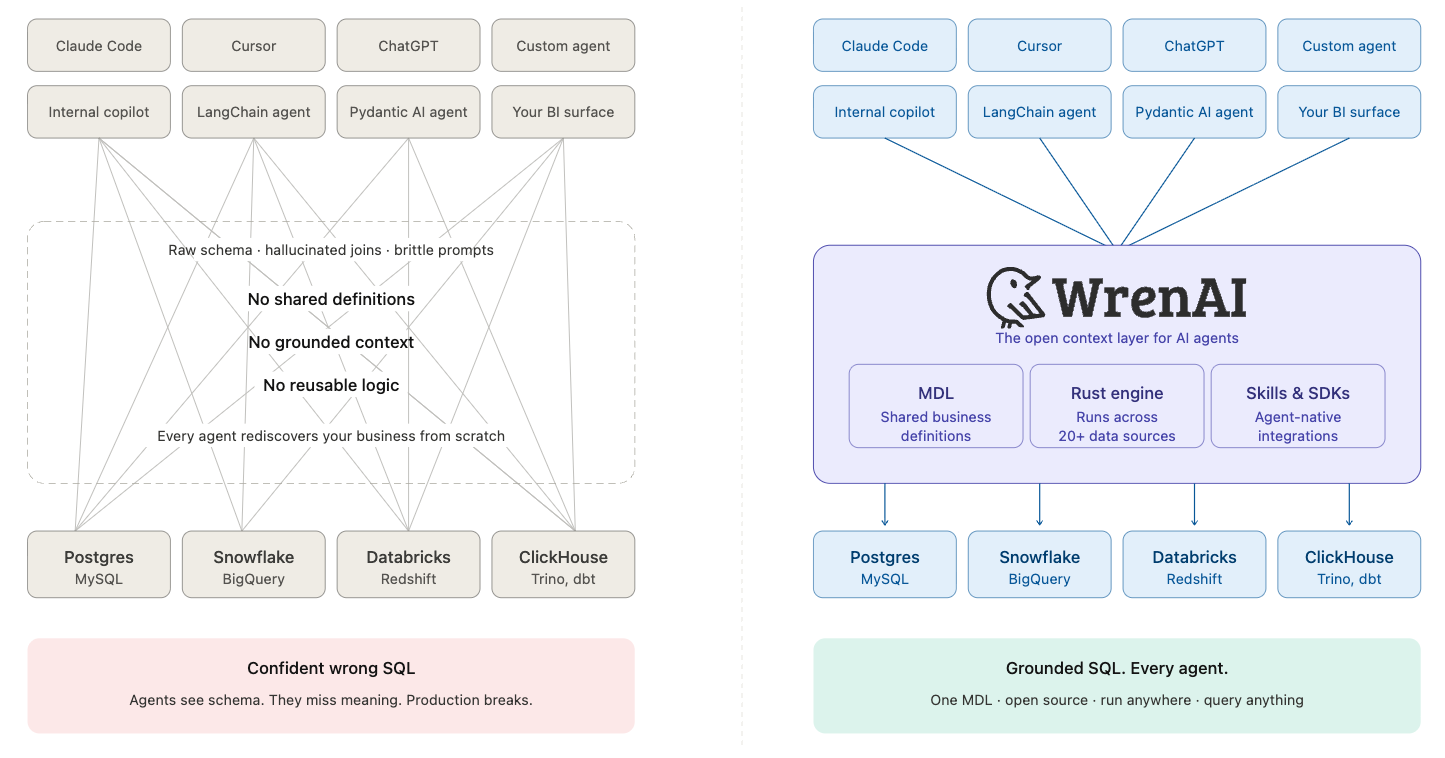
The official document positions WrenAI as an open context layer. It complements business semantics that are not expressed in the database schema, for example:
-'status = 4 'represents refunded in business.
-"Active customer" excludes test accounts or service accounts.
-A team is actually using a loyalty_v3, not a legacy table.
-The Project Lighthouse needs to be mapped to a campaign_id.
-"Income" should use approved revenue caliber, rather than simply SUM an amount field.
The key schematic diagram in the official document is a good way to express the difference between "lack of context layer" and "after the introduction of WrenAI:
4.3 MDL
MDL is a Modeling Definition Language that uses YAML files to describe models, fields, relationships, views, cubes, indicators, and permissions. It turns the original database structure into a business semantic surface that the Agent can use.
A minimalist example:
name: orders
table_reference:
  schema: public
  table: orders
columns:
  - name: order_id
    type: integer
  - name: customer_id
    type: integer
  - name: total
    type: double
  - name: status
    type: varchar
primary_key: order_id
Pre-sales explanation can be said: MDL is equivalent to turning enterprise data dictionary, indicator caliber, available fields and join relationship into files that can be read by AI, reviewed by engineering and managed by Git.
4.4 Memory
Memory uses local LanceDB semantic memory to save and recall:
-MDL schema.
-The business rules in 'knowledge/rules.
-The confirmed natural language to SQL sample in 'knowledge/SQL.
-Past success questions and queries.
This solves a common problem: don't throw the schema of 500 tables to the model, and don't let the model pick the table intuitively, but recall the relevant context based on the problem.
4.5 Skills
WrenAI's skill is a workflow guide for AI coding agents such as Claude Code, Codex, Cursor, and Cline. Users only need to install a discovery stub, and specific workflow guides such as onboarding, generate-mdl, usage, enrich-context, and genbi are obtained by 'wren skills get
This is interesting for pre-sales: instead of having customers manually learn a bunch of CLI, it encapsulates the CLI into a controllable process that the Agent can execute.
5. Core Competence List
| Capabilities Module | Current Capabilities | Pre-Sales Value |
|---|---|---|
| Natural language to SQL | Agent writes governed SQL based on MDL and memory | Reduces service query threshold and SQL dependency |
| Semantic layer modeling | MDL describes models, columns, relationships, views, cubes, metrics, RLAC/CLAC | |
| SQL planning and validation | 'dry-plan' and 'dry-run' expand and validate SQL before execution | reduce the risk of illusion SQL direct execution |
| Multi-data source connection | DuckDB, Postgres, MySQL, BigQuery, Snowflake, ClickHouse, Trino, SQL Server, Databricks, Redshift, Oracle, Athena, Spark, etc. | Adapts to the customer's existing data warehouse and warehouse |
| Memory system | LanceDB-based memory and supports fetch, recall, store, and index | The more you use the system, the better you understand your business. |
| GenBI Dashboard | Agent generates browser-side Dashboard app, supports snapshot / live data mode | precipitates from one-time question and answer to shareable data application |
| Deployment | Vercel, Cloudflare Pages | Easy to do fast Demo, lightweight report publishing |
| SDK | wren-langchain, wren-pydantic, and Python SDKs | Can be embedded into the self-developed agent/data platform of the enterprise |
| MCP | 'wren serve mcp' can expose project query, schema, and knowledge tools to MCP client | Friendly to Agent platform integration |
| Security policy | strict mode, denied functions, MDL visibility, column-level/row-level access control capabilities | There is a governance foundation, but production permissions still need to be completed by customer engineering |
6. Applicable Scenarios
6.1 Enterprise Trusted Text-to-SQL
Customer pain points:
-Business people don't write SQL.
-The data team is overwhelmed by a large number of ad hoc fetching requirements.
-Let LLM check the library directly. It is easy to have wrong caliber, wrong join and wrong field.
Value of WrenAI:
-Use MDL to specify which tables, fields, relationships, and metrics can be used by the Agent.
-Recall similar historical queries with memory.
-Use dry-plan and dry-run to expose errors before execution.
Pre-sales statement:
"instead of exposing the database directly to the big model, we add a layer of reviewable business semantics in the middle, allowing AI to check the number according to the caliber approved by the enterprise."
6.2 Agentic BI/Data Analysis Agent
If the customer is already working on an enterprise Agent platform, WrenAI can be used as a "data analysis tool layer" to enable the Agent to have trusted data search capabilities.
Suitable for:
-Internal Copilot of the enterprise.
-Data analysis agent.
-Business analysis assistant.
-Sales/Operations/Finance self-help analysis assistant.
-BI platform enhancements.
6.3 Data Semantic Layer Governance
Many enterprises already have warehouses, dbts, metrics platforms, or BI, but lack an agent-friendly context layer. WrenAI can manage business definitions, query rules, and historical samples in the form of files.
Suitable for customers:
-The data team wants to make the business caliber Git.
-dbt/data warehouse modeling is available, but AI applications cannot understand business semantics.
-The same data context needs to be reused between multiple agents or tools.
6.4 Quickly generate shareable Dashboard
The GenBI app can generate browser-side Dashboard from the analysis results and deploy them to Vercel or Cloudflare Pages. The default snapshot mode packages data into app and is suitable for demo, small reports and one-time analysis and delivery. Live mode is suitable for production billboards that require real-time data, but requires additional processing of CORS and credential security.
Suitable for:
-Pre-sales demo report.
-Project weekly report, operation review.
-Small customer data story presentation.
-Share a temporary report link to management.
6.5 Data Product PoC Base
WrenAI is very suitable for PoC because it covers several points that customers are most concerned about:
-Whether you can understand the business caliber.
-Whether the customer can connect to the real data source.
-Whether it can reduce SQL illusion.
-Whether you can turn your answers into charts and Dashboard.
-Whether the context can be reviewed and iterated as a file.
7. Not quite the scene
| Scenario | Reason |
|---|---|
| Customers only want a mature traditional BI reporting platform | The current open source mainline is more Agent/CLI/SDK than a complete Web BI SaaS |
| Only do one-time CSV drawing | WrenAI's context layer and governance capabilities will be biased |
| No data modeling and caliber governance will | WrenAI's value comes from MDL, rules and memory. If customers are unwilling to organize context, the effect will be limited |
| Strong real-time large screen and complex permission reports | GenBI app is currently more suitable for agents to generate and deploy lightweight Dashboard, and heavy BI capabilities need to be combined with existing platforms |
| Production-level data permissions are fully dependent on open-source default capabilities | Requires integration with enterprise IAM, data permissions, auditing, and desensitization systems |
| WrenAI can reduce illusion, but still requires modeling, verification, evaluation and manual review to be closed loop |
8. Architecture and Components
8.1 Warehouse Structure
The project structure given in the README:
core/
  wren-core/         Rust semantic engine, Apache DataFusion
  wren-core-base/    Shared manifest types + MDL builder
  wren-core-py/      Python bindings, PyPI: wren-core
  wren-core-wasm/    WebAssembly build, npm: wren-core-wasm
  wren/              Python SDK and CLI, PyPI: wrenai
  wren-mdl/          MDL JSON schema
sdk/
  wren-langchain/    Reference agent SDK integration
skills/              Agent skills for context authoring
docs/                Module documentation
examples/            Example projects
8.2 Technology Stack Understanding
| Hierarchy | Composition | Description |
|---|---|---|
| Semantic Engine | Rust Apache DataFusion | Responsible for planning and executing modeling SQL |
| Python CLI/SDK | 'wrenai' | Project initialization, profile, context, memory, query, genbi, and MCP |
| WASM | 'wren-core-wasm' | Supports browser-side Dashboard execution |
| Agent Integration | Skills, LangChain, Pydantic, MCP | Let all kinds of Agents call Wren according to specifications |
| Data source connection | connector extras | Install database adaptation through different extras |
| Memory | LanceDB | Semantic Search MDL, Rules and History SQL |
8.3 correctness mechanism
The official document splits the anti-illusion into five layers:
| Layer | Action | Error proofing |
|---|---|---|
| Skills | Solidify Agent Workflow | Require to check memory, write SQL, verify, and execute first |
| MDL | Limit available tables, fields, and relationships | Unmodeled fields are not visible to the Agent |
| Memory | Recall the relevant context accurately | Avoid stuffing the full schema into prompt or letting the model guess the table |
| Plan Validate | Expand and verify SQL statements before execution | Expose missing relationships, field errors, etc. before execution |
| Connectors | Performs | checks on the database layer such as dialect, type, and permission for the data source. |
This section is the most convincing technical gripper when selling to data teams and IT architecture teams.
9. How to install and use
9.1 install CLI
pip install wrenaiInstall extras according to the data source:
pip install "wrenai[postgres,memory,main]"
pip install "wrenai[bigquery,main]"
pip install "wrenai[snowflake,main]"
pip install "wrenai[all]"
Requires Python 3.11. If you install the Agent skill using 'npx skills add', Node.js/npm is also required.
9.2 Install Agent discovery stub
npx skills add Canner/WrenAIYou can also use install script:
curl -fsSL https://raw.githubusercontent.com/Canner/WrenAI/main/skills/install.sh | bashAfter installation, you can call '/wren' or related skill processes in agents such as Codex, Claude Code, Cursor, and Cline.
9.3 Initialization Project
mkdir my-wren-project
cd my-wren-project
wren context init
The build structure is roughly:
my-wren-project/
├── wren_project.yml
├── models/
├── views/
├── cubes/
├── relationships.yml
├── knowledge/
│   ├── rules/
│   └── sql/
└── target/
    └── mdl.json
9.4 Configure Data Source profile
wren profile add my-db --ui
wren profile debug
wren context set-profile my-db
You can also use YAML files to import, which is suitable for Agent driver and environment variable management:
wren profile add my-db --from-file connection.ymlGenerate MDL 9.5
Let it use Wren skill in the Agent:
Use Wren to explore my Postgres database and generate the MDL for all tables.The agent calls the wren skills get generate-mdl, and then performs the following steps: table discovery, field type parsing, relationship inference, YAML writing, validate, build, and memory index.
9.6 Questions and Inquiries
Who are our top 10 customers by sales this quarter?Behind the typical action:
wren memory fetch --query "top customers by sales this quarter"
wren memory recall --query "top customers"
wren dry-plan --sql "..."
wren --sql "..."
wren memory store --nl "..." --sql "..."
9.7 Generate Dashboard
Turn this into an interactive dashboard I can filter by product, then preview it locally.The Agent calls 'wren skills get genbi' to generate an app, verify, preview, and deploy:
Deploy it to Vercel.The deployment token is in '~/.wren/.env', such as' VERCEL_TOKEN 'or Cloudflare related tokens. We do not recommend that you pass the token through command line parameters.
10. What can I say before sales
10.1 to Business Leader
"Instead of letting business people learn SQL, WrenAI lets them ask questions in natural language, and the system checks them according to the company's approved data caliber. For example, revenue, active customers, refunds, and retention are no longer left to the AI to guess, but are managed uniformly through auditable business definitions."
10.2 to Data Team
"WrenAI can precipitate your existing data dictionary, indicator caliber, join relationship and historical SQL samples into MDL and knowledge files. Agent uses these contexts to generate SQL and dry-plan and validate before execution, which is much more reliable than throwing schema directly to a large model."
10.3 to IT Architecture Team
"It is an open capability layer composed of CLI/SDK/engine/skills, which can access the existing Agent platform, data warehouse and CI/CD. The core and SDK are Apache-2.0, which is convenient for secondary development. When production falls to the ground, we will combine it with enterprise identity authentication, data permissions, auditing and model gateway instead of running naked alone."
10.4 to management
"It can turn scattered temporary analysis needs into reusable data applications. A natural language question and answer can further generate charts and Dashboard and publish them as links, reducing the pressure on the data team to repeat numbers and make reports manually."
11. Frequently Asked Customer Questions
| Is it a complete BI tool? | The current open source mainline is more like a Agentic BI engine and context layer than a traditional BI SaaS. Complementary to existing BI/data platforms. | |||||||||||||||||||||||||||||||||||||||||||||||||||||||||||||||||||||||||||||||||||||||||||
| Can you directly connect to our database? | Supports multiple mainstream data sources, including Postgres, BigQuery, Snowflake, ClickHouse, Databricks, Redshift, etc. You need to install connector extra according to the data source. | |||||||||||||||||||||||||||||||||||||||||||||||||||||||||||||||||||||||||||||||||||||||||||
| How to reduce the AI of incorrect SQL writing? | The visible model and relationship are limited by MDL, the context is recalled by memory, the pre-verification is performed by dry-plan/dry-run, and the process is solidified by skills. | |||||||||||||||||||||||||||||||||||||||||||||||||||||||||||||||||||||||||||||||||||||||||||
| Will data be exposed? | WrenAI itself can run locally, but the agent, LLM, deployment platform, and database credentials require a separate security architecture. Production must be connected to the enterprise permissions, audit, and model gateways. | |||||||||||||||||||||||||||||||||||||||||||||||||||||||||||||||||||||||||||||||||||||||||||
| Is the Dashboard real-time? | The default snapshot mode is suitable for demo and small reports, and the data is packaged with app; Live mode is suitable for producing fresh data, but API/CORS/credential security design is required. |
Does | conflict with the dbt/metric platform? | Not necessarily. WrenAI can reuse or supplement existing modeling assets, focusing on enabling AI agents to understand business semantics. |
| Is the open source protocol commercially available? | The core, SDK, skills, examples, and root files are Apache-2.0, which is business-friendly; docs is CC BY 4.0; Open source compliance checks are still recommended before commercial use. |
| Can the old version of Docker GenBI still work? | The old version is' legacy/v1', officially called sunset, and has no new features and security fixes. It is not recommended to make long-term delivery of new projects based on it. |
12. PoC Recommendations
12.1 PoC Target
It is suggested that PoC should not only verify "whether the library can be connected", but should be designed around "trusted number checking:
-Whether the correct SQL can be generated with the customer's real business caliber.
-Whether the error table, error join, and error indicator caliber can be reduced.
-Can you turn natural language questions into charts and Dashboard.
-Can the data team review and version the context.
-Whether the customer can access the existing Agent or BI workflow.
610.00g Week PoC Design
| Phase | Time | Task | Output |
|---|---|---|---|
| Preparation | Day 1-2 | Select a business domain, such as sales, operations, and finance; Prepare 5-10 typical questions | PoC question list, data source permission |
| Connect | Day 3 | Install 'wrenai', configure profile, connect data sources | Wren projects available |
| Modeling | Days 4-6 | Generate and manually revise MDL, supplement relationships, rules, descriptions | First Edition Context Layer |
| Query Verification | Days 7-9 | Run typical problems and compare manual SQL or existing BI results | Accuracy and Error Reason List |
| Memory Optimization | Days 10-11 | Store Correct NL-SQL, Supplement rules, Re-index | Improved Query Effect |
| Dashboard | Days 12-13 | Generate 1-2 GenBI apps, preview or deploy | Demo Dashboard |
| Report | Day 14 | Summary Value, Risk, Production Modification Items | PoC Report Document |
12.3 Recommended Metrics
| Indicator | Measurement method | |
|---|---|---|
| SQL Correctness | Comparison with manual SQL or existing BI results of the data team | |
| Caliber Consistency | Whether to use approved definition, such as revenue, active users, refunds | |
| Query Correction Times | The number of times the Agent corrects SQL statements after dry-plan/dry-run | |
| Context Coverage | Whether the tables, fields, relationships, and rules involved in a typical problem have been modeled | |
| Response time | Time taken to get from natural language question to available results | |
| Reuse capability | Whether new similar problems can recall historical successful samples from memory | |
| Dashboard Availability | Can Business Users Read, Filter, Share |
13. Risks and Considerations
13.1 Don't Over-Promise "Zero Illusion"
WrenAI's architecture is in reducing illusion and error SQL, but is not guaranteed to be 100 percent correct. Business caliber, MDL quality, historical samples, model capabilities, and data permissions all affect the results.
13.2 requires data team involvement in modeling
If no one from the customer can confirm the table relationships, indicator calibers, enumeration meanings, and business rules, it is difficult for WrenAI's context layer to be effective. The pre-sale PoC must involve the data team, not just the business side.
13.3 the current main line is Agent/CLI, not a complete Web product
This is both an advantage and a threshold. The advantage is that it is open, integrable and suitable for Agent engineering. The threshold is that if customers expect a BI platform with a little mouse, they may need additional product packaging.
13.4 production authority and audit to be completed
Strict mode, denied functions, MDL visibility, etc. are the basics, but enterprise production usually also requires:
-SSO/IAM.
-The least privileged database account.
-Row-level/column-level permissions are tied to the organizational schema.
-Query audit.
-Sensitive field desensitization.
-LLM call log and cost control.
-Dashboard sharing permissions.
13.5 Dashboard deployment should pay attention to data exposure
The GenBI snapshot model packages the data with the app. The official document also reminds that when deploying to a public static site, anyone who gets the URL may read the app file, so sensitive details or credentials cannot be typed in. In the live mode, credentials cannot be embedded. It requires backend APIs and permission control.
13.6 version evolves faster
The project has undergone significant positioning changes since 2026-05, and 2026-07 is still intensively release. Formal projects suggest freezing versions, establishing upgrade strategies, and avoiding reliance on unstable roadmap capabilities.
14. Difference from adjacent products
| Categories | Represents | WrenAI Difference |
|---|---|---|
| Original LLM Text-to-SQL | Directly let the big model read the schema and write SQL | WrenAI adds MDL, memory, dry-plan, and skills to emphasize governed SQL |
| Traditional BI | Tableau, Power BI, Metabase, Superset | WrenAI is more Agent-native than traditional drag-and-drop BI |
| Semantic layer | dbt Semantic Layer, Cube, LookML | WrenAI puts more emphasis on the context layer and GenBI app for agents |
| Data Intelligence Platform | Dify, LangGraph Agent, Self-Research Copilot | WrenAI can be accessed as a data query tool layer/semantic layer. |
| Commercial Wren AI | getwren. AI commercial products | The open source mainline is more suitable for secondary development and agent integration, and the commercial version may be more suitable for customers who want to host the experience |
15. The direction of a packable solution
15.1 Enterprise Trusted Data Q & A Assistant
Connect WrenAI to the customer warehouse and enterprise Agent platform to provide natural language search data for business personnel. Focus on delivering MDL, business rules, historical SQL memory, and permission control.
15.2 AI Data Analysis Agent Tool Layer
For the existing Agent platform to add a "governance data query tool". Agents do not directly access libraries, but access the modeled data objects through the Wren context layer.
15.3 Data Semantic Governance Workbench
The customer data dictionary, indicator caliber, join relationship, common problems, and historical SQL are uniformly deposited into the Git warehouse to form data semantic assets that can be reviewed and versioned.
15.4 Rapid generation of business analysis Dashboard
Generate shareable Dashboard in natural language for management reports, weekly reports, sales analysis, and operational reprocessing. The snapshot mode is preferred in the PoC phase, and the live mode is evaluated in the production phase.
16. My Pre-Sales Judgment
WrenAI is a very interesting Agentic BI foundation project. Its selling point is not "how complete the UI is", but it accurately captures the pain point of the enterprise landing Text-to-SQL: the model lacks business context and it is dangerous to generate SQL directly. It uses MDL, memory, dry-plan, skills, and multi-data source connector to split the "trusted number" into a set of engineering primitives that the Agent can call.
For pre-sales, WrenAI is suitable for "enterprise AI data assistant", "trusted Text-to-SQL" and "semantic layer for Agent to access data warehouse", rather than being packaged as a complete BI platform. The best way to play is to select a customer's real business domain, use 5-10 high-frequency questions as PoC, prove that it can reduce caliber errors and query errors through manual SQL comparison, and further demonstrate Dashboard generation and deployment.
If the customer already has a data team, several warehouses and AI Agent strategy, WrenAI has a high degree of fit. If the customer only wants to buy an out-of-the-box reporting tool, he should consider commercial BI or Wren AI Commercial instead of directly adopting the current open source main line.
17. REFERENCE
-GitHub repository:Canner/WrenAI
-Official Documentation:Wren AI OSS Introduction
-Quick Start:Quick Start: Wren CLI with jaffle_shop
-Data source connection:Connect your database
-GenBI Dashboard:Build & deploy a GenBI app
-Correctness mechanism:How does Wren AI keep agents from hallucinating?
-PyPI package:wrenai
-Latest Release:wren-v0.13.1
-Business website:getwren. AI