2. Basic Project Information
| Item | Content |
|---|---|
| GitHub | https://github.com/KnockOutEZ/wigolo |
| Official Website/Documents | https://knockoutez.github.io/wigolo/ |
| Latest version | v0.2.1, Posted 2026-07-19 |
| Main language | TypeScript, plus Python SDK/samples |
| Agreement | AGPL-3.0-only |
| Project Phase | Public beta |
| Core Positioning | Local-first web intelligence for AI agents |
| Operating requirements | Node.js >= 20; The browser engine and local model will be downloaded for the first initialization, and the official prompt is about 1.5GB of disk space |
| Typical access methods | MCP, REST API, CLI, TypeScript SDK, Python SDK, Docker |
As of 2026-07-25, the GitHub API shows that the repository is about 3.6k stars, 239 forks, and 33 open issues. The project is hot, but it is still in the beta stage. It should not be packaged as a mature enterprise search SaaS before sales, but should be positioned as a "potential local Web Agent capability layer/technology base".
3. What can it mainly do
The wigolo's abilities can be divided into three layers.
The first layer is Web acquisition capability:
-Multi-search engine search: Get search results through multiple direct adapters, and then do rank fusion and rearrangement.
-Web crawling: the URL into a clean Markdown, if necessary, can be upgraded to headless browser processing SPA, anti-crawling, dynamic pages, etc.
-Site crawling: crawl a batch of pages by BFS, DFS, sitemap or map-only, and support robots, speed limit and deduplication.
-PDF/HTML/page body processing: convert web pages, PDFs, tables, metadata, etc. into content that is easier for the Agent to consume.
The second layer is content understanding and memory ability:
-Structured extraction: Extract tables, metadata, JSON-LD, brand information from the page, or extract structured fields by JSON Schema.
-Local cache: Store the viewed web pages, search results and content in the local cache.
-Similar content discovery: Find similar pages in local cache and real-time Web based on keyword and semantic retrieval.
-Change monitoring: Monitor page changes through diff/watch and trigger webhook.
The third layer is agent-oriented research capabilities:
-research: break down the problem into subqueries, search, crawl, organize evidence, and output cited research reports or structured brief.
-agent: autonomously executes the cycle of plan/search/fetch/extract/synthesize, with step logs and budget control.
-Unified tool interface: These capabilities can be exposed to different agents and automation platforms through MCP, REST, SDK, CLI.
4. Key Schematics and Product Feeling
The project itself provides Demo, comparison chart and result explanation chart, which are more suitable for notes than additional screenshots.
4.1 Demo
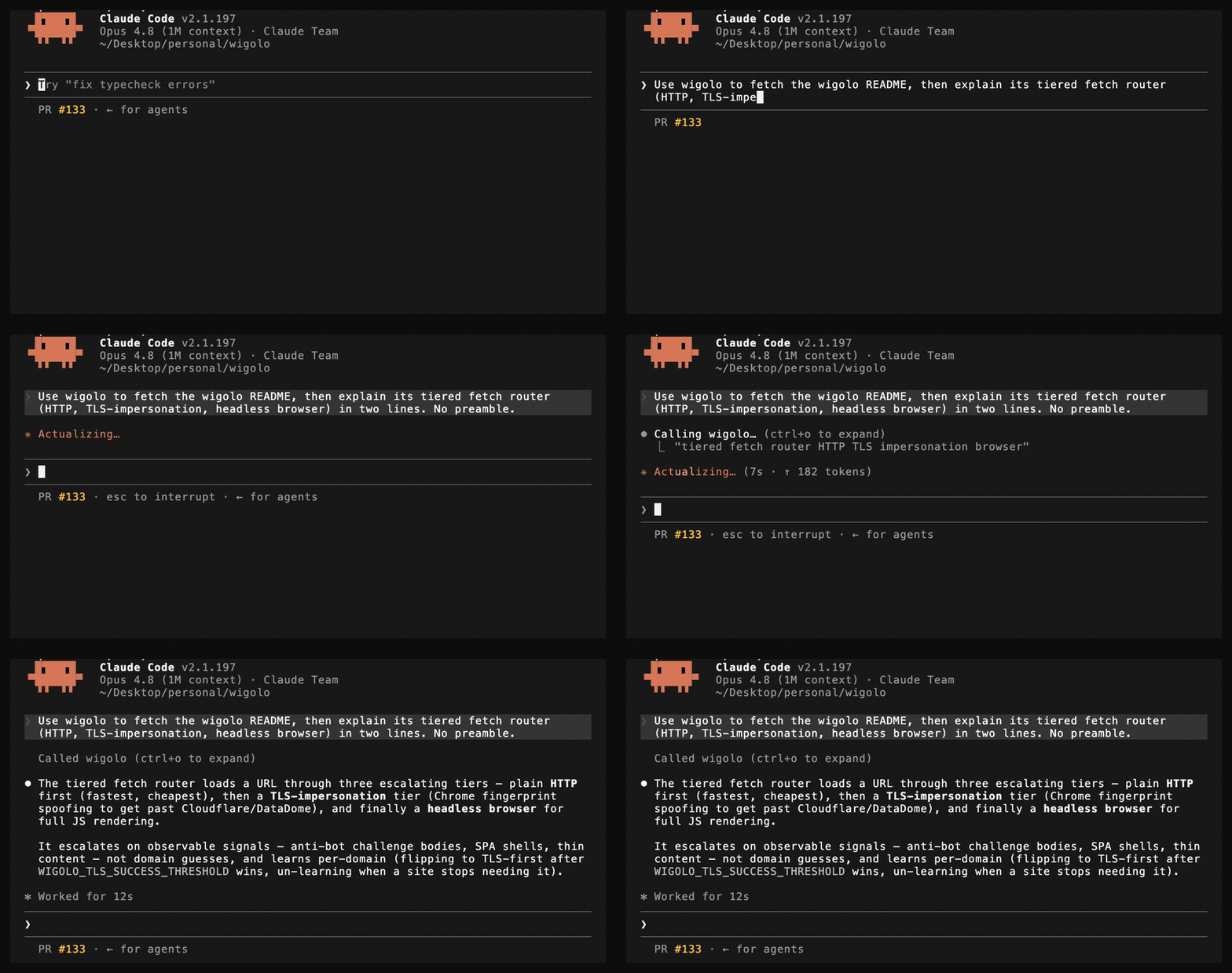
This Demo is suitable for explaining in pre-sales materials: wigolo is not a simple web crawler, but provides Agent with the ability to search, crawl, organize and reference through the tool interface.
4.2 Results Interpretation Chart
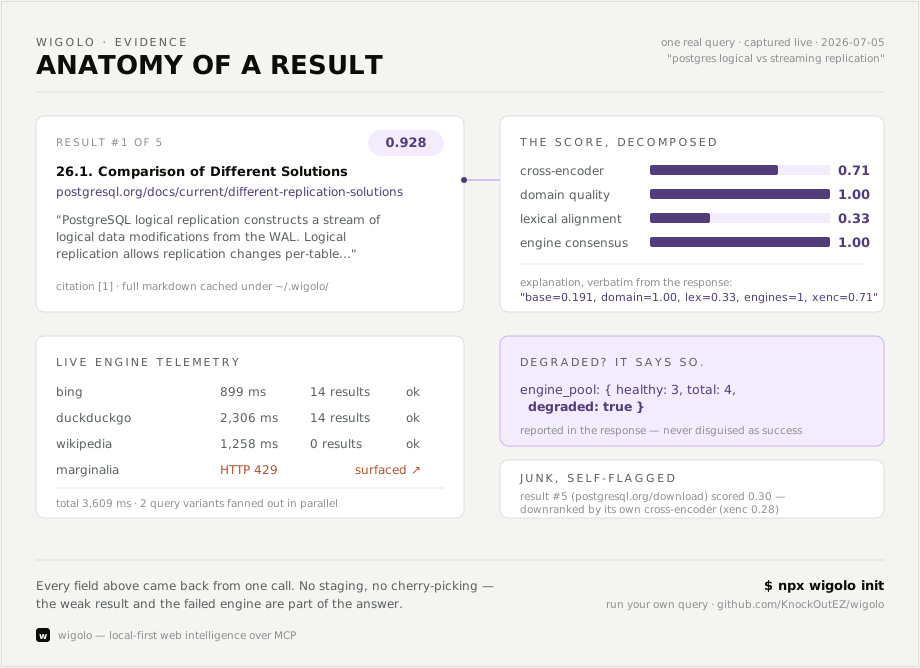
This graph is very suitable for talking about wigolo differentiation: it emphasizes that the results are not black box sorting, but with evidence fragments, rating explanations, search engine sources, downgrade tips, and spam result labels. For enterprise customers, this means governing around "where the answer came from," "whether the results are fresh," and "whether it hits a low-quality source.
4.3 vs. API Billing Search
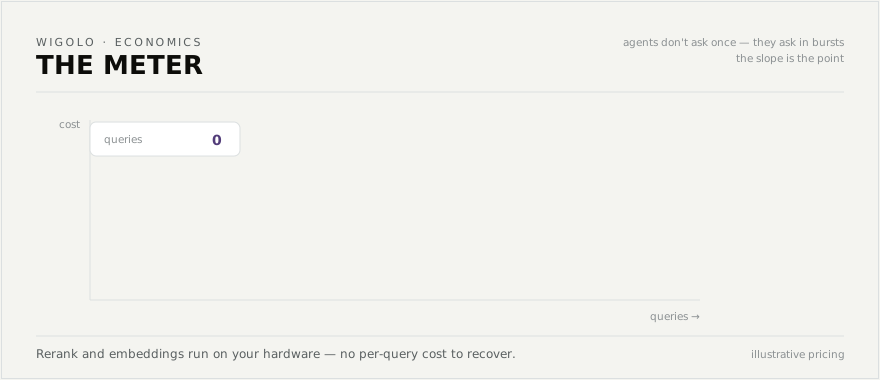
This figure is suitable for cost speech: if the customer's Agent needs to search, grab web pages and read documents a lot every day, the cost of search/crawl API on a per-time basis will accumulate quickly; Wigolo's idea is to keep core retrieval and crawling locally, reducing the dependence on paying for each call.
4.4 Project Comparison Dynamic Chart

This material can be used to show the difference in the positioning of Firecrawl, Exa, Tavily and other similar abilities by the project author. However, it should be noted that this is a comparison between the project side's self-report and self-test, not an independent third-party evaluation, and "take the official benchmark as a reference" should be added when quoting before sales ".
5. Technical Architecture Understanding
The architecture given in README can be summarized as follows: AI Agent calls wigolo through MCP/REST/SDK/CLI, and wigolo has search, crawling, crawling, extraction, caching, similar retrieval, research and autonomous Agent tools; The bottom layer connects multiple search engines, browser pools, local databases, local models and optional LLM.
The key to this architecture is not how complex each module is, but rather "agent-friendly":
-The Agent does not need to handle the search interface, browser crawling, web page cleaning, caching, referencing, and error degradation on its own.
-MCP/REST allows the same set of capabilities to be reused across multiple tools.
-Local cache and local model reduce duplicate visits and duplicate charges.
-Optional LLM is only used for tools that need to generate answers/reports, ordinary search/fetch/crawl/extract do not force dependence on LLM.
6. Main tool capability dismantling
| Tools | Pre-Sales Explanation | Points for Presentation |
|---|---|---|
| search | multi-engine search, fusion sort, ML rearrangement, support for domain name/time/precise phrase/image filtering | search results with evidence, rating explanation, freshness and source |
| fetch | URL to clean Markdown; Use browser to process dynamic pages when necessary; Support PDF, screenshot, page action | Turn complex web pages into Agent readable content |
| crawl | grabs multiple pages of the site and supports BFS, DFS, sitemap, speed limit, robots, deduplication | document station, competition station, knowledge base batch collection |
| extract | Extract tables, metadata, JSON-LD, brand information, or custom schemas from pages | Automatically generate structured leads, product lists, price fields from web pages |
| cache | do keyword or semantic search in web pages that have been viewed locally | reuse of internal research, reduce access and call costs |
| find_similar | Find similar web pages, combine local cache and real-time web | Find competitors, alternatives, similar open source projects |
| research | Automatically disassemble problems, retrieve, grab, organize evidence, generate citation reports | Competition research, technology selection, industry data collation |
| agent | independent multi-step research cycle with step log and budget | shows the data collection link independently completed by agent |
| diff | Compare page content changes | Product document, price page, policy page change monitoring |
| watch | Continuously monitors page changes and can trigger webhook | Competition dynamics, bidding announcements, regulatory change reminders |
7. Differences from common alternatives
Wigolo officials often compare Firecrawl, Exa and Tavily. This can be said before sales:
-Firecrawl is more biased towards web crawling, cleaning and climbing API.
-Exa more biased neural search/semantic search API.
-Tavily is more biased towards LLM/Agent's managed search API.
-wigolo is more "local priority, no Key, self-hosted, Agent toolbox-based Web intelligence layer".
Its differentiation can be summed up in five words:
- Local priority: cache, model, configuration, and data are set to '~/.wigolo' by default'.
- Keyless: API Key is not required for core search, crawling, crawling, extraction and caching capabilities.
- Agent-ready:MCP, REST, SDK, and CLI are available, which is suitable for receiving various agents.
- Evidence-first: Results attach importance to citations, fragments, source positioning, scoring interpretation and degradation identification.
Cost-aware: Reduce the cost of calling the paid search API with every query.
But also be objective: Managed search APIs usually have clearer SLAs, data source stability, enterprise support, and compliance boundaries; wigolo is more suitable for self-hosting and deep integration of technical teams.
8. Applicable Scenario
8.1 Enterprise Internal AI Agent Platform
If customers are building an internal Agent platform and hope that different Agents can access the Internet, crawl web pages, and organize evidence, then wigolo can be used as a unified Web capability layer. It provides standard interfaces through MCP and REST, which can avoid repeated access to Tavily, Firecrawl, browser automation or search API for each agent.
Suitable for customer portraits:
-AI programming/agent tools such as Claude Code, Cursor, Codex, Gemini CLI are already in use.
-There are multiple Agent prototypes or automated processes inside, all requiring search and web page reading.
-You want to control web retrieval costs and don't want to consume third-party APIs for every query.
-There are requirements for data localization, observability and chain of evidence.
8.2 Pre-Sales/Market/Competition Information
Wigolo's research, crawl, watch and diff capabilities are suitable for pre-sales data collection and competition monitoring. For example:
-Regularly grab the competition official website, price page, document page, GitHub README, release notes.
-Compare the capabilities, licenses, deployment methods, and business risks of a certain type of open source project.
-Monitor product page or document changes, discover new features, new pricing, new customer stories.
-Generate sourced research briefs for pre-sales Q & A.
The value in this scenario is not to replace manual judgment, but to reduce the time for data collection and preliminary collation.
Data collection before 8.3 RAG/knowledge base construction
Many RAG projects are stuck in "How to get clean content from external web pages, document stations, PDFs". Wigolo's fetch/crawl/extract can be used as a pre-collection layer:
-Crawl product documentation station.
-Extract web page body, title, table, metadata.
-turns content into Markdown/structured JSON.
-Save in vector library or knowledge base.
It should be noted that wigolo itself is not a complete RAG platform, it is more like a Web ingestion component in the RAG data preparation link.
8.4 AI Programming Assistant Enhancements
For tools such as Claude Code, Cursor and Codex, wigolo can supplement the ability to "check the latest documents, check issue, check API usage and read web pages. Especially when the team wants AI programming assistants to have access to external documents, and does not want each tool to have a set of search services, wigolo's MCP access is more attractive.
8.5 automation workflow and n8n class scenarios
Through REST APIs, wigolo can access n8n, internal automation systems, scheduled tasks, or back-end services:
-Timing search keywords.
-Crawl web content.
-Extract the specified field.
-Send webhook for page changes.
-Push results to CRM, Fly Book, Slack, Notion, or internal knowledge base.
9. Not quite the scene
Wigolo is not a universal Web data platform. Be cautious in the following scenarios:
-Large-scale commercial crawler: If the customer's goal is to capture public web pages with high concurrency, mass and long-term stability, more professional crawler infrastructure, agent pool, compliance audit and risk control are still needed.
-Strong SLA Enterprise Search: If customers require contract-level SLAs, official data authorization, stable index coverage, and enterprise support, the hosted search API may be more robust.
-Severe anti-crawling sites: banks, social platforms, e-commerce login status, strong verification code pages, etc., should not promise stable crawling.
-Direct use by non-technical teams: wigolo is not a visual SaaS for ordinary business users, but a developer and agent platform component.
-License-sensitive commercial products: AGPL-3.0-only there are requirements for modification, distribution, and use of network services, business evaluation must be conducted before commercial integration.
-Completely offline environment: the browser engine and local model need to be downloaded for the first installation; offline deployment needs to prepare images and cache in advance.
10. How to install and use
10.1 the fastest start
npx wigolo init
npx wigolo doctor
'init' will install the configuration, download the browser engine and local model required to run, and connect wigolo to the supported Agent tools. The official documentation also supports installing by target Agent:
npx wigolo init --agents=claude-code,cursor,codexIf you don't want to download all the Warmup resources for the first time, you can use:
npx wigolo init --no-warmup10.2 manual MCP configuration
For clients that support MCP, you can use a similar configuration:
{
  "mcpServers": {
    "wigolo": {
      "command": "npx",
      "args": ["-y", "wigolo"]
    }
  }
}
10.3 the REST API pattern
Local startup service:
wigolo serveDefault listener:
http://127.0.0.1:3333Example call:
curl -s http://127.0.0.1:3333/v1/search \
  -H 'Content-Type: application/json' \
  -d '{"q":"MCP web search agent local first","max_results":5}'
If a non-local address is bound, the official design is fail-closed: you need to configure the WIGOLO_API_TOKEN or explicitly allow unauthenticated access. It is recommended to use local loopback during pre-sales demonstration. Certification must be turned on for production deployment.
10.4 Docker deployment
MCP stdio mode:
docker run -i --rm -v wigolo-data:/data ghcr.io/knockoutez/wigoloHTTP service mode:
docker run -p 3333:3333 \
  -v wigolo-data:/data \
  -e WIGOLO_API_TOKEN=your-token \
  ghcr.io/knockoutez/wigolo serve --host 0.0.0.0
10.5 optional LLM configuration
Core tools such as search, fetch, crawl, extract, and cache are not forced to rely on LLM. LLM is used for 'research', 'agent', and 'search format = answer' when you need to synthesize an answer or research report.
Example:
export WIGOLO_LLM_PROVIDER=gemini
export GEMINI_API_KEY=...
Also supports OpenAI, Anthropic, Groq, Ollama/local OpenAI-compatible services, etc.
11. Security and Privacy
Wigolo's privacy design is an important selling point. The official document highlights:
-Data is saved locally by default in '~/.wigolo'.
-Telemetry is off by default.
-There is no account system, license check, or default cloud backhaul.
-External network requests are generated only when using the landing page, search engine, or configured LLM provider.
-REST service default binding '127.0.0.1 '.
-Non-loopback binding requires authentication, otherwise fail-closed.
-Protection against SSRF, private address access, origin, DNS rebinding, request body size, timeout, and concurrency.
This is important for enterprise customers, because many customers are very sensitive about where AI tools send web pages, prompt, cache, and internal research data. Wigolo's speech should be "structurally easier to localize and self-host", but it cannot be said that "absolutely no data transfer", because once an external LLM provider is configured or an external web page is accessed, the necessary network requests will still be generated.
12. LICENSE AND BUSINESS RISKS
Project usage AGPL-3.0-only. This must be made clear before sales and cannot be understated.
It can be understood as follows:
-Direct local use of unmodified wigolo, generally closer to the tool usage scenario.
-If wigolo is modified and made available to users as a web service, AGPL usually triggers an open source obligation.
-If wigolo is deeply embedded in commercial products, provided with services after transformation, or distributed with products, legal evaluation is required.
-README/FAQ mentions that authors can be contacted to discuss commercial licensing.
Suggested pre-sales expression:
wigolo is very suitable for PoC, internal tool, technical verification and self-managed Agent capability layer, but open source compliance review is required before commercial product integration.
13. Pre-sales value refining
Core Value of 13.1 to Customers
First, reduce the cost of Agent to obtain Web information.
Once many Agents enter the real business, they will frequently search, grab web pages, read documents, and watch competitors. Purely relying on the volume API will make the cost uncontrollable. Wigolo provides a more cost-sensitive option through local search adaptation, caching, and local models.
Second, make Agent's answer more traceable.
It emphasizes evidence, citation, source span, score explanation, freshness, and degradation labels. For corporate customers, this is easier to verify, audit and review than the "LLM direct answer.
Third, unified multi-tool Web capabilities.
Customers may use both Claude Code, Cursor, Codex, Internal Agent, n8n, and backend services. Wigolo uses MCP and REST to make these systems share a Web capability layer to avoid duplication of construction.
Fourth, it is suitable for localization and self-hosting.
For customers who pay attention to privacy and compliance, wigolo's local data directory, telemetry default shutdown, REST fail-closed, Docker deployment and other designs are all technical points to talk about.
Highlights of 13.2 Presales
A 15 minute presentation can be designed:
- Use 'npx wigolo init -- agents = codex' to access the Agent.
- Let the agent search for an up-to-date technical topic, such as "the latest release and license risks of an open source agent framework".
- Display the evidence, citation, and score explanation in the search results.
- Grab GitHub README or document station with fetch and output clean Markdown.
- Use research to generate briefing notes with citations.
- Use cache to find what you have just seen, indicating local memory and reuse.
The focus of this demonstration is not "how fast the search speed is", but to show customers that Agent can investigate with evidence, reuse local cache, and serve multiple tools through a unified interface.
14. Suitable for customer portrait
High Match Customer:
-An in-house Agent platform is being built.
-AI programming assistant is frequently used and needs to check external documents, API, issue and release.
-There are a large number of market, competition, regulations, bidding, product data monitoring needs.
-Want to reduce the call cost of Tavily, Exa, Firecrawl, etc.
-Self-hosting capability, able to accept Node/Docker/MCP/REST integration.
-Clear requirements for data localization, chain of evidence and auditable results.
Medium Match Customer:
-Need to do PoC or internal tools, but not yet mature Agent platform.
-The business side needs research automation, but the technical team can encapsulate the UI or workflow.
-Tools such as n8n, Dify, LangChain, CrewAI, etc. have been used and need to be supplemented by external web capabilities.
Low Match Customers:
-Just want a SaaS search product out of the box.
-No technical team to maintain local service.
-Not acceptable to AGPL.
-The target site relies heavily on login, verification code, and strong anti-crawling.
-Requires official authorization, stable SLA and commercial index coverage.
15. PoC Recommendations
15.1 PoC Target
It is recommended that PoC be defined as "verifying whether wigolo can be used as a unified Web capability layer for enterprise agents", rather than "whether it can search web pages" in general ".
15.2 PoC Scenario
You can select 3 types of tasks:
- Technical data research: Given an open source project or technical topic, generate pre-sales analysis with references.
- Document station collection: grab a product document station, extract the core page and turn it into a Markdown.
- Competition monitoring: monitor the title, price and function description changes of 3 to 5 competition pages.
15.3 evaluation index
| Indicator | Observation Point |
|---|---|
| Search Quality | Whether relevant sources are found and whether key sources such as official website, documents, GitHub, and release are covered. |
| Quality of evidence | Whether the citation is available, whether the excerpt is accurate, and whether source span is helpful |
| Capture Success Rate | Whether Dynamic Pages, Document Stations, PDF and GitHub Pages Can Be Stable to Markdown |
| Output controllability | Whether max tokens, structured output, and schema extraction meet the requirements for subsequent system consumption |
| Cost | Is the cost per task reduced compared to Tavily/Exa/Firecrawl/API Search |
| Delay | Response time of search/fetch/research in real tasks |
| Local Cache Benefits | Does a recurring task significantly reduce access and time |
| Failure Transparency | Whether blocked, stale cache, truncation, and degraded backend are clearly identified |
| Security Compliance | Whether the data catalog, authentication, SSRF, anti-outreach, log, and LLM provider configurations meet the requirements |
| Operation and Maintenance Complexity | Whether Node/Docker, model download, browser dependency, and disk usage are acceptable |
15.4 PoC cycle
Recommended cycle 1 to 2 weeks:
-Day 1: Install and access an MCP client and REST API.
-Days 2 to 3: Run standard research tasks and crawling tasks to compare existing tools.
-Days 4 to 5: do business verification of cache, watch, diff and extract.
-Week 2: Security, license, deployment, cost and stability assessment.
16. Competition and integration relationship
16.1 and Firecrawl
Firecrawl is more easily understood by customers as a web crawling and site crawling API. Wigolo can also capture, but its focus is more on Agent toolkits and local priorities. If the customer only needs a stable managed crawler API, the Firecrawl may be more direct. If the customer wants multi-Agent sharing, local cache, MCP access and keyless core search, wigolo has more characteristics.
16.2 and Tavily
Tavily is the default search API for many Agent projects. Its advantages are hosting, simplicity, and stability. Wigolo's selling points are local priority and reduced cost-by-volume. Wigolo can be used as a substitute or supplement for Taviy, rather than a complete substitute.
16.3 and Exa
Exa partial semantic search and neural retrieval, suitable for similar content, research search. Wigolo also provides similar lookups, but relies heavily on local caching, hybrid retrieval, and multi-engine fusion. For customers who need high-quality semantic Web indexes, Exa still has advantages; for customers who are more sensitive to cost, localization, and agent interface unification, wigolo is attractive.
16.4 & LangChain/CrewAI/LlamaIndex
Instead of replacing these frameworks, wigolo provides Web tools for them. It is more like a tool layer or a connector layer:
-LangChain/CrewAI/LlamaIndex is responsible for task orchestration, agent logic, and RAG process.
-Wigolo is responsible for search, crawling, extraction, caching, research reports and page monitoring.
17. FAQ
Q1: What does API Key mean?
For the core search/fetch/crawl/extract/cache, you do not need to provide a search API key. It does a lot of work through local processes, multi-search adapters, browsers, and local models. However, if you use LLM to synthesize answers, you still need to configure provider such as Gemini, OpenAI, Anthropic, Groq, and Ollama.
Q2: Will the data be uploaded to the wigolo cloud?
The official location is no cloud, local-first, and there is no wigolo account or default cloud backend. Data is in '~/.wigolo' by default'. However, if you query an external web page, you will certainly visit the target website; if you configure an external LLM provider, the composition task will call the corresponding LLM service.
Q3: Can you grab the web page after logging in?
The document mentions that authenticated sessions and browser actions are supported, but whether the login status, verification code, and risk control pages are available depends on the target site and deployment environment. Don't promise to catch all landing pages before sales.
Q4: Can it be used in production?
Can do internal production pilot, but it is still public beta. Evaluate stability, resource usage, monitoring, logs, security certifications, licenses, and target site compliance before production use.
Q5: Will AGPL affect us?
Depends on the way of use. Internal unmodified use and as a tool call, the risk is relatively low, modified as a network service to provide, embedded in commercial products or distribution, the risk is significantly increased. It is recommended to conduct an open source compliance review before entering commercial use, and contact the author for commercial authorization if necessary.
18. Risks and Precautions
- Beta phase risk: the project is active and hot, but the version is still 0.x, and the interface and behavior may change.
- Search stability risk: relies on public search engines and page crawling, and is affected by search engine strategy, anti-crawling, IP reputation, and page structure changes.
- Compliance risk: Crawling a public web page does not mean that it can be used for any commercial purposes. It needs to comply with robots, website terms, copyright and data compliance requirements.
- License risk: AGPL-3.0-only have constraints on the integration of commercial products and network services.
- Resource usage: The browser and model will be downloaded for the first initialization, occupying about 1.5GB; Browser capture will bring CPU/memory fluctuations.
- External LLM disclosure risk: If external LLM provider is enabled, you need to evaluate whether the prompt, web page content, and business issues will be sent to third parties.
Outcome quality risk: Official benchmark are valuable, but not independent. The PoC must be validated with the customer's own task set.
- O & M risks: As a shared service, you need to consider token, port exposure, log, throttling, queue, monitoring, upgrade, and backup.
19. Pre-sales recommended play
19.1 the most suitable opening
Don't talk about wigolo as "another search tool", but:
When an enterprise starts to use the Agent, the Agent will frequently need to access the Web, read documents, verify facts, and organize evidence. Wigolo provides a local-first, self-hosted, MCP/REST-reusable Web intelligence layer to reduce costs, enhance evidence chains, and unify multi-Agent external information capabilities.
19.2 three points that are most likely to impress customers
- Cost: Core queries are not charged by API times, and local cache can be reused.
- Credibility: Results have evidence fragments, citations, score explanations, and failure/degradation markers.
- Integration: Claude Code, Cursor, Codex, LangChain, CrewAI, LlamaIndex, REST, Docker can be connected.
19.3 do not recommend the point of over-commitment
-Don't promise to catch all websites.
-No commitment to search quality necessarily over Exa/Tavily.
-No commitment that AGPL has no effect on commercial use.
-No promise that the beta version is suitable for all production scenarios.
-No external data flow at all is promised, because external web page visits and optional LLM calls still generate network requests.
20. My overall judgment
Wigolo is a AI agent infrastructure project of great concern. It is a high-frequency problem after the real Agent lands: the Agent cannot rely solely on the knowledge of the model itself, but must be able to check new data, read web pages, grab documents, save evidence, reuse results, monitor changes, and it is best not to rely on expensive external APIs at every step.
From a pre-sales perspective, it is suitable for "Enterprise Agent Platform Capability Enhancement", "AI Programming Assistant Enhancement", "Competition/Market Intelligence Automation" and "RAG Data Acquisition Pre-Processing. It is not a product sold directly to business users, but a capacity base sold to technically capable customers.
The most recommended entry method is PoC: select the customer's real 20 to 50 research questions, 10 document stations and 5 competition pages, and compare them with the existing Tavily/Firecrawl/Exa or manual process to see the evidence quality, capture success rate, cost, delay, cache revenue and operability. As long as the customer's Agent is used frequently enough, the cost and localization value of wigolo will be easier to explain.
21. References
-GitHub repository: https://github.com/KnockOutEZ/wigolo
-Official Document: https://knockoutez.github.io/wigolo/
-README:https://github.com/KnockOutEZ/wigolo/blob/main/README.md
-Installation documentation: https://github.com/KnockOutEZ/wigolo/blob/main/docs/installation.md
-Tool documentation: https://github.com/KnockOutEZ/wigolo/blob/main/docs/tools.md
-REST API Documentation: https://github.com/KnockOutEZ/wigolo/blob/main/docs/rest-api.md
-SDK Documentation: https://github.com/KnockOutEZ/wigolo/blob/main/docs/sdks.md
-Self-hosted documentation: https://github.com/KnockOutEZ/wigolo/blob/main/docs/self-hosting.md
-Privacy & Security Document: https://github.com/KnockOutEZ/wigolo/blob/main/docs/privacy-security.md
-Latest Release:https://github.com/KnockOutEZ/wigolo/releases/tag/v0.2.1
-npm package: https://www.npmjs.com/package/wigolo