1. Project Overview
MOSS-Transcribe-Diarize 0.9B is an end-to-end audio understanding model. The core goal is Speaker-Attributed, Time-Stamped Transcription, or SATS for short, that is, "transcription with speaker attribution and timestamp". It receives raw audio or video files and directly generates compact, structured transcribe text:
[start_time][Sxx]transcribed speech[end_time]For example:
[0.48][S01]Welcome everyone[1.66][12.26][S02]The new transcription pipeline is ready for evaluation[13.81]This means that it is not the traditional "ASR model first to text, then a diarization model, and finally by post-processing alignment" splicing scheme, but through a multi-modal model joint to complete transwriting, speaker separation and timestamp generation.
| Dimension | Information |
|---|---|
| Hugging Face | OpenMOSS-Team/MOSS-Transcribe-Diarize |
| GitHub | OpenMOSS/MOSS-Transcribe-Diarize |
| Technical Report | arXiv:2601.01554 |
| Model size | About 0.9B,Hugging Face API shows BF16 parameters about 908M |
| Weight size | About 3.66GB of display storage Hugging Face API |
| Support language | Official said 50 languages, Chinese and English explicitly support |
| Task type | audio-text-to-text |
| Model License | Apache-2.0 |
| whether gated | no |
| Published | 2026-07-09 Open Source |
| Latest model update | 2026-07-31, check date: 2026-08-01 |
| GitHub heat | About 1.3k stars, 71 forks, 15 open issues, check date: 2026-08-01 |
| Hugging Face heat | about 206000 downloads, 349 like, inspection date: 2026-08-01 |
| Production backend | Official recommendation SGLang Omni;CUDA 12 environment also available vLLM |
2. What does it mostly do?
2.1 long audio transcription
It can convert long audio into text for meetings, lectures, podcasts, interviews, videos, calls, etc. Both the official paper abstract and the README emphasize that it can process up to about 90 minutes of input and use 128K context to carry long audio encoded sequences.
Pre-sales value: customers do not need to cut long meetings into many small segments and then splice them manually, which is suitable for directly entering the process of "retrievable, summarizable, quality inspection and discipline generation" from "recording files.
2.2 speaker separation
The model directly outputs anonymous speaker labels such as '[S01]' and '[S02]. It is not to identify the real name, but to try to keep the same speaker's label consistent within the same audio.
Pre-sales value: meeting minutes, interview arrangement, customer service quality inspection all need to know "who is talking", otherwise only get a whole paragraph of text, follow-up summary and responsibility tracking will become weak.
2.3 Timestamp Callout
Each segment has a start and end timestamp, which makes it easy to jump back to the original audio/video and to generate subtitles.
Pre-sales value: customers can directly locate the original audio and video evidence from summary, to-do and quality inspection issues, which is suitable for meeting resumption, training review, legal leaving marks and customer service sampling.
2.4 Acoustic Event Perception
The official introduction mentions that acoustic event annotations, I .e. acoustic event annotation, can be selectively output. This is more suitable as a "potential enhancement capability". In actual PoC, customer audio needs to be used to verify whether the desired event label can be stably output.
Suitable for exploration:
-Meeting/class events such as applause, laughter, silence, noise, etc.
-Abnormal pauses or ambient noise in the customer service scene.
-Non-speech event assisted annotation in video content.
2.5 hot word tips
It supports custom prompt and hotwords. The official suggestion is to add "hot word prompt: hot word 1, hot word 2, hot word 3" after the default transcription prompt ".
This is critical for industry customers, as the most common ASR mistakes are:
-Name of person
-Company Name
-Product name
-Proprietary Terms
-Place names
-Abbreviations
-Business system name
2.6 Subtitle Web App and Batch Processing
The GitHub package provides a local subtitle workflow:
-Upload audio/video.
-Review the parsed subtitle fragment.
-Export JSON/SRT/ASS.
-If FFmpeg/ffprobe is installed, MP4 generation can be suppressed.
-Web UI supports Simplified Chinese and English.
This makes it not just a model, but also a tool interface that can be demonstrated to the business side.
3. Core Competence List
| Capabilities | Descriptions | Pre-Sales Value |
|---|---|---|
| Long Audio ASR | Officially supports up to 90 minutes | Suitable for meetings, courses, interviews, podcasts |
| speaker separation | output '[S01]', '[S02]' and other relative tags | support meeting minutes, customer service double recording, multi-person interview |
| Timestamp | Each segment has start/end time | Playback positioning, subtitle generation, evidence tracing |
| Multilingual | Official 50 Languages | Cross-lingual Content Processing, Overseas Meetings |
| hot words | prompt adds hot word tips | improves proper noun recognition |
| Subtitle export | JSON/SRT/ASS, burn-in support | Video production and training materials collation |
| OpenAI-compatible interface | '/v1/audio/transscriptions' | Easy access to existing platforms |
| Private Deployment | Apache-2.0, Model Open Download | Suitable for Customers with Data Security Requirements |
| SGLang/vLLM | Supports high-performance inference services | Has a production extension path |
4. Architecture and technical roadmap
The official model architecture is as follows:
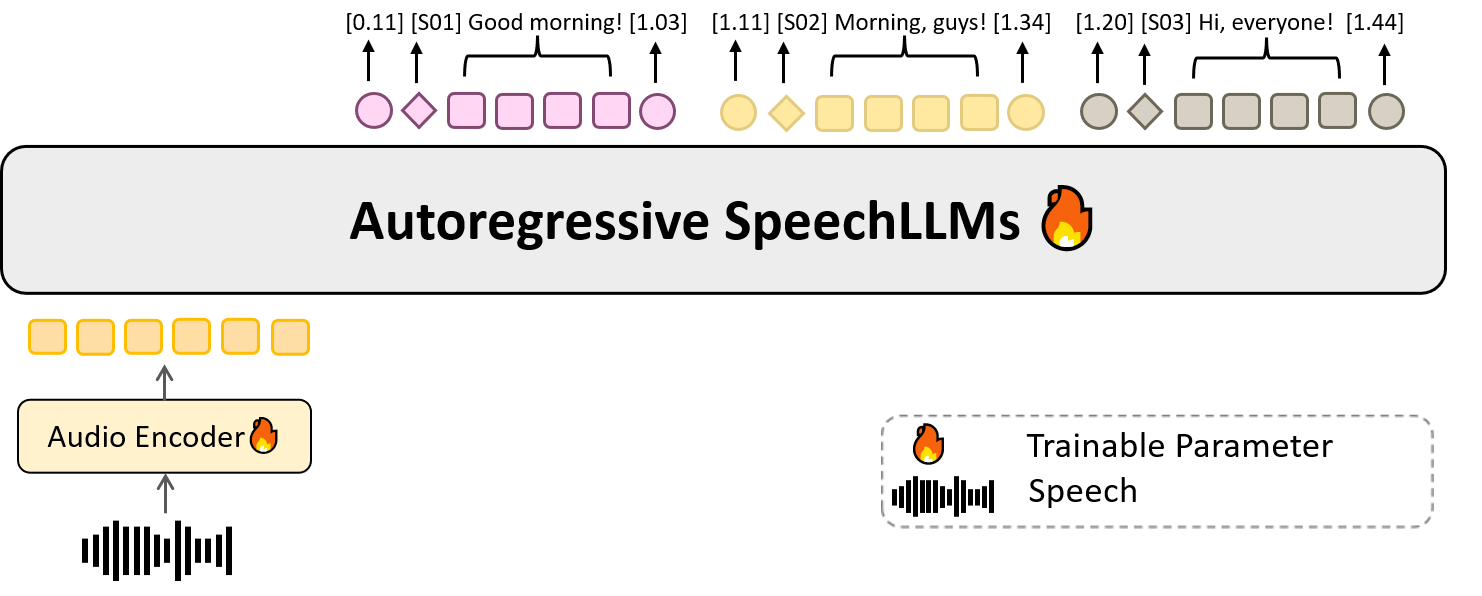
Main components:
| Components | Specifications | ||
|---|---|---|---|
| Text backbone | Qwen3-0.6B style causal decoder | ||
| Audio Encoder | Whisper-Medium encoder Configuration | ||
| audio front end | WhisperFeatureExtractor,16kHz,80 mel bins,30-second block | ||
| Audio-Text Bridge | 4x temporal merge MLP adaptor | ||
| Fusion method | Audio feature replacement '<\ | audio_pad \ | >' embedding |
| output format | '[start][Sxx]text[end]' |
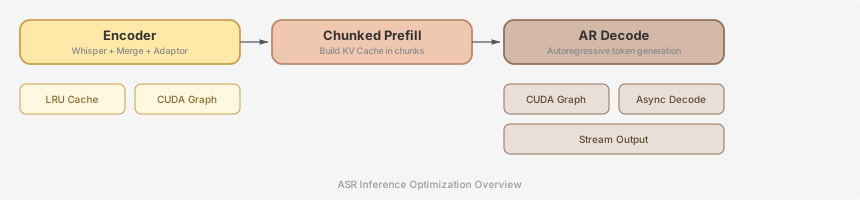
The inference pipeline given by the SGLang Omni cookbook is as follows:

It can be understood as three stages:
- Encoder: Audio waveform to log-mel spectrogram, and then through Whisper encoder to obtain continuous audio features.
- LLM Prefill: Audio features are projected into the LLM embedding space, replacing the audio placeholders in the prompt to build a KV cache.
- AR Decode: Qwen3 style decoder self-regression generates transcribed text with speaker and timestamp.
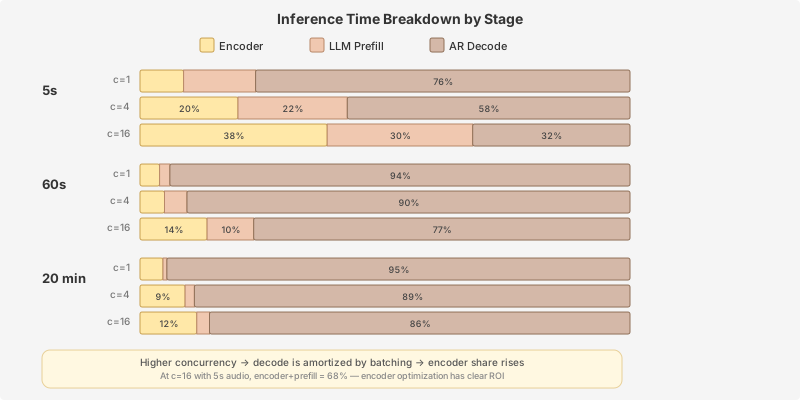
SGLang Omni optimization focuses on CUDA Graph, chunked prefill, continuous batching, KV cache management, async decode, encoder cache, etc. For long audio, autoregressive decoding is the main time consuming point.
5. Applicable Scenario
5.1 Intelligent Meeting Minutes
This is the most direct scene. The client uploads the meeting recording, the model outputs a verbatim draft with a timestamp and speaker, and then the LLM does the summary, issues, to-do, risk, and decision items.
Value points:
-From "Recordings not retrievable" to "Structured Text Assets".
-Each sentence can be traced back to the original audio time point.
-Speaker tags make the summary closer to the real meeting process.
-Can be integrated with enterprise knowledge base, OA, flying book/enterprise micro/DingTalk conference system.
5.2 Call Center Quality Inspection
Customer service recording is generally a conversation between two or more people, not only to identify the content, but also to distinguish between seats and customers. MOSS-Transcribe-Diarize native output speaker-aware transcript, suitable for entering quality inspection rules, sentiment analysis, sensitive word detection, sales speech analysis.
Value points:
-Reduce the cost of manual sampling.
-Automatically locate offending speech and critical fragments.
-Linkage with subsequent quality inspection models, summary models, and CRM work orders.
5.3 Interviews and Survey Arrangement
User interviews, expert interviews, and market research recordings are usually very long, and many people speak alternately. Traditional ASR only gives words, and post-finishing is still very tired. Verbatim drafts with a speaker and time stamp are more suitable for researchers to do coding, excerpting and attribution.
5.4 Classroom/Lecture/Training Content Precipitation
Course recording, live playback and offline training videos can be converted into subtitles and text to regenerate course abstracts, knowledge points, question and answer questions and review materials.
Value points:
-Improve the reuse rate of training content.
-Support video subtitle generation.
-Easy retrieval of learning materials.
5.5 podcast and video caption production
The project comes with subtitle Web App and batch command, supports export SRT/ASS/JSON, and can use FFmpeg to suppress video. It's friendly to the media operations, the course team, the short video team.
5.6 compliance recording and evidence tracing
In judicial, financial, insurance, government hotline and other scenarios, time stamp and original audio positioning is very important. The model output is not final evidence, but can be used as an entry point for retrieval and manual review.
6. Not quite the scene
| Scenario | Reason |
|---|---|
| Very low delay real-time subtitles | README is more offline/quasi-real-time long audio, SGLang documentation also mentions that streaming input is still being optimized |
| requires real identification | '[S01]' is an anonymous label, which does not mean identifying "Zhang San/Li si" |
| High-noise industrial site | Requires real audio testing by customers, not just public benchmark judgment |
| dialect/small language strong demand | official 50 languages, but specific dialect/industry accent must be PoC |
| Medical/judicial direct automatic finalization | Manual review should be retained, and automatic transcription cannot be used as the final authoritative text |
| Ultra Low Resource Edge Device | Although 0.9B is not large, GPU is still required for long audio KV cache and decoding |
| Only single short audio ASR is required | Whisper, SenseVoice, Paraformer, etc. may be simpler |
7. Deployment Resource Estimates
Officials did not directly write "minimum memory", but disclosed the model size, weight size and single H100 benchmark. The following is a pre-sales estimate based on official information and engineering experience. Formal projects need to be tested with real customer audio.
| Scenario | Recommended hardware | Fit for purpose |
|---|---|---|
| Feature Trial | 16GB GPU | Minutes of Audio, Low Concurrency Feature Validation |
| PoC recommendation | 24GB GPU, such as RTX 4090 / L4 24G / L40S 24G level | single-channel conference clip, subtitle verification, hot word effect test |
| Getting Started with Production | 48GB GPU, such as L40S 48G / A40 48G | Medium and Long Audio, Low to Medium Concurrency, Internal Services |
| Long audio high concurrency | A100 80GB / H100 80GB | 30-90 minutes audio, batch transcription, multiple concurrency |
| CPU | Not recommended | Can only do very slow function verification |
The official SGLang Omni benchmark is given on the single H100 80GB:
| Data set | Concurrency | Average latency | RTF | audio_s/s |
|---|---|---|---|---|
| movies short sequence | 16 | 0.659s | 0.0922 | 81.98 |
| aishell4_long long sequence | 16 | 282.8s | 0.1237 | 98.83 |
RTF less than 1 means faster than real time. For example, RTF 0.1237, theoretically about 1 hour of audio can be processed in 7-8 minutes, but this is under the condition of H100 80GB, and the official benchmark shall prevail.
Pre-sales advice:
-Demo only: Single 24GB GPU verified first.
-Customer meeting minutes PoC:24GB starting, 48GB preferred.
-Call center batch processing: 48GB start, estimated by concurrent and daily recording hours.
-90 minutes long sessions with multiple concurrency: Evaluate directly by 80GB card.
-When deploying 24GB/48GB cards, reduce the max-running-requests from 16 in the official example to 1-4.
How to use #8.
8.1 Environment Preparation
The official GitHub README uses Python 3.12 and Transformers 5.x:
git clone https://github.com/OpenMOSS/MOSS-Transcribe-Diarize.git
cd MOSS-Transcribe-Diarize
uv venv --python 3.12 .venv
source .venv/bin/activate
uv pip install -e ".[torch-runtime]" --torch-backend=auto
The main Python package requirement comes from 'pyproject.toml ':
| Dependent | Description |
|---|---|
| 'transformers>= 5.6.0,<6.0.0 ' | Model loading and generation |
| 'torch>= 2.8 ', 'torchaudio>= 2.8' | Optional torch runtime |
| 'safetensors ' | Weight format |
| 'av', 'librosa', 'soundfile', 'soxr' | audio video and audio processing |
| 'fastapi', 'uvicorn', 'python-multipart | Subtitle Web App/Service Interface |
8.2 Python calls
import torch
from transformers import AutoModelForCausalLM, AutoProcessor

from moss_transcribe_diarize import parse_transcript
from moss_transcribe_diarize.inference_utils import (
    build_transcription_messages,
    generate_transcription,
    resolve_device,
)

model_id = "OpenMOSS-Team/MOSS-Transcribe-Diarize"
audio_path = "audio.wav"

device = resolve_device("auto")
dtype = torch.bfloat16 if device.type == "cuda" else torch.float32

model = AutoModelForCausalLM.from_pretrained(
    model_id,
    trust_remote_code=True,
    dtype="auto",
).to(dtype=dtype).to(device).eval()

processor = AutoProcessor.from_pretrained(
    model_id,
    trust_remote_code=True,
)

messages = build_transcription_messages(audio_path)
result = generate_transcription(
    model,
    processor,
    messages,
    max_new_tokens=2048,
    do_sample=False,
    device=device,
    dtype=dtype,
)

print(result["text"])

for segment in parse_transcript(result["text"]):
    print(segment.start, segment.end, segment.speaker, segment.text)
Note: Hugging Face loading needs 'trust_remote_code = True', and the enterprise must do code audit before production.
8.3 SGLang Omni Servitization
Officially recommended SGLang Omni:
hf download OpenMOSS-Team/MOSS-Transcribe-Diarizesgl-omni serve \
--model-path OpenMOSS-Team/MOSS-Transcribe-Diarize \
--port 8000 \
--max-running-requests 16 \
--cuda-graph-max-bs 16 \
--mem-fraction-static 0.80Call:
curl -X POST http://localhost:8000/v1/audio/transcriptions \
  -F model=OpenMOSS-Team/MOSS-Transcribe-Diarize \
  -F file=@audio.wav \
  -F response_format=verbose_json
Long Audio Adjustable Large:
curl -X POST http://localhost:8000/v1/audio/transcriptions \
  -F model=OpenMOSS-Team/MOSS-Transcribe-Diarize \
  -F file=@audio.wav \
  -F response_format=verbose_json \
  -F max_new_tokens=65536
8.4 vLLM Servitization
The CUDA 12 environment may consider vLLM. The official tip requires a pinned vLLM nightly that contains the model registration.
vllm serve OpenMOSS-Team/MOSS-Transcribe-Diarize --trust-remote-codeCall:
curl http://localhost:8000/v1/audio/transcriptions \
  -F model="OpenMOSS-Team/MOSS-Transcribe-Diarize" \
  -F file=@"audio.wav" \
  -F response_format="json" \
  -F temperature="0"
8.5 Subtitles Web App
mtd-subtitle-web \
  --model OpenMOSS-Team/MOSS-Transcribe-Diarize \
  --host 127.0.0.1 \
  --port 7860
After opening 'http:// 127.0.0.1:7860 ', you can upload audio/video, review segments, and export JSON/SRT/ASS. MP4 can also be suppressed if FFmpeg/ffprobe is installed.
Batch:
mtd-subtitle /path/to/input.mp4 \
  --model OpenMOSS-Team/MOSS-Transcribe-Diarize \
  --out-dir runs/example \
  --render
9. What can I say before sales
9.1 for Meeting Minutes Customers
"It's not simply turning the audio into a whole paragraph of text, but directly outputting who said what at what time. Following the big model summary, you can generate meeting minutes, to-do items, controversial points and key decisions, and you can jump back to the original recording."
9.2 for Call Center Customers
"Call center quality inspection is most afraid of only the full text, no role. MOSS-Transcribe-Diarize can output speaker tags and time stamps, the follow-up can distinguish between agents and customers, do speech compliance, complaint identification, sales opportunity analysis."
9.3 for audio and video content customers
"It provides a local captioning workflow, supports exporting SRT/ASS/JSON, and can also work with FFmpeg to suppress video. For courses, podcasts, interviews, and live playback, it can convert content assets into retrievable, distributable, and reusable text and captions."
9.4 for information security/government and enterprise customers
"The model is Apache-2.0 open source, which can be deployed privately, and audio can not go out of the intranet. For meeting recordings, hotline recordings, law enforcement records, and training videos with privacy and compliance requirements, this is a route that is easier to pass security reviews than pure SaaS transcriptions."
10. Frequently Asked Customer Questions
| What is the difference between it and Whisper? | Whisper is mainly ASR;MOSS-Transcribe-Diarize native output speaker tags and timestamps, it is more suitable for multi-person long audio. | |||||||||||||||||||||||||||||||||||||||||||||||||||||||||||||||||||||||||||||||||||||||||||
| Can you identify the real speaker's name? | Can not directly identify the real identity, only output '[S01]' such anonymous relative tags. To map a real name, you need to incorporate a voiceprint library, meeting member information, or manual confirmation. | |||||||||||||||||||||||||||||||||||||||||||||||||||||||||||||||||||||||||||||||||||||||||||
| Support Chinese? | Support, Chinese and English clearly listed in the model card, the official said support 50 languages. | |||||||||||||||||||||||||||||||||||||||||||||||||||||||||||||||||||||||||||||||||||||||||||
| Can you handle a 90-minute meeting? | The official said that the maximum support is about 90 minutes, but the actual view depends on the video memory, max_new_tokens, concurrency and audio quality, PoC must be verified with the customer's real recording. | |||||||||||||||||||||||||||||||||||||||||||||||||||||||||||||||||||||||||||||||||||||||||||
| How many GPUs do you need? | The function trial run can start from 16/24GB; Production suggests 48GB; Long audio and high concurrency suggest A100/H100 80GB. | |||||||||||||||||||||||||||||||||||||||||||||||||||||||||||||||||||||||||||||||||||||||||||
| Can it be deployed privately? | Yes, the Apache-2.0 model supports local Python, SGLang Omni, and vLLM. | |||||||||||||||||||||||||||||||||||||||||||||||||||||||||||||||||||||||||||||||||||||||||||
| Can I output subtitles? | Yes, the project comes with a subtitles Web App and batch processing tool that can export JSON/SRT/ASS. | |||||||||||||||||||||||||||||||||||||||||||||||||||||||||||||||||||||||||||||||||||||||||||
| Are hot words effective? | Official support hotword prompt, but the effects of industry terms, personal names, and product names need to be tested with customer audio. | |||||||||||||||||||||||||||||||||||||||||||||||||||||||||||||||||||||||||||||||||||||||||||
| Is it suitable for real-time transcription? | More suitable for offline or quasi-real-time long audio. The SGLang documentation mentions that streaming input is still being optimized and it is not recommended to commit to low-latency real-time conference captioning. |
11. PoC Recommendations
11.1 PoC Data Preparation
Customers are advised to provide 3 types of real data:
| Data Type | Suggested Quantity | Purpose |
|---|---|---|
| Conference recording | 5-10 segments, 20-90 minutes each | Verify long audio, multi-speaker, timestamp |
| customer service recording | 50-200 segments, 2-10 minutes each | verify the two-person conversation, business terms, quality inspection availability |
| Video/Course | 5-20 paragraphs | Verify subtitle export, hot words, follow-up abstract |
11.2 acceptance index
| Indicator | Description |
|---|---|
| CER/WER | CER can be seen in Chinese and WER can be seen in English |
| speaker separation accuracy | whether the same speaker has the same label and whether different speakers are confused |
| Timestamp Offset | Whether the start and end of each segment are sufficiently close |
| Leak/Repeat | Whether long audio is missed, repeated or ended early |
| Hot Word Hit Rate | Name, Company Name, Product Name, Professional Terms |
| RTF | Processing Time/Audio Duration, Estimate Cost |
| Concurrent Throughput | How many hours of audio per hour can be processed |
| Manual Proofing Savings | Comparison with Original Manual Transcription/Subtitling Process |
| Downstream Availability | Generate meeting minutes, customer service quality inspection, and whether subtitles are easy to use |
11.3 Demo script
- Upload a 10-20 minute multi-person meeting recording.
- Output verbatim with '[S01]', '[S02]', timestamp.
- Presentation of 'verbose_json segment' results.
- Export SRT subtitles.
- Use LLM to generate meeting minutes, to-do, risk points for the transfer results.
- Click the timestamp to listen back to the original audio clip.
- Add hot words in the customer industry and compare the term recognition effect.
Comparison of 11.4 and Competitions/Alternatives
| Scenario | Benefits | Limitations | MOSS-Transcribe-Diarize Differences |
|---|---|---|---|
| Whisper / Faster-Whisper | Mature and Ecological Wide | Speaker Separation Requires External | MOSS Native speaker-aware |
| pyannote ASR Stitching | diarization Specialty | Complex Pipeline and Difficult Alignment | MOSS Generates Structured Text at One Time |
| Business Cloud ASR | out of the box, stable | Data out of the cloud, cost, customization limited | MOSS can be privatized, Apache-2.0 |
| SenseVoice/Paraformer | Chinese ASR Strong, Mature Deployment | Multi-speaker/Long Audio Structured Additional Scheme | MOSS Focused Long Audio speaker timestamp |
| Large model audio API | High capability, low maintenance | Cost, privacy, uncontrollable | MOSS can be deployed and customized locally |
12. Risks and Considerations
12.1 New Project Maturity
Project 2026-07 is open source and is growing fast, but production stability still requires customer scenario stress testing. Don't just look at the official benchmark and promise direct production.
12.2 'trust_remote_code = True'
Hugging Face loading requires remote custom code execution. The enterprise environment must:
-Fixed model version and commit sha.
-Auditing documents such.
-Do mirror curing.
-Prohibit the production environment from dynamically pulling unaudited code.
12.3 long audio memory and delay
Long audio results in a long encoded sequence and output. The actual consumption is affected by the audio length, the number of people speaking, the output text length, the number of max_new_tokens, and the number of concurrency. Pre-sales quotes are estimated by "audio hours per day" and "need to return in real time.
12.4 speaker label is not identity authentication
'[S01]' is just an anonymous label generated by the model. It does not prove true identity, nor does it replace voiceprint recognition or real-name participation information.
12.5 transcription results still need manual review
In high-risk scenarios such as finance, justice, medical care, and government affairs, automatic transcription can only be used as an aid. The manual review process shall be retained for official texts, evidentiary materials and compliance reports.
12.6 Pro Version Differences
README mentioned that MOSS-Transcribe-Diarize Pro is more powerful and can be used through online Playground. Before the sale to distinguish:
-Open source 0.9B: suitable for privatization, self-deployment, PoC.
-Pro: may be more effective, but involves online services, commercial terms, data flow and fees.
13. My Pre-Sales Judgment
MOSS-Transcribe-Diarize is a project that is closer to the business floor than the early MOSS dialogue model. It solves a very clear high-frequency problem: large amounts of audio/video content cannot be structured, cannot be retrieved, and cannot be quickly reproduced.
I think it is best suited to cut into three categories of scenarios:
- Meeting Minutes/Training Content Precipitation : Audio to verbatim draft, followed by large model summary and knowledge base.
- Call Center Quality Inspection: Speaker-differentiated timestamp business rules/LLM quality inspection.
- Video subtitles and content production: Automatically generate subtitles, manuscripts, abstracts, and slice materials.
If customers are concerned about data security and want to deploy it privately, its Apache-2.0 license and open source weight are obvious advantages. If customers are looking for extreme real-time, extremely high concurrency, or legal-level accuracy, they need to be evaluated carefully and suggest adding manual review, proper noun hot words, voiceprint/identity mapping, and post-processing rules.
My suggestion: PoC can be made before sales with the combination of "30 minutes of meeting recording, 100 minutes of customer service recording, 5 course videos. As long as the transcription, speaker, timestamp and subtitle export can meet the customer's expectations, this project can easily be linked to several mature business topics such as meeting minutes, quality inspection, knowledge base and capitalization of audio and video content.
14. REFERENCE
-Hugging Face model card:OpenMOSS-Team/MOSS-Transcribe-Diarize
-GitHub repository:OpenMOSS/MOSS-Transcribe-Diarize
-Chinese README:README_zh.md
-English README:README.md
-SGLang Omni Cookbook:moss_transcribe_diarize.md
-Technical Report:MOSS Transcribe Diarize Technical Report
-Online Playground:MOSS Transcribe Diarize Pro
-OpenMOSS official website:open-moss.com
-MOSI.AI:mosi.cn