1. Project Overview
| Dimension | Information |
|---|---|
| Project | microsoft/autogen |
| Positioning | A programming framework for agentic AI |
| Core Direction | Single Agent, Multi-Agent Collaboration, Tool Invocation, MCP, Code Execution, Studio Prototype Interface |
| Main Language | Python |
| Cross-Language | Python. NET related packages/runtime |
| Python Requirements | Python 3.10 |
| LATEST release | 'python-v0.7.5', Posted at 2025-09-30 |
| Recently pushed | 2026-04-15 |
| GitHub Hot | 2026-06-30 Query: About 59.4k stars, 8.9k forks, 921 open issues |
| Current Status | Official README Mark Maintenance Mode, Only Limited Maintenance such as bug/security/docs will be accepted in the future |
| License | Warehouse metadata display CC-BY-4.0;README legal instructions state document/content CC-BY-4.0, code according to MIT License |
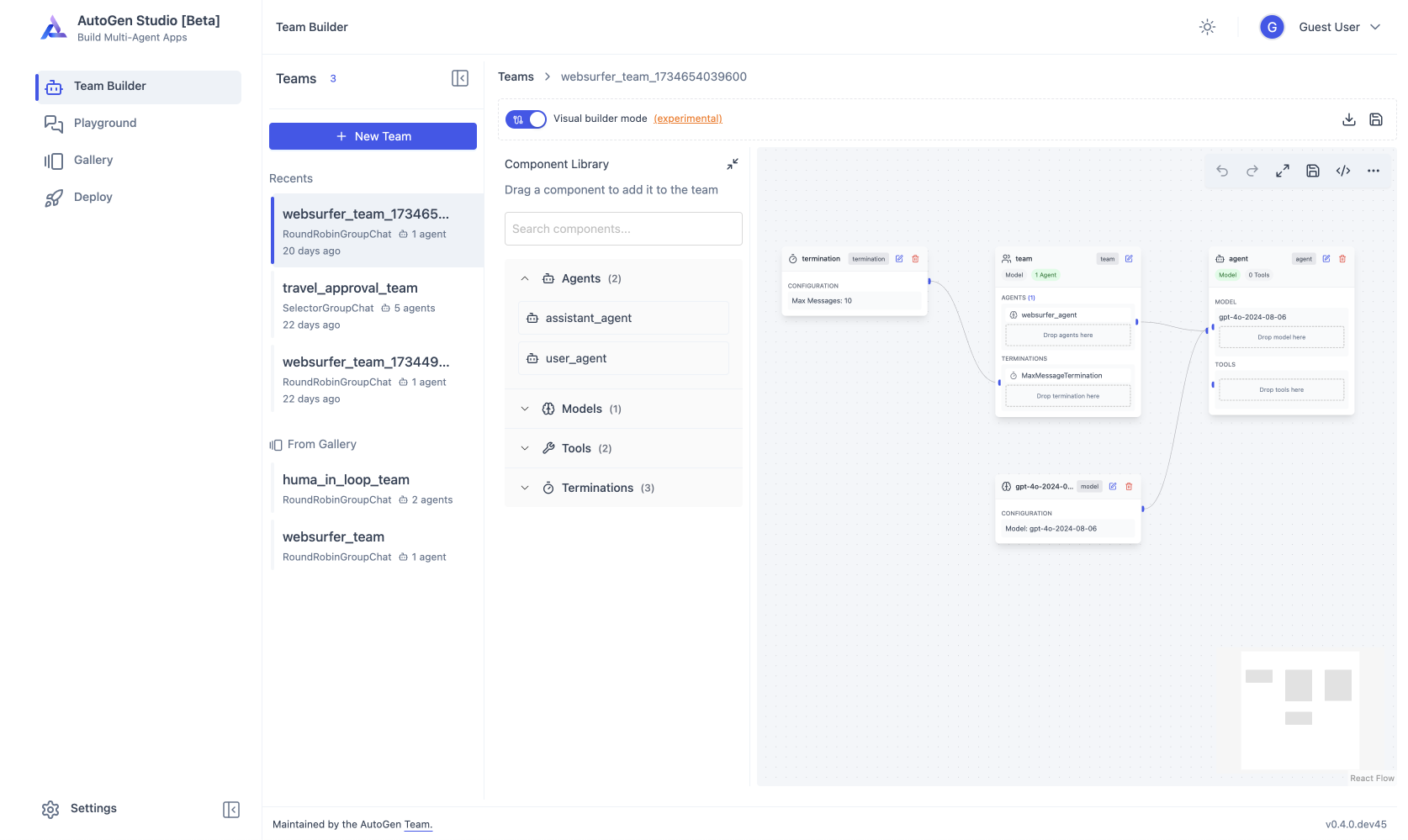
The project comes with key diagrams:

2. The most important judgment now: AutoGen has entered maintenance mode
AutoGen the current biggest pre-sale information is not "how many stars it has", but the official has clearly stated at the top of the README:
| Facts | Pre-Sales Meaning |
|---|---|
| AutoGen is now in maintenance mode | New features and enhancements do not continue into the AutoGen mainline |
| New users should start with Microsoft Agent Framework | It is not recommended to use AutoGen as the long-term main architecture for new customers and new projects |
| Existing users are encouraged to migrate | If customers have already used AutoGen, they should discuss the migration route instead of continuing to add codes on a large scale |
| Community managed going forward | Community response, enterprise support, long-term route certainty will decline |
This should be made clear in the pre-sales materials. Otherwise, customers will question the judgment of the scheme when they find out the official recommendation for migration.
3. What can it mainly do
| Capabilities | AutoGen Description | Customer Value |
|---|---|---|
| Single-agent application | 'AssistantAgent' combines the model client to complete the task | Quickly build a AI assistant with the ability to call tools |
| Multi-Agent Orchestration | Use 'AgentTool', GroupChat, Team and other modes to combine multiple expert Agents | Separate complex tasks into multiple roles, such as researcher, code clerk, and reviewer |
| Tool call | Supports function tools, code execution, MCP Workbench, etc. | Enabling the Agent to access external systems, browsers, and code environments |
| MCP Support | Can be connected to MCP servers such as Playwright MCP | Suitable for demonstrating the ability of "Agent to operate browsers/external tools" |
| Layered architecture | Core, AgentChat, and Extensions | There are entries from prototype to lower-level event-driven runtime |
| AutoGen Studio | Web UI Prototyping Tool, No-Code/Low-Code Build Multi-Agent Workflow | Suitable for Quick Presentation of Multi-Agent Workflow Concepts in Pre-Sales |
| AutoGen Bench | Agent Performance Measurement Kit | Can be used to compare agent task completion rates and costs |
| Magentic-One | AgentChat/Extensions-based general-purpose multi-agent team example | Demonstrates complex tasks such as web browsing, code execution, and file handling |
4. Architecture Understanding
AutoGen official framework is divided into three layers:
| Level | Role | For whom |
|---|---|---|
| Core API | Messaging, event-driven Agent, local/distributed runtime, support. NET and Python | R & D teams that need custom runtime, event model, and complex distributed agents |
| AgentChat API | High-level, opinion-based rapid prototyping API, supporting common modes such as dual-agent chat and GroupChat | Business PoC, R & D rapid verification and multi-agent collaboration |
| Extensions API | Extend external capabilities such as model client, code execution, and OpenAI/Azure OpenAI/MCP | Engineering teams that need access to models, tools, and execution environments |
It can be explained to customers that AutoGen design is not "a chatbot SDK", but "a multi-agent communication and collaboration framework". It regards Agent as a role that can send/receive messages, invoke tools, and collaborate to complete tasks. The high-level API can quickly build demo, and the low-level Core can make a more flexible system.
5. Applicable Scenario
| Scene | Current Fit | Description |
|---|---|---|
| Learning multi-agent ideas | High | The project has great influence and rich examples, which is suitable for understanding the multi-agent orchestration paradigm |
| Existing AutoGen project maintenance | High | Continue bug fixing, stable operation, and migration planning |
| Multi-Agent PoC Demo | Mid-High | Quick display of expert agents, tool calls, MCP, Studio |
| Research Agent Experiment | Medium-high | AutoGen derived from Microsoft Research, suitable for research and paper prototyping |
| New enterprise-level production project | Medium-low | The official recommendation is to Microsoft Agent Framework, and it is not recommended to bet on AutoGen for new projects |
| Long-term productization platform | Low to medium | Maintenance model brings route risk, unless the customer has already invested heavily in AutoGen |
6. Not quite the scene
| Unsuitable point | Cause |
|---|---|
| The new project requires long-term official support. | The AutoGen has maintenance mode, and the official succession direction is Microsoft Agent Framework. |
| Customer demands stable API and LTS commitment | README makes it clear that new features will not continue to be enhanced, and the production route is not as clear as MAF |
| Requires enterprise governance/observable/persistent workflow | AutoGen can do some capabilities, but MAF emphasizes production-grade, durability, observability, governance |
| I hope that Low-Code Studio will go online for production. | AutoGen Studio README is definitely a rapid prototype and sample UI, not a production application. |
| High security requirements for third-party tools | MCP, code execution, and browser tools all require strict sandboxing, permissions, and auditing |
How to use #7.
Install AgentChat and OpenAI extensions:
pip install -U "autogen-agentchat" "autogen-ext[openai]"Minimum Single Agent Example:
import asyncio
from autogen_agentchat.agents import AssistantAgent
from autogen_ext.models.openai import OpenAIChatCompletionClient

async def main() -> None:
    model_client = OpenAIChatCompletionClient(model="gpt-4.1")
    agent = AssistantAgent("assistant", model_client=model_client)
    print(await agent.run(task="Say 'Hello World!'"))
    await model_client.close()

asyncio.run(main())
Installation idea of MCP browser Agent example:
npm install -g @playwright/mcp@latestAutoGen Studio:
pip install -U "autogenstudio"
autogenstudio ui --port 8080 --appdir ./my-app
Note: AutoGen Studio can be used for pre-sales demo and prototype verification, but the official reminder is that it is not a production-level application, and production deployment should supplement its own authentication, security, permissions, auditing and other capabilities.
8. Relationship with Microsoft Agent Framework
AutoGen is no longer a recommended portal for Microsoft new multi-agent projects. Both the official README and the migration guide point to the Microsoft Agent Framework.
| Comparison Items | AutoGen | Microsoft Agent Framework |
|---|---|---|
| Current Location | Maintenance Mode, Multi-Agent Pioneer Framework | Production-level Agent and Multi-Agent Workflow Framework |
| Fit To | Existing AutoGen Users, Research/Learning, PoC | New Projects, Enterprise Production, Long Term Support |
| Languages | Python/.NET Support | Python and C#/.NET Consistent API |
| Orchestration style | Event-driven core team/AgentChat | typed graph-based Workflow |
| Tools | FunctionTool, MCP, Code Execution, etc. | '@ tool', hosted tools, middleware, etc. |
| People in the loop | Can do it, but many scenes need to be customized | Workflow request/response built-in support |
| Persistence/recovery | Team abstraction does not have built-in checkpointing | Workflow support checkpoint/resume |
| observability | OpenTelemetry support | more emphasis on unified observation of agents/workflows/tool execution |
Microsoft Agent Framework official banner:
Pre-sales suggestion: if the customer is "new agent platform/multi-agent application", give priority to Microsoft agent Framework. If the customer has already used the AutoGen, then talk about AutoGen maintenance and migration.
9. What can I say before sales
One-sentence positioning:
"AutoGen is a multi-intelligent AI application framework driven by Microsoft Research, suitable for understanding and validating multi-Agent collaboration, tool invocation, and Agent prototypes; but it is now in maintenance mode, and new projects should prioritize the evaluation of Microsoft Agent Framework."
Customer Value:
| Customer Pain Points | AutoGen/MAF Related Value |
|---|---|
| A single large model is difficult to complete complex tasks | Multi-Agent can split tasks to different roles, such as planning, execution, review, and tool invocation |
| AI external tools need to be called | AutoGen support MCP, function tools, code execution and other modes |
| Want to quickly build a multi-agent demo | AutoGen Studio and AgentChat can quickly prototype |
| You have used the AutoGen 0.2/0.4 | You can evaluate the upgrade, freeze the version, and migrate to MAF |
| To do enterprise-level landing | Suggest to turn to MAF, focusing on workflow, observable, governance, persistence, human review |
10. Frequently Asked Customer Questions
| Can AutoGen still be used? | Yes, existing projects can continue to be maintained; However, the official has entered the maintenance mode, and new projects are not recommended as the first choice. | |||||||||||||||||||||||||||||||||||||||||||||||||||||||||||||||||||||||||||||||||||||||||||
| Why is it not recommended for new projects because of its high stars? | stars reflects historical influence and community concern, not the current route. The official current recommendation Microsoft Agent Framework. | |||||||||||||||||||||||||||||||||||||||||||||||||||||||||||||||||||||||||||||||||||||||||||
| Can AutoGen Studio be produced online? | Not recommended. Officially, it is used for rapid prototyping and sample UI, and production should implement authentication, security, permissions, and auditing on its own. | |||||||||||||||||||||||||||||||||||||||||||||||||||||||||||||||||||||||||||||||||||||||||||
| How to choose between AutoGen and LangGraph/DeepAgents? | AutoGen Microsoft more ecological and multi-agent research traditions; However, new projects should look at MAF under the Microsoft route. LangGraph more biased state diagram/controlled workflow ecology. Need to be selected according to customer technology stack and governance requirements. | |||||||||||||||||||||||||||||||||||||||||||||||||||||||||||||||||||||||||||||||||||||||||||
| What if the customer already has AutoGen code? | Freeze the version, sort out the usage points of Agent, Tools, GroupChat, and Studio, and then evaluate the migration to MAF according to the Microsoft migration guide. | |||||||||||||||||||||||||||||||||||||||||||||||||||||||||||||||||||||||||||||||||||||||||||
| Does MCP Support? | The AutoGen Extensions supports MCP Workbench. You can connect to the MCP server. However, you must only connect to a trusted MCP server. |
11. PoC Recommendations
If the customer only learns multi-Agent, AutoGen can be used as PoC. If the customer plans to produce and land, it is recommended to do MAF PoC at the same time.
| PoC Items | AutoGen Verification Points | MAF Extended Verification |
|---|---|---|
| Expert collaboration | Agent division of labor among mathematics experts, chemistry experts, researchers, code members, etc. | Use Workflow to express sequential, parallel, and handoff |
| MCP tool calls | Playwright MCP to browse the web, extract information | Verify MCP/A2A and enterprise tool boundaries |
| Man-in-the-loop | Manually approve plans or results | Verify Workflow request/response |
| Long task recovery | Custom status management is required on the AutoGen side | Verification checkpoint/resume |
| Observability | OpenTelemetry runtime/tool tracing | Comparative workflow-level observability |
| Studio Prototype | AutoGen Studio Quick UI | Evaluate whether self-developed UI is required |
Suggested indicators:
| Indicator | Description | |
|---|---|---|
| Task completion rate | Whether multi-agent completes complex tasks more stably than single agent | |
| Cost | Multi-Agent tends to increase the cost of token and tool invocation | |
| Delay | Multi-round collaboration may be significantly slower than single agent | |
| Controllability | Whether the role, tool permissions, maximum rounds, and failure retries can be restricted. | |
| Security | Whether code execution, MCP, and local file access are controllable and auditable | |
| Migration cost | The amount of modifications to migrate existing AutoGen code to MAF |
12. Risks and Considerations
- Official maintenance mode: This is the biggest risk. New features, long-term support, and enterprise-level routes should not be AutoGen.
- Old documents may be out of date: there are still some historical statements about 0.4 active maintenance in FAQ, which should be based on the maintenance mode at the top of README.
- Multi-Agent costs are higher: the more agents, the more message delivery, reflection, and tool calls, and the cost and delay will increase.
- Tool security: MCP Server, code execution, browser operations may access the local environment or sensitive information, there must be sandboxes and permissions boundaries.
- Studio non-production: AutoGen Studio cannot replace enterprise application shell, permission system and audit system.
- Migration planning: Existing AutoGen projects should evaluate MAF migration as early as possible, rather than continuing to expand complex functions.
13. My Pre-Sales Judgment
AutoGen is still worth learning because it is a very important project in the history of multi-agent framework. Many concepts such as GroupChat, Agent-as-tool, tool execution, MCP integration, Studio prototype, etc. can help customers understand why they need Agent orchestration before sales.
But for real business opportunities, I will divide it into two ways:
| Customer Type | Recommendation |
|---|---|
| AutoGen has been used | Status assessment, version freeze, risk warning, migration route and short-term maintenance plan |
| Create a new Agent project | We do not recommend that you push the main AutoGen, and give priority to analyzing Microsoft Agent Framework, LangGraph, Semantic Kernel, and other frameworks that are more suitable for long-term implementation. |
A more realistic judgment is: AutoGen is suitable for "historical benchmark and prototype reference of multi-Agent capability", and Microsoft Agent Framework is the production route that Microsoft currently wants you to take. When talking about AutoGen before sales, we must take the initiative to speak maintenance mode. This is not to reduce points, but to show that our judgment is stable.
14. REFERENCE
-AutoGen GitHub: https://github.com/microsoft/autogen
-AutoGen documentation: https://microsoft.github.io/autogen/
-AutoGen Releases: https://github.com/microsoft/autogen/releases
-AutoGen FAQ: https://github.com/microsoft/autogen/blob/main/FAQ.md
-AutoGen to Microsoft Agent Framework Migration Guide: https://learn.microsoft.com/en-us/agent-framework/migration-guide/from-autogen/
-Microsoft Agent Framework: https://github.com/microsoft/agent-framework
-Microsoft Agent Framework Documentation: https://learn.microsoft.com/en-us/agent-framework/