1. Project Overview
| Dimension | Information |
|---|---|
| Project Name | DeerFlow |
| GitHub | bytedance/deer-flow |
| official website | deerflow.tech |
| Project Location | Open Source Super Agent Harness |
| An open-source long-horizon SuperAgent harness that researches, codes, and creates | |
| Open Source License | MIT |
| Technology Stack | Python, TypeScript, LangGraph, LangChain, FastAPI, Next.js, Nginx, Docker, Sandbox |
| Python Requirements | README annotation Python 3.12 |
| Node.js requirements | README annotation Node.js 22 |
| Latest Release | v2.0.0,2026-06-25 Released |
| Current Activity | 2026-06-30 Check: About 75.5k stars, 10.2k forks, 589 issues, 401 PR |
| Important | DeerFlow 2.0 is a complete rewrite and does not share code with v1; v1 Deep Research framework is maintained in the main-1.x branch |
The full name of the DeerFlow is Deep Exploration and Efficient Research Flow. It was originally a Deep Research framework, and then the community extended it to more scenarios such as data pipeline, presentation generation, Dashboard, content automation, etc., so it was 2.0 refactored into a more general Super Agent Harness.
Pre-sales can be interpreted as an open source Agent platform base that equips large models with "working environment, long-term memory, skill system, file system, tools and sub-agents.
2. What does it mostly do?
2.1 in-depth research and report generation
DeerFlow inherits the core capabilities of Deep Research. It can search for data, crawl web pages, organize information, analyze from multiple perspectives, and output reports around a complex problem.
Suitable scenarios:
| Scenario | Value |
|---|---|
| Industry Research | Automatically collects public data to form structured industry insights |
| Competition Analysis | Comparison of Positioning, Capacity, Price and Ecology of Multiple Products |
| Policy/Regulatory Tracking | Summarize original policies, refine impacts, and form recommendations for action |
| Pre-sales data preparation | Generate customer background, pain points, proposal, PoC route |
2.2 long task execution
The website emphasizes that DeerFlow can handle tasks ranging from a few minutes to a few hours. It supports long-link tasks through planning, subtask disassembly, file systems, memory, and sandbox execution environments.
Typical tasks:
-Research an open source project and generate an analysis report.
-Read uploaded data and generate PPT or web pages.
-Write a small application or script.
-Analyze data files and produce charts and interpretations.
-Multiple rounds of iteration over a content item or technical solution.
2.3 Sub-agents Parallel Collaboration
The DeerFlow lead agent can dynamically pull up sub-agents. Each sub-agent has an independent context, tool, and termination condition, can process different directions in parallel, and is finally aggregated by the lead agent.
Presentation:
DeerFlow is not just a single agent in a context, but can split complex tasks into multiple sub-tasks, allowing different sub-agents to study, execute, and summarize in parallel, which is more suitable for complex business scenarios.
2.4 Sandbox and File Systems
DeerFlow provide an executable environment for the Agent. Each task has isolated working directories, including upload files, workspace, and output directories:
/mnt/user-data/
├── uploads/          ← 用户上传文件
├── workspace/        ← Agent 工作目录
└── outputs/          ← 最终交付物
It supports:
-Read and write files
-Edit files
-Execute bash or code
-View pictures
-Generate final deliverables
-Isolate execution environment in Docker or Kubernetes dependent mode
This brings it closer from "a chatbot that invokes tools" to "an agent with a controlled computer".
2.5 Skills and Tool Extensions
DeerFlow supports the standard Agent Skill. A Skill is typically a 'SKILL.md' that can contain workflows, best practices, reference materials, scripts, and templates.
Built-in and adaptable to include:
-research
-report-generation
-slide-creation
-web-page
-image-generation
-video-generation
-claude-to-deerflow
Example structure:
/mnt/skills/public
├── research/SKILL.md
├── report-generation/SKILL.md
├── slide-creation/SKILL.md
├── web-page/SKILL.md
└── image-generation/SKILL.md

/mnt/skills/custom
└── your-custom-skill/SKILL.md
Core value: Enterprises can solidify internal methodology, industry knowledge, delivery templates, and pre-sales processes into Skill to form a reusable Agent capability library.
2.6 long-term memory
DeerFlow supports cross-session memory to gradually accumulate user portraits, preferences, background knowledge, work habits, and common processes.
Suitable for:
-Personal work assistant
-Team knowledge assistant
-Long-term customer follow-up assistant
-Fixed business process automation assistant
2.7 multi-end entrance
DeerFlow is not just a backend SDK, it provides multiple entries:
| Entry | Description |
|---|---|
| Web UI | Next.js frontend, accessed through the Nginx unified portal |
| Gateway API | FastAPI REST LangGraph-compatible agent runtime |
| Embedded Python Client | You can embed Python without starting the full HTTP service. |
| Terminal Workbench / TUI | Interactive workbench for end users |
| IM Channels | Telegram, Slack, Feishu/Lark, Enterprise WeChat, DingTalk, WeChat and other channels access |
| Claude Code Skill | Control the DeerFlow directly from Claude Code via the claude-to-deerflow skill |
3. Project comes with schematics and official visuals
3.1 official website positioning map and demonstration entrance
The official website describes DeerFlow as an open source SuperAgent Harness that can be researched, coded and authored. With sandbox, memory, tools, skills and subagents, long tasks can be handled at different levels.
-Official website:https://deerflow.tech
-README also contains a link to the official demo video:deer-flow-720p.mp4
3.2 InfoQuest Integration Chart
BytePlus InfoQuest search and crawler integration is demonstrated in DeerFlow README.

Pre-sales implications: DeerFlow not only rely on the model itself in the "deep research" scenario, but also emphasize search, crawling and data acquisition capabilities. For customer public web research, competition research, industry information collection, this kind of tool chain is the key.
3.3 TUI Official Preview
DeerFlow project comes with Terminal Workbench preview:
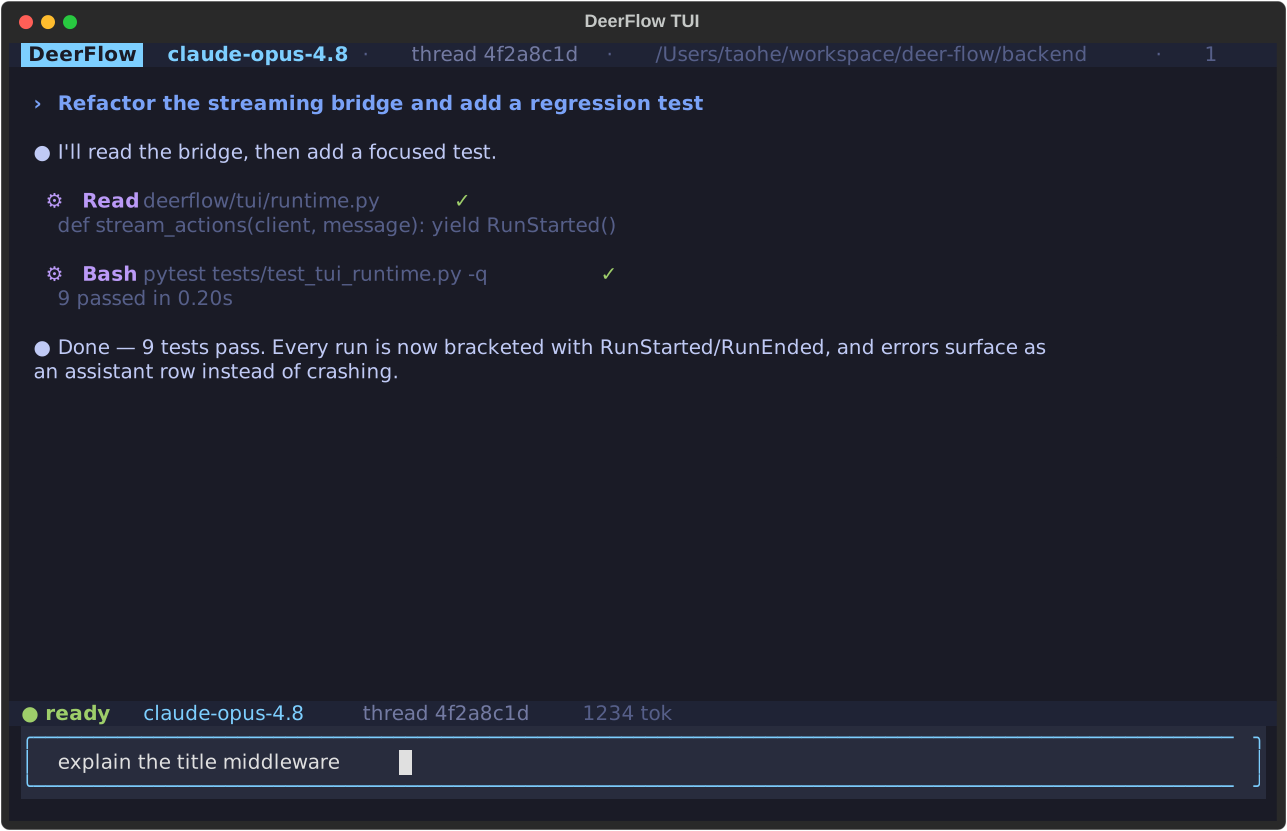
Pre-sales meaning: It not only has a Web experience, but also supports terminal native workflow, suitable for R & D, data, operation and maintenance, and Agent engineering teams.
3.4 Star History
README built-in Star History diagram:
Pre-sales meaning: high community attention can be used as auxiliary evidence of open source maturity and ecological heat, but it cannot be equated with production stability.
Schematic 3.5 Backend Architecture
The core architecture given by the project back-end README can be summarized as follows:
统一入口 :2026"] N --> F["Frontend
Next.js :3000"] N --> G["Gateway API
FastAPI :8001"] G --> R["Embedded LangGraph-compatible Agent Runtime"] R --> L["Lead Agent"] L --> M["Middleware Chain"] L --> T["Tools / MCP / Skills / Sandbox / Subagents"] T --> S["Sandbox FS
uploads / workspace / outputs"] T --> O["Observability
LangSmith / Langfuse"]
Key points:
-'/api/langgraph/*' is forwarded by Nginx to the Gateway LangGraph-compatible API.
-Gateway assume both REST API and Agent Runtime.
-Lead Agent combines context, upload files, sandbox, memory, skills, children, and clarify processes through the middleware chain.
4. Core Competence List
| Capabilities | Descriptions | Pre-Sales Value |
|---|---|---|
| Deep Research | Search, Crawl, Organize, Report Generation | Automation from Data Collection to Draft Report |
| Long-horizon Agent | Supports tasks from minutes to hours | Demonstrates complex business automation |
| Sub-agents | Dynamic disassembly of molecular tasks for parallel processing | Suitable for complex research, content production and R & D tasks |
| Sandbox | Executes commands, code, and file operations in isolation | More like an executive agent than a normal chatbot |
| File System | Upload, Workspace, Output Directory | Intermediate results can be precipitated, traced, and delivered |
| Skills | Extensible Workflow Module | Precipitable Industry/Customer/Delivery Methodology |
| MCP | Supports access to external tools and services | Connects to internal systems |
| Memory | Cross-session memory | Suitable for personal/team long-term assistants |
| Web UI | For ordinary users | For business presentations |
| TUI | for end users | Easy to use by R & D and technical teams |
| IM Channels | Access to Slack, Feishu, Enterprise WeChat, etc. | Close to Enterprise Daily Collaboration Portal |
| Observability | LangSmith, Langfuse | Support trace, debug and evaluation |
| Multi-model | Support OpenAI-compatible, DeepSeek, OpenAI, Gemini, Doubao, etc. | Not binding a single model, suitable for privatization/multi-model strategy |
5. Applicable Scenario
5.1 Presales and Solutions Team
DeerFlow is a great pre-sales research assistant ":
-Enter the customer name, industry, official website and public information.
-Automatically complete the sorting of customer background, business pain points, competition trends and industry trends.
-Output pre-sales call outline, PoC suggestion, scheme structure and demonstration speech.
Advantages:
-Pre-sales methodology can be made into skills.
-The results can be written to the file system to form deliverable materials.
-The use threshold can be lowered through the Web UI or IM portal.
5.2 Enterprise Knowledge Work Automation
Suitable for departments:
-Market research
-Strategic analysis
-Consultant
-Legal/compliance screening
-Product operation
-Content Team
Typical tasks:
-First Draft Industry Report
-Summary of policy impact
-Competition database
-Customer data collation
-Multi-document analysis
-Web page/report/PPT generation
5.3 R & D and technical team
Suitable for tasks:
-Code Repository Understanding
-Small function implementation
-Bug Localization
-Generate scripts and tools
-Code documentation and architecture description
-Access the development process via TUI or API
The project supports Codex CLI, Claude Code OAuth, ACP agent, MCP Server, Docker sandbox, which will be more attractive to technical teams.
5.4 Enterprise Agent Platform PoC
If customers want to build an internal Agent platform instead of just making a single robot, DeerFlow can be used as a reference base:
-Unified model configuration
-Unified tool configuration
-Unified skill library
-Unified sandbox execution
-Unified Web / API / IM portal
-Unified trace and memory management
5.5 multi-terminal enterprise assistant
DeerFlow support Telegram, Slack, Feishu/Lark, Enterprise WeChat, DingTalk, WeChat and other IM channels. For enterprises that already rely heavily on collaborative tools, this means that agents can be embedded in existing work portals rather than opening up a new system.
6. Not quite the scene
| Scenario | Reason |
|---|---|
| Simple FAQ or standard RAG | DeerFlow the structure is heavy, simple Q & A does not require a complete harness |
| Strong transaction, strong deterministic process | Traditional workflow engine/BPM/RPA more controllable |
| Public network bare deployment | The official clearly prompts that there is a risk of high-privilege operation and should not be exposed without authentication |
| Simple, latency-sensitive queries | Overhead and longer tool call links for long task agents |
| Environment that cannot provide model/API/search/sandbox resources | Many capabilities rely on external models, tools, and operating environments |
| Production-level multi-tenant customers who lack security isolation capabilities | Need to supplement authentication, isolation, auditing, permissions, and network security first |
7. Architecture, Deployment and Integration
7.1 full stack architecture
DeerFlow is a complete application, not just a library:
| Level | Technology/Component |
|---|---|
| Frontend | Next.js Web UI |
| Unified portal | Nginx, default port 2026 |
| API | FastAPI Gateway, default port 8001 |
| Agent Runtime | LangGraph-compatible runtime embedded Gateway |
| Agent Orchestration | Lead Agent middleware chain subagents |
| Tools | Built-in tools, MCP, community tools, Python functions |
| Execution Environment | LocalSandboxProvider, AioSandboxProvider, Kubernetes/provisioner |
| Observability | LangSmith, Langfuse |
| data and status | thread data, memory, checkpointer, uploads, outputs |
7.2 deployment method
Docker is officially recommended, especially for long-term running or shared environments.
| Deployment target | Starting configuration | Recommended configuration | Description |
|---|---|---|---|
| Local Experience/'make dev' | 4 vCPU, 8 GB RAM, 20 GB SSD | 8 vCPU, 16 GB RAM | Light-weight experience for a single developer |
| Docker Development/'make docker-start' | 4 vCPU, 8 GB RAM, 25 GB SSD | 8 vCPU, 16 GB RAM | You need to consider image building and sandbox container |
| Long-Run Service/'make up' | 8 vCPU, 16 GB RAM, 40 GB SSD | 16 vCPU, 32 GB RAM | Suitable for sharing, multi-agent, report generation and heavier sandbox |
7.3 Model Integration
DeerFlow model configuration is managed through 'config.yaml. Support:
-OpenAI
-Anthropic
-DeepSeek
-Gemini
-OpenRouter
-vLLM
-Xiaomi MiMo
-Codex CLI
-Claude Code OAuth
-Arbitrary LangChain-compatible provider
Example:
models:
  - name: gpt-5-responses
    display_name: GPT-5 (Responses API)
    use: langchain_openai:ChatOpenAI
    model: gpt-5
    api_key: $OPENAI_API_KEY
    use_responses_api: true
    output_version: responses/v1
Pre-sales focus: It can be adapted to the customer's existing model gateway, privatized vLLM, OpenAI-compatible services, or combined with volcano engine/BytePlus related models and InfoQuest tools.
7.4 Tools and MCP Integration
DeerFlow support:
-web_search
-web_fetch
-image_search
-file read/write
-bash
-MCP Server
-Python functions
-Custom skills
This provides an entry point for enterprise systems integration, such:
-Internal knowledge base
-CRM
-Work Order System
-Database
-BI Platform
-Documentation system
-Private search
-Code Warehouse
How to use #8.
8.1 Docker Recommended Path
git clone https://github.com/bytedance/deer-flow.git
cd deer-flow

make setup
make docker-init
make docker-start
Access:
http://localhost:20268.2 Local Development Path
git clone https://github.com/bytedance/deer-flow.git
cd deer-flow

make config
make check
make install
make dev
8.3 TUI usage
uv pip install 'deerflow-harness[tui]'

deerflow
deerflow --continue
deerflow --resume THREAD
deerflow --print "summarize this repo"
deerflow --json "hello"
Note: the package named "deerflow-harness" on PyPI is displayed as' 0.0.1 'placeholder when queried on 2026-06-30, while the' backend/packages/harness/pyproject.toml' label version' 2.1.0' in the warehouse '. Therefore, the actual use should be based on the warehouse README/source code installation method to avoid misinstallation of placeholder packages.
8.4 Embedded Python Client
from deerflow.client import DeerFlowClient

client = DeerFlowClient()

response = client.chat("Analyze this paper for me", thread_id="my-thread")

for event in client.stream("hello"):
    if event.type == "messages-tuple" and event.data.get("type") == "ai":
        print(event.data["content"])
9. What can I say before sales
9.1 a word
DeerFlow is an open source Super Agent Harness that can upgrade large models from "answering questions" to "completing tasks": it has sandboxes, file systems, skills, memory, child generation, and multi-terminal portals, and is suitable for building enterprise-wide research assistants, content assistants, R & D assistants, and long-task automation platforms.
9.2 for Business Owner
It can help the team to automatically complete repetitive knowledge work such as data collection, research and analysis, report generation, PPT/web page first draft, content production, etc., liberating manual work from "finding data and sorting out formats" and focusing more on judgment and decision-making.
9.3 for Technical Leader
Based on LangGraph and LangChain, the DeerFlow provides complete agent runtime, middleware chain, sandbox, MCP, skills, memory, and subagents. It is not a closed SaaS, but MIT open source, self-hosted, scalable, can be used as an internal Agent platform for engineering reference.
9.4 for security responsible person
The DeerFlow has high permissions such as system command execution, file reading and writing, and business logic invocation, so it cannot expose the public network. The correct methods are local trusted network, strong authentication, IP whitelist, network isolation, sandbox isolation, least privilege, and audit trail.
10. Customer pain point mapping
| Customer pain points | DeerFlow correspondence capabilities | Pre-sales cut-in |
|---|---|---|
| RAG can only be used for Q & A, but cannot be executed. | Sandbox, Tools, File System | Upgrade from Q & A to Task Execution |
| Complex tasks are easy to lose context | Context Engineering, Memory, and Sub-agents | Supports long tasks and multi-step processes |
| Internal processes are difficult to integrate | MCP, Python tools, Gateway API | connect enterprise systems and tool chains |
| Agent output is uncontrollable | Skills, Prompt, Workflow, and Human review are extensible | Constrain output with enterprise methodology |
| Lack of audit and troubleshooting | LangSmith, Langfuse tracing | Observable, Reviewed, Evaluable |
| Multi-entry hassle | Web UI, TUI, IM Channels | Embed an existing workflow |
| Model Selection Uncertain | Multi-model, OpenAI-compatible, vLLM | Not Bind a Single Model Vendor |
11. Frequently Asked Customer Questions
| Question | Suggested Answer |
|---|---|
| What is the difference between RAG and ordinary RAG? | RAG mainly solves the problem of "answering after searching data", and DeerFlow is more "long task execution". It can plan, call tools, write files, degenerate subagents and generate deliverables. |
| What is the relationship between it and LangGraph? | DeerFlow is based on LangGraph and LangChain, and LangGraph more basic, DeerFlow more complete Agent applications and harness. |
| Can the project be deployed privately? | The MIT project is open source and supports local/Docker/production deployment. However, authentication, network isolation, and sandbox must be configured according to official security recommendations. |
| Can I receive enterprise WeChat/Feishu/DingTalk? | README display supports IM channels such as Telegram, Slack, Feishu/Lark, WeChat, WeCom, DingTalk, etc. The corresponding platform key needs to be configured for actual landing. |
| Can I connect to the internal system? | It can be accessed through MCP Server, Python tools, API and file system, but permission control and audit are required. |
| Production available? | The project is active and fully functional, but the 2.0 is a new rewrite. It is recommended to do PoC first, and then do security, stability, performance, version locking and regression testing. |
| Can I use a domestic model? | README recommends Doubao-Seed-2.0-Code, DeepSeek v3.2 and Kimi 2.5, and also supports OpenAI-compatible/vLLM access. |
| What are the biggest risks? | Security risks caused by high-privilege tools and command execution, as well as long task costs, latency, stability, and model tool invocation reliability. |
12. PoC Recommendations
12.1 PoC 1: Pre-sales Research Assistant
Objective: Enter customer name, official website, industry and competition to automatically generate pre-sales research report.
Recommended Validation:
| Indicator | Validation Method |
|---|---|
| Information Integrity | Does it cover customer background, business, competition, industry trends |
| Source Reliability | Whether to keep the source link |
| Delivery Quality | Whether the first draft of the visit outline or plan can be directly formed |
| Efficiency improvement | vs. time-consuming manual research |
| Controllability | Can skill be used to solidify pre-sales templates |
12.2 PoC II: Enterprise Document Analysis and Report Generation
Objective: Upload multiple PDF/Word/PPT/Excel to generate summary, risk points, recommendations and final report.
Validation Focus:
-File upload and conversion capabilities
-Long context processing capability
-Structured quality of results
-Output file deliverability
-Sensitive data isolation and permissions
12.3 PoC III: R & D Code Assistant
Objective: Let DeerFlow analyze a real-world code repository, complete small fixes or generate architectural notes.
Validation Focus:
-Warehouse understanding ability
-File reading and writing ability
-bash/test execution capability
-TUI experience
-Generate change notes and audit records
12.4 PoC IV: IM Ingress Enterprise Assistant
Objective: To access DeerFlow in Feishu/Enterprise WeChat/DingTalk so that business personnel can submit tasks through chat.
Validation Focus:
-Channel access costs
-User Experience
-Permissions and identity mapping
-File upload/download
-Multi-round task status management
13. Risks and Considerations
13.1 security risk is the first priority
The official README clearly indicates that the DeerFlow has high permission capabilities such as system command execution, resource operation, and business logic invocation, and is designed as a local trusted environment by default. Strict security measures must be taken for public or untrusted network deployment.
Recommendation:
-Don't bare the public.
-Use strong authentication and reverse proxy.
-Configure the IP whitelist.
-The network is isolated to a private VLAN.
-The Docker/Kubernetes sandbox is preferred for the production environment.
-Minimum permissions and audits for high-risk tools.
-Do not allow the Agent to directly operate on the production database.
13.2 Docker Socket Risk
The configuration document points out that some Docker-outside-of-Docker modes need to mount the host Docker socket, and the Docker socket is equivalent to the root-level control capability of the host. Multi-tenant or public network environments should prioritize provisioner/Kubernetes isolation.
Stability of 13.3 2.0 after rewriting
DeerFlow 2.0 is a ground-up rewrite, it means that the architecture has been upgraded, but it also means that:
-Versions may change quickly.
-Documentation and implementation may have update discrepancies.
-Locked version required for production landing.
-Complete regression testing is required.
13.4 PyPI Package Name Note
2026-06-30 Query deerflow-harness PyPI is displayed as placeholder 0.0.1, while the harness version in the warehouse is 2.1.0. The pre-sales demo and PoC should not directly rely on the PyPI placeholder package and should be executed according to the official installation path of the warehouse.
13.5 Cost and Performance
Long tasks, subagents, searches, crawls, code execution, and multiple model calls introduce costs and delays.
PoC is recommended when recording:
-Single task time-consuming
-Number of model calls
-Token consumption
-Number of tool invocations
-Number of failed retries
-Number of manual interventions
-Generate results availability
14. Competition and Alternative Perspectives
| Category | Represents | Difference from DeerFlow |
|---|---|---|
| RAG Framework | Dify, RAGFlow, LangChain RAG | More partial knowledge question and answer, long task and execution environment are not the core |
| Agent Orchestration Framework | LangGraph, AutoGen, and CrewAI | LangGraph a lower level; DeerFlow provides complete applications and harness |
| Deep Research Products | Various Research Agents/SaaS | DeerFlow Open Source, Self-Hosting, and Retrofit |
| Coding Agent | Claude Code, Codex, Cursor | DeerFlow covers research, content, file, IM, multi-portal, not just coding |
| RPA/BPM | UiPath, Power Automate, traditional workflow | RPA is more deterministic; DeerFlow better for open knowledge tasks |
Pre-sales judgment: If the customer wants to do "Enterprise Agent Platform PoC", the DeerFlow will produce results faster than the pure framework. If the customer only needs a simple question and answer, it may be too heavy. If the customer needs strict production process control, it should be combined with the workflow/approval/permission system instead of letting the Agent bear all the responsibilities alone.
15. My Pre-Sales Judgment
DeerFlow is an open source project that is well suited as a pre-sales demo and PoC base. Its highlight is not a single point algorithm, but a complete set of engineering capabilities required for Agent landing: Web UI, Gateway, TUI, IM, sandbox, file system, skills, memory, subagents, MCP and tracing.
It is suitable for showing customers the new stage of "AI from chat to task execution", especially suitable for in-depth research, pre-sales data preparation, content generation, document analysis, research and development assistance and enterprise internal Agent platform construction.
But it's also not a silver bullet produced directly out of the box. When landing, security boundaries, authentication and authorization, sandbox isolation, tool permissions, cost control, observability, evaluation system and version governance must be designed simultaneously. It is recommended to use it to make a PoC with clear boundaries before sales: select non-production data, read-only systems, limited tools, and clear output indicators, so that customers can see the business value of long-task Agent first, and then discuss production transformation.