1. Project Overview
| Dimension | Information |
|---|---|
| Project Name | DeepTutor |
| GitHub | https://github.com/HKUDS/DeepTutor |
| Official Website/Project Page | https://deeptutor.info/ |
| Papers | https://arxiv.org/abs/2604.26962 |
| PyPI | https://pypi.org/project/deeptutor/ |
| Agent-native intelligent learning companion with multi-agent collaboration and RAG | |
| Latest Version | v1.5.4,2026-07-24 Released |
| Main languages | Python, TypeScript |
| Technology Stack | Python 3.11-3.13, FastAPI, Next.js 16, RAG, Multi-Agent, CLI, Docker |
| License | Apache-2.0 |
| GitHub Hot | 2026-07-25 Query: About 29.7k stars, 3.9k forks, 69 open issues |
| Installation method | PyPI, Docker, source code, CLI-only |
| OFFICIAL STATUS | Completely open source, README clear currently no paid online products |
The core selling point of DeepTutor is "lifelong personalized counseling". It puts multiple links in the learning process in the same context: students can chat and ask questions, do questions, generate tests, do in-depth research, compile the knowledge base into living books, write in Co-Writer, let the memory system continuously accumulate learning portraits, and can also access sub-intelligence such as Partners or local Claude Code/Codex.
As mentioned in the project paper abstract, DeepTutor try to make up for two kinds of deficiencies: ordinary LLM relies on static pre-training knowledge, which is difficult to adapt to individual learners; traditional RAG can provide knowledge enhancement, but it does not necessarily provide personalized and guided feedback. The paper also puts forward the TutorBench to measure the effect of personalized counseling by interactive evaluation with learner's portrait. The paper reports that DeepTutor improved on average by 10.8 percent on personalized metrics and reasoning by 29.4 percent on five backbone models to enhance general agentic. These figures are from project papers, and pre-sales references should be made to indicate that they are the results of a technical report by the author team, not an independent third-party evaluation.
2. Official Key Schematic
The project itself has relatively complete screenshots and architecture diagrams, which are suitable for direct entry into study notes and pre-sales materials.
2.1 Product Overview
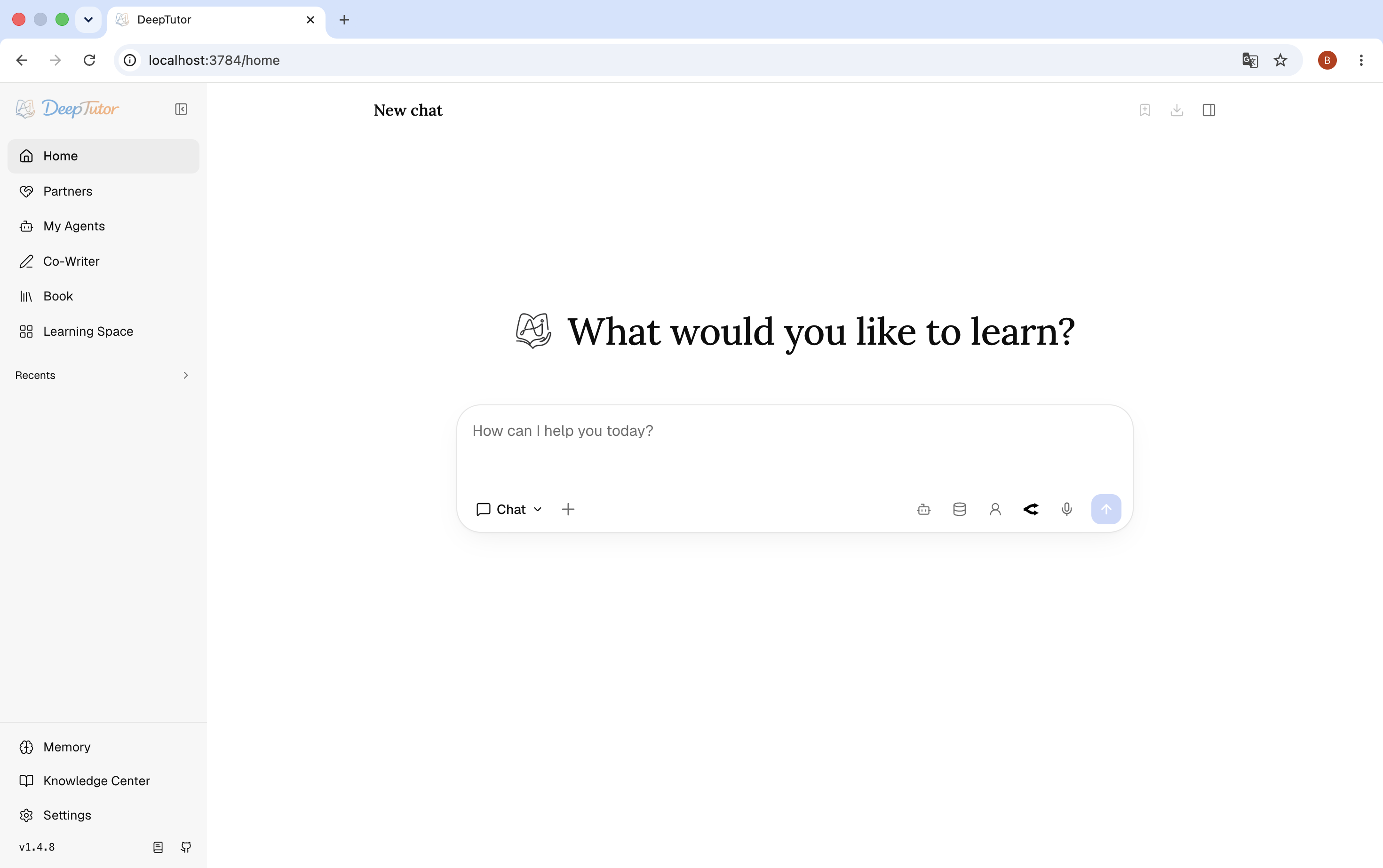
The official website describes the DeepTutor as "Eight surfaces, one running context": Home, Partners, My Agents, Co-Writer, Book, Learning Space, Memory and Knowledge Center share the same agent-native runtime. This point is very suitable for product explanation opening: it is not a bunch of isolated tools, but a workspace connected around learner context.
2.2 System Architecture
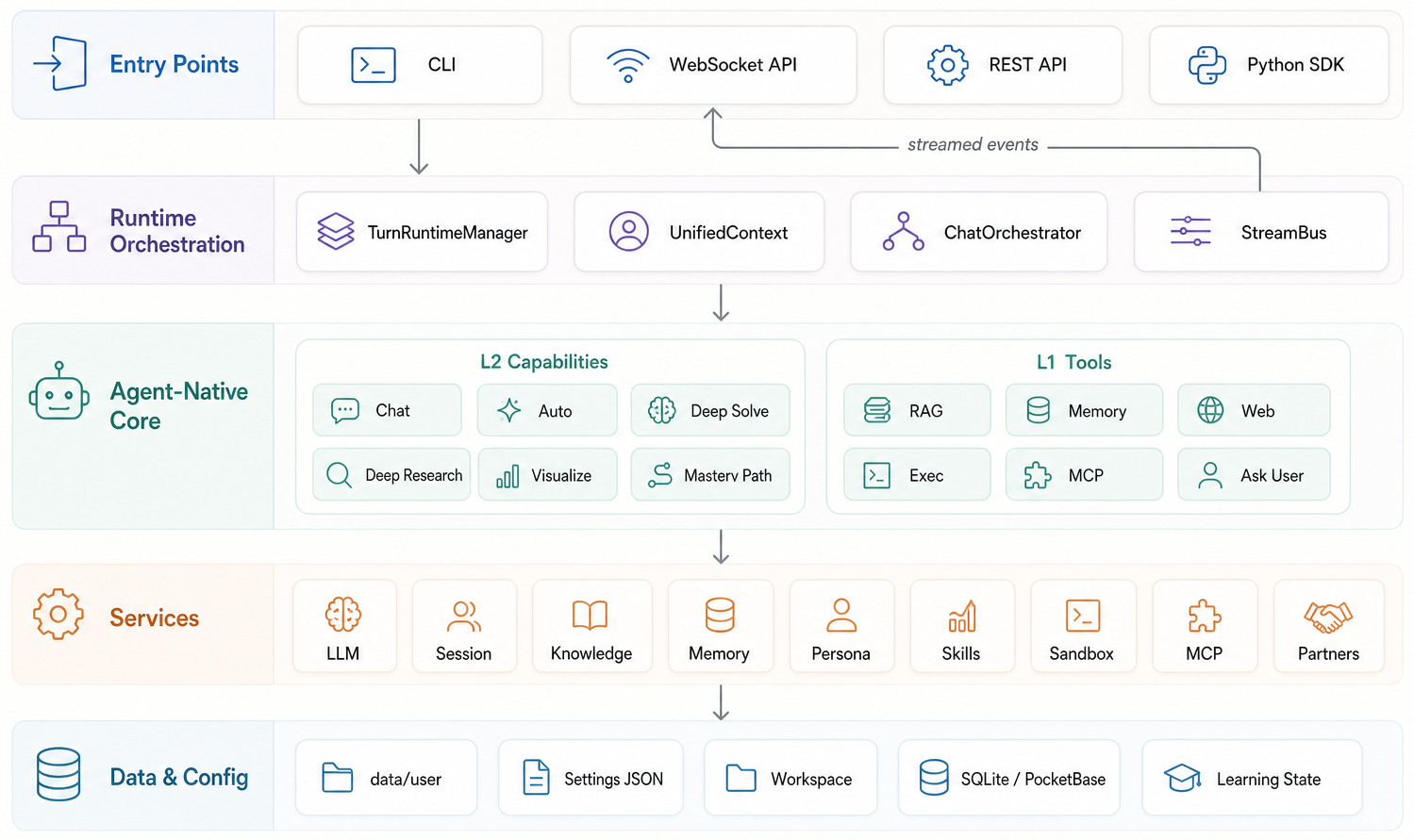
This diagram is suitable for explaining the DeepTutor system composition: front-end learning space, back-end agent loop, knowledge base/RAG, tools/capabilities, memory, models and external integration together constitute a scalable learning system.
2.3 Chat Agent Loop
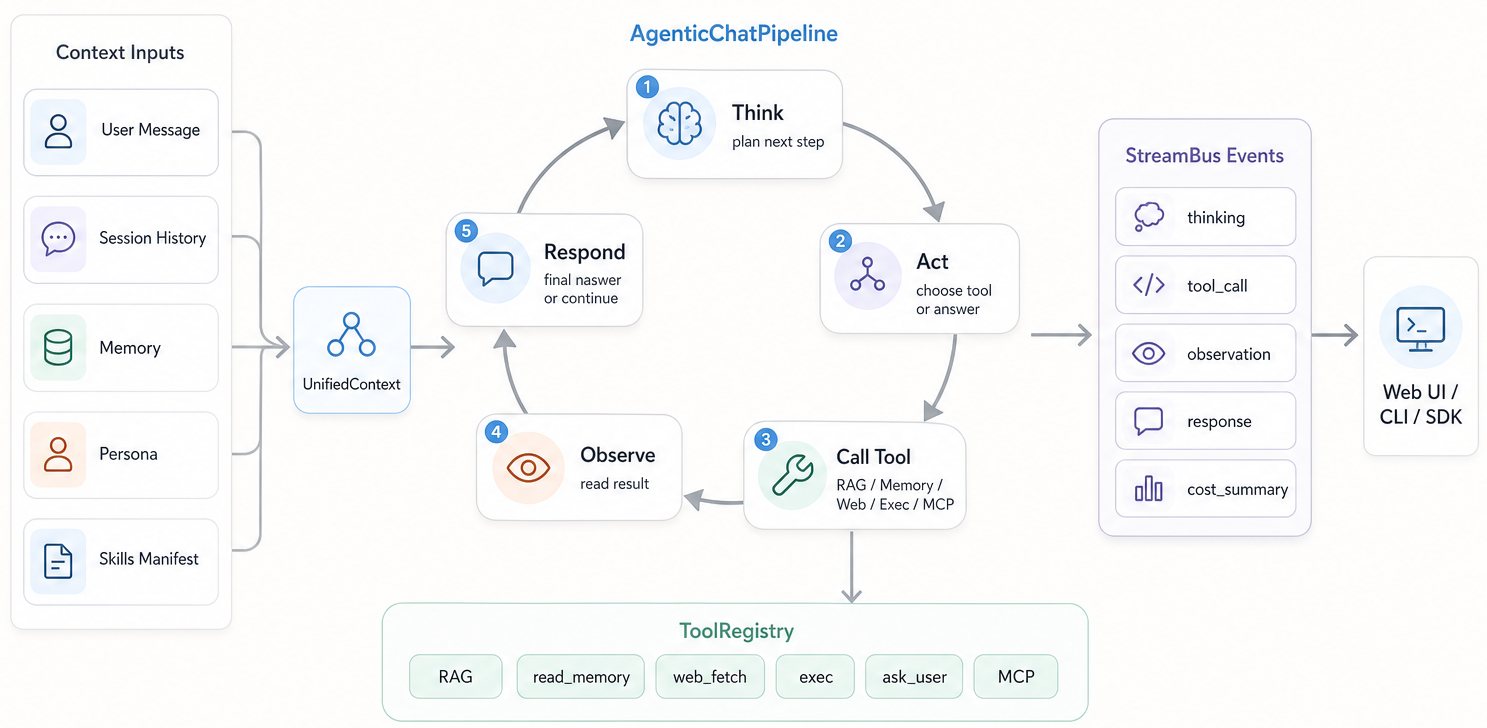
Chat is the default entry, but the underlying is not a simple question and answer, but an agent loop: the model can think, call tools, observe results, continue reasoning, and when necessary, pause through the ask_user and clarify to the user.
2.4 Knowledge Center
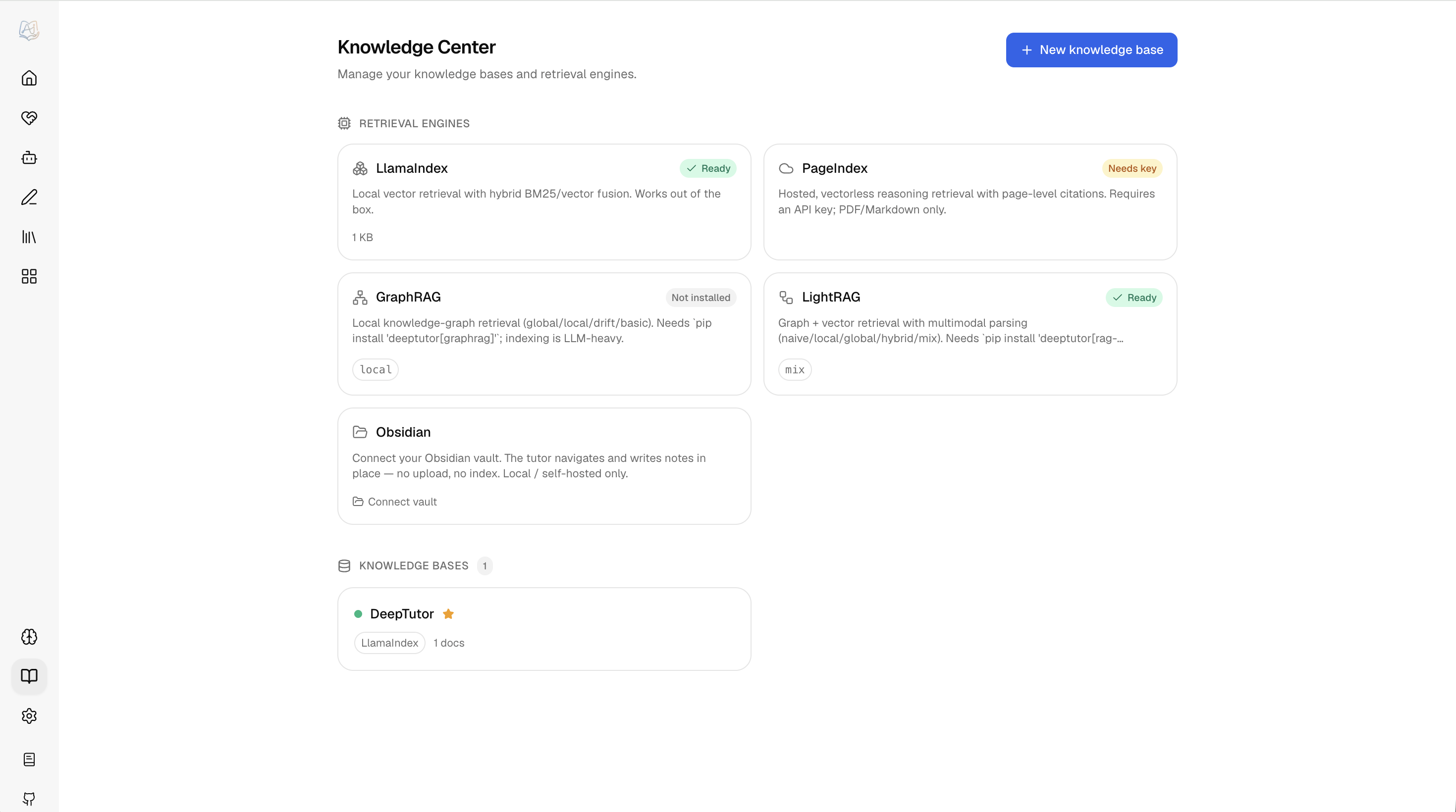
Knowledge Center is a DeepTutor RAG center that supports multiple knowledge base/retrieval modes such as LlamaIndex, PageIndex, GraphRAG, LightRAG, LightRAG Server, Obsidian vault, etc.
2.5 Memory Graph
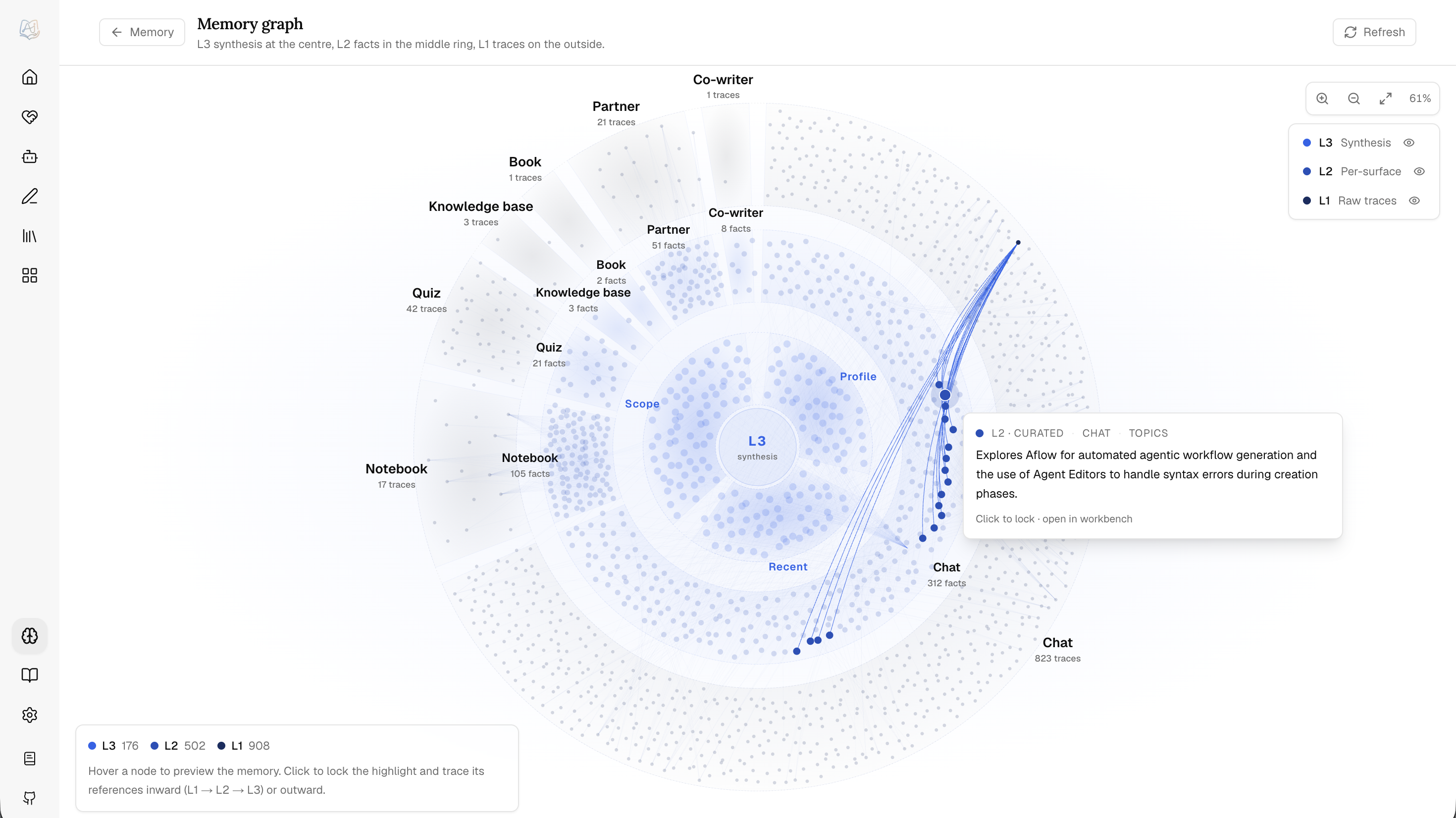
The DeepTutor Memory is a three-tier auditable structure: L1 original event tracking, L2 surface-organized facts, and L3 cross-surface comprehensive portrait. It can be said before sales as a "traceable portrait of the learner", not a hidden black box memory.
2.6 Book Living Book
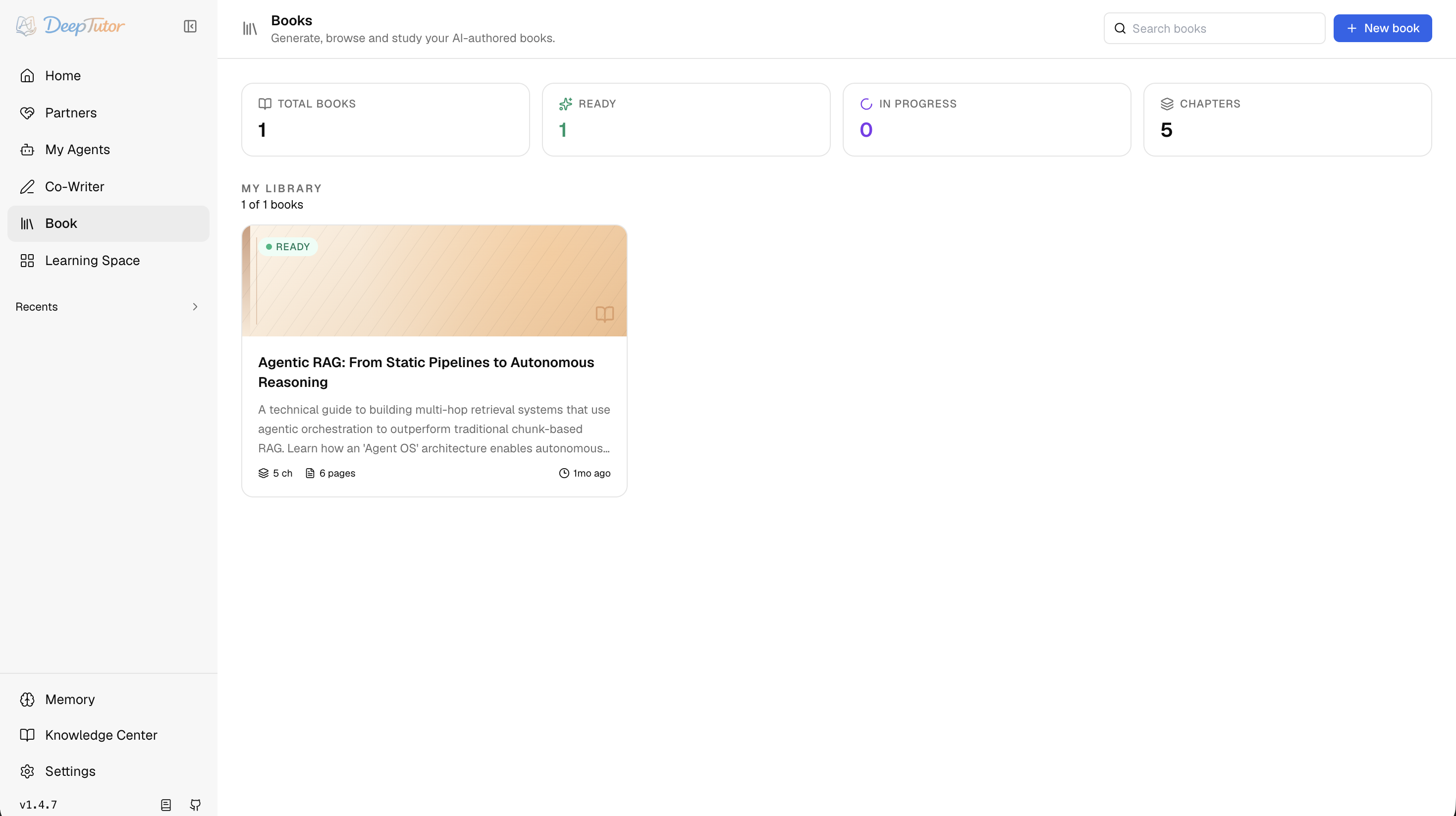
Book can turn knowledge bases, notes, question banks, or chat history into interactive live books containing text, quizzes, flashcards, timelines, code, graphics, interactive HTML, animations, concept maps, and page-level chats.
3. What can it mainly do
DeepTutor can be understood as an "educational AI agent workspace". It combines capabilities common in learning products:
| Capabilities | Descriptions | Pre-Sales Value |
|---|---|---|
| Chat | Default dialog portal, callable tools, read knowledge base, process attachments, write to notebooks, use memory | Students/teachers can start from the natural language portal |
| Deep Solve | for problem solving, reasoning, explanation steps | suitable for mathematics, programming, engineering, science topic explanation |
| Deep Question | Generate tests, questions, exercises | Suitable for after-school exercises, knowledge consolidation, self-test |
| Deep Research | for research reports and data summary | suitable for research study, paper/topic data collation |
| Visualize | Generate diagrams, visualizations, interactive content | Help abstract concepts materialize |
| Math Animator | Generate Math Animation Based on Manim | Suitable for Math/Physics Concept Teaching Demonstration |
| Mastery Path | Mastery Path and Phased Practice | Support Personalized Learning Path and Competency Diagnosis |
| Knowledge Center | Multi-Engine Knowledge Base/RAG | School, Institution, Course Materials as Trusted Knowledge Source |
| Memory | Three layers of auditable learning memory | Continuous formation of learning portraits, preferences and weak points |
| Book | Generate interactive live books | Turn course content into readable, practical and informative learning resources |
| Co-Writer | Markdown Writing/Rewriting Workspace | Suitable for composition, report, paper, lesson plan co-creation |
| Partners | Persistence IM Partner, Multi-channel Accompanying Learning | Connect AI Teaching Assistants to Slack, Flying Books, Enterprise WeChat, etc. |
| My Agents | Connect to local Claude Code, Codex, Gemini, Kimi, etc. | Suitable for programming learning and developer education scenarios |
| EduHub Skills | Education Skills Community | Support Socratic Tutors, Flash Cards, Essay Feedback and other skills extensions |
4. Core Design Understanding
4.1 is not a "question and answer robot", but a unified learning runtime
Many educational AI products have made multiple decentralized functions: a page question and answer, a page generation topic, a page making courseware, and a page reading document. The DeepTutor difference is that Chat, Quiz, Research, Visualize, Solve, and Mastery Path run on the same agent loop. Users switch to learning goals, not to change a set of isolated engines.
Before the sale can say:
the DeepTutor idea is to unify the learning activities into a continuous context: what students have asked, what they have read, what they have practiced, what they have missed and what they have saved can be reused by subsequent learning activities.
4.2 RAG is not just data retrieval, but part of the learning context
The DeepTutor knowledge base supports several search engines:
-LlamaIndex: default, local vector BM25.
-PageIndex: Managed, inferential retrieval of page-level references.
-GraphRAG/LightRAG: Knowledge map search.
-LightRAG Server: Connect to an external LightRAG instance.
-Obsidian vault: direct link Obsidian note library, read and write in-situ content.
Document parsing can also be switched: Text-only, MinerU, Docling, markitdown, PyMuPDF4LLM, etc.
This is of great significance to the educational scene: teaching materials, courseware, lecture notes, exercises, student notes and teacher lesson plans of schools and training institutions can all enter the knowledge base and become the basis for AI guidance.
4.3 Memory is an auditable portrait of personalized learning.
DeepTutor divide memory:
| Level | Description | Pre-Sales Explanation |
|---|---|---|
| L1 | Original Event Tracking, append-only trace | What did the students do, ask and answer |
| L2 | Faces by Surface | A partial summary of different learning activities |
| L3 | Cross-surface synthesis | Learner profile, recent status, preferences, weak points |
It emphasizes that L2 refers to L1 and L3 refers to L2, so the memory conclusion can be traced back. This is very suitable for educational compliance and home-school communication: it is not just "AI that this student does not understand functions", but should be traceable to specific exercises and dialogue evidence.
4.4 Skills and EduHub: Education Scenario Scalable
DeepTutor using the open Agent-Skills format, the skill is a folder containing 'SKILL.md. EduHub is its built-in educational skills registry, which supports searching, installing and publishing teaching skills, such:
-Socratic tutor.
-Flash card generator.
-Composition feedback.
-Examination blueprints.
-Concept interpreter.
-Review plan generation.
This is very useful for pre-sales, because customers often want to deposit their own teaching methods, course SOPs, problem-solving specifications, and marking rules instead of general AI. Skills offers a lighter-weight approach to "teaching ability encapsulation.
4.5 Partners and multi-channel companion learning
DeepTutor Partners can be understood as "persistent learning partners with their own personality, knowledge base, skills and memory" and can access IM channels. The channels mentioned in README/release include flying book, Slack, Mattermost, enterprise WeChat, DingTalk, Telegram, Zulip, Matrix and other related SDK/channel capabilities.
Pre-sales can map it:
-AI teaching assistants in the class group.
-Q & A partner in the course program group.
-Learning reminder/answering assistant in enterprise training group.
-Code teaching assistant in programming learning group.
5. Applicable Scenario
5.1 K12/University Intelligent Assistant
DeepTutor suitable for a student-oriented "learning workbench":
-Students upload courseware, teaching materials, handouts.
-AI based on course knowledge base to answer questions.
-Generate variant questions and quizzes for wrong questions.
-Record weak points via Memory.
-Generates a staged Mastery Path.
-Put chapter knowledge into Book Living Book.
Customer Value:
-Reduce the pressure on teachers to answer questions repeatedly.
-Give students more continuous personalized tutoring.
-Precipitate learning behavior into analyzable data.
Personalized Learning Products of 5.2 Education and Training Institutions
Teaching and training customers are often concerned about "how to scale to provide an experience similar to one-on-one counseling". DeepTutor can be used as product prototype reference:
-Unified course materials and question bank.
-Students get personalized AI coaching.
-The learning path changes according to the exercise performance.
-Wrong questions, notes, question and answer and question bank linkage.
-The teaching and research team encapsulates their teaching strategies into skills.
Suitable for English, mathematics, programming, postgraduate entrance examination, vocational qualification examination, such as the need for continuous practice and feedback of the scene.
5.3 enterprise training and post learning
In-house training often has a large number of systems, products, sales skills, technical documents, and operation manuals. DeepTutor can be used:
-New employee learning path.
-Product/program knowledge Q & A.
-Sales/pre-sales aptitude test.
-Role-playing Q & A and walkthroughs.
-Compile the knowledge base into an interactive learning manual.
In this scenario, Memory can record the learning progress of employees, the Knowledge Center can connect to enterprise data, and the Co-Writer can assist in writing plans/reports.
5.4 AI programming education and developer training
DeepTutor My Agents can access local or external coding CLI such as Claude Code, Codex, Gemini, Kimi, opencode, and MiMo. Suitable for:
-Programming class AI teaching assistant.
-Step-by-step explanation of code questions.
-Code review and debugging in project-based learning.
-Let students ask concepts, write code, and call coding sub-intelligences in the same learning space.
In such scenarios, DeepTutor can be combined with code warehouses, course documents, question banks, and programming practice platforms.
5.5 teachers' lesson preparation, textbook reprocessing and interactive courseware
Book, Co-Writer, Visualize, Math Animator are also valuable to the teacher side:
-Generate handouts into chapter outlines.
-Generate interactive courseware, concept maps, quiz blocks.
-Convert the content of the textbook into a "living book".
-Expand, rewrite and generate examples of a lesson plan.
-Generate mathematical animation with Manim.
Don't just talk about the student side before sales, the teacher side can also form a clear value.
6. Not quite the scene
| Scenario | Reason |
|---|---|
| Only simple chatbots are required | Overweight DeepTutor, costly to deploy and configure |
| Want to use SaaS out of the box | The project is an open source local/self-hosted form, and README clearly does not currently have a paid online product |
| Schools/institutions without technical teams | Require configuration such as model, embed, RAG, Docker/port, permissions, etc. |
| High compliance requirements for learning data but no governance ability | Student data, memory, dialogue, topics and API Key all need serious governance |
| Large-scale examination formal scoring system | LLM generation/evaluation must be reviewed, interpretable, and appealing, and is not suitable as the sole basis for scoring |
| As long as the question bank management system | DeepTutor is a AI learning workspace, not a traditional question bank background |
| Requires localization/offline integration but no model infrastructure | Can connect to local models, but needs to verify model capability, hardware and deployment complexity |
7. How to install and use
7.1 PyPI installation
Full Local Web App CLI:
mkdir -p my-deeptutor && cd my-deeptutor
pip install -U deeptutor
deeptutor init
deeptutor start
Default port:
-Back end: '8001'
-Front end: '3782'
Open after startup:
http://127.0.0.1:3782Requirements:
-Python '>=3.11,<3.14'
-PyPI package 1.5.4 uploaded on 2026-07-24
-Node.js runtime is also required for complete Web applications. README Chinese version mentions Node.js 20, and source code development suggests Node.js 22 LTS
7.2 Docker Installation
docker run --rm --name deeptutor \
  -p 127.0.0.1:3782:3782 \
  -v deeptutor-data:/app/data \
  ghcr.io/hkuds/deeptutor:latest
Only the '3782' port needs to be published. The front end forwards '/api/' and '/ws/' to the FastAPI back end through the Next.js middleware in the container. Data, configuration, API Key, log, workspace file, memory and knowledge base are saved in deeptutor-data '.
7.3 source code installation
git clone https://github.com/HKUDS/DeepTutor.git
cd DeepTutor
python3 -m venv .venv && source .venv/bin/activate
python -m pip install --upgrade pip
python -m pip install -e .
( cd web && npm ci --legacy-peer-deps )
deeptutor init
deeptutor start
7.4 CLI usage
deeptutor chat
deeptutor chat --capability deep_solve --kb my-kb --tool rag
deeptutor run chat "解释傅里叶变换"
deeptutor run deep_research "调研 2026 年 RAG 论文" \
  --config mode=report --config depth=standard
Machine-readable mode:
deeptutor run deep_solve "Find d/dx[sin(x^2)]" --tool reason --format json'-- format json' outputs NDJSON, which is suitable for being called by other agents or automation systems.
8. Deployment and integration methods
8.1 single-user local learning space
The default certification is closed, suitable for personal learning, teacher lesson preparation, developer trial. The data is placed under 'data/'in the current working directory, which can also be specified with 'DEEPTUTOR_HOME or 'deeptutor start -- home.
8.2 Docker self-hosting
Suitable for pilot within schools/institutions. Both the FastAPI backend and the Next.js frontend run in the container, and the data directory is mounted to the host. Common reverse proxies only need to proxy the frontend '3782', and the API is forwarded by the frontend server.
8.3 multi-user shared deployment
DeepTutor support optional authentication and quarantine workspaces:
data/
├── user/                    # 管理员工作区 + 全局设置
├── users//             # 每个用户的聊天历史、记忆、笔记本、知识库
├── partners//workspace/ # Partner 工作区
└── system/                  # auth/users.json、grants、audit
The first registered user becomes an administrator and can be assigned model, knowledge base, skills, Partner, tools/MCP policies, and code execution permissions. For education clients, this means segregation and empowerment by class, teacher, student. However, multi-user deployments still require strict validation of the permission model and data isolation.
8.4 model and knowledge base integration
The model level supports multiple provider, including OpenAI, Anthropic, DashScope, Perplexity, NVIDIA NIM, Gemini, local Ollama/LM Studio/llama.cpp/vLLM/Lemonade, and other related directions. The specific support varies with the version, and the actual configurable items of Settings → Models shall prevail in PoC.
The knowledge base level can be connected:
-Document upload.
-LlamaIndex local vector BM25.
-PageIndex.
-GraphRAG.
-LightRAG/LightRAG Server.
-Obsidian vault.
-Different document parsing engines.
9. What can I say before sales
9.1 Recommended Opening
DeepTutor is not a single point of AI answer robot, but a AI learning workspace built around the continuous context of the learner. It puts question answering, problem solving, testing, research, courseware generation, knowledge base, learning memory and multi-channel teaching assistants in an agent-native runtime, so that AI can not only answer a question, but also continuously understand a student, a textbook, a course and a learning goal.
9.2 three core selling points
| Selling Point | Customer Language |
|---|---|
| Personalized continuous learning | "Students don't ask AI from scratch every time. The system retains learning history, weak points, preferences and mastery paths." |
| Activation of Teaching Resources | "Teaching materials, lecture notes, courseware and question bank can not only upload and retrieve, but also generate interactive books, tests, illustrations, animations and page chats." |
| Self-hosted and scalable | "Schools/institutions can bring their own knowledge base, models, skills, IM channels and teaching SOPs into it." |
9.3 Demo Story Line
A 30-minute presentation for educational clients:
- Create a course knowledge base and upload PDF/handouts.
- Answer student questions based on the knowledge base in Chat and demonstrate the citation/retrieval process.
- Use Deep Solve to solve a course problem and require step-by-step explanation.
- Use Deep Question to generate tests for the same knowledge point.
- Generate the chapter materials into Book, and display quiz block, interactive block, and page chat.
- Open the Memory Graph and explain how learning portraits can be traced back.
- Show the question bank, notebook, persona and skill in the Learning Space.
- Demonstrate models, knowledge bases, tools, and multi-user control in the Settings.
9.4 speech for different customer roles
| Customer Roles | Concerns | Words |
|---|---|---|
| Principal/Head of Organization | Cost Reduction and Efficiency Increase, Personalized Scale | "Standardize and scale the answering, questioning, practice and feedback parts of one-on-one tutoring with AI." |
| person in charge of teaching and research | reuse of teaching quality and lesson plan item bank | "deposit existing teaching materials, lecture notes, item bank and teaching and research methods into reusable knowledge bases and skills." |
| front-line teacher | reduce repeated answering questions and prepare lessons | "the AI is responsible for preliminary answering questions, topic variation and interactive courseware. the teacher reserves the right to review and design teaching." |
| Informatization/Technical Leader | Deployment, Security, Integration | "Supports local/container deployment, multi-model, multi-knowledge base, permission and data directory isolation, but requires PoC verification." |
| Parent/Student | Personalization, Companion, Effect | "The system will continue to practice around the student's weak points instead of giving general answers every time." |
10. PoC Recommendations
10.1 PoC Target
It is recommended that PoC be defined:
verify whether the DeepTutor can be used as a AI personalized learning space for a certain course/certain type of training, realizing data access, knowledge-based answering, topic explanation, exercise generation, learning memory and teacher review closed loop.
10.2 PoC Data Preparation
| Data | Suggested quantity |
|---|---|
| Lecture Notes/PDF | 5-20 copies |
| Typical Topics | 50-100 |
| student history wrong questions/answer records | optional, 10-30 samples |
| Teacher Standard Explanation | 10-20 Knowledge Points |
| Course Outline | 1 Set |
| Teaching Specifications/Grading Criteria | 1 Set |
10.3 PoC tasks
| Task | Verification Point |
|---|---|
| Knowledge Base Creation | Whether the document parsing is complete and whether Chinese formulas, tables, and pictures are supported. |
| Answer questions based on materials | Answer whether to quote course materials and whether to have less illusion |
| Step-by-step problem solving | Can you give steps suitable for students' level |
| Automatic Question | Difficulty, Knowledge Coverage, and Answer Analysis Available |
| Mastery Path | Whether learning paths can be generated based on performance |
| Book Generation | Chapter Structure, Interactive Blocks, Test Blocks Suitable for Teaching |
| Memory Audit | Whether the learning portrait can be traced, edited or deleted |
| Multi-user isolation | Whether to isolate student data, API Key, and knowledge base permissions |
| Teacher Review | Can teachers view, correct, save and reuse content |
10.4 evaluation index
| Indicator | Description |
|---|---|
| Correct answer rate | Compared with teachers' standard answers |
| Reference accuracy | Whether it is truly based on the specified knowledge base |
| Step-by-step presentation quality | Whether it conforms to the student's grade and course style |
| Question Quality | Whether to cover knowledge points, controllable difficulty and clear answer |
| Personalized Validity | Can I adjust subsequent exercises based on historical errors |
| Interactive Experience | Streaming Response, Interface Stability, Chinese/Formula/Table Rendering |
| Data Analysis Quality | PDF, PPTX, docx, Picture, Formula Processing Effect |
| Management Capabilities | Whether users, permissions, knowledge bases, models, and logs are controllable |
| Security Compliance | Student Privacy, Code Execution, External Model Calls, Data Retention |
| Operational complexity | Docker, Node, Python, models, vector libraries, and storage costs |
10.5 PoC cycle
Recommended 2-4 weeks:
-Week 1: Deployment, Model Configuration, Knowledge Base Import, Core Function Run-through.
-Week 2: Teachers/teaching and research create test questions and explanations, and collect quality feedback.
-Week 3: Small-scale student trial, observation experience, accuracy and personalization.
-Week 4: Security, permissions, operations, costs and secondary development assessment.
11. Risks and Considerations
11.1 Education Compliance and Minor Data
If used in K12 or minor scenarios, focus on:
-Student personal information and learning behavior data.
-Whether the dialogue content, wrong questions and ability portrait can be deleted.
-Whether the parent/school is informed and authorized.
-Whether to call the overseas model API.
-Whether unnecessary external services can be turned off.
-Learning whether the portrait may cause labeling or discriminatory judgments.
11.2 LLM Illusion and Teaching Responsibility
DeepTutor enhances the learning experience, but does not take AI answer as absolutely correct. Formal teaching requires:
-Teachers review key content.
-High risk answers retain references and reasoning process.
-Set boundaries for exam scoring, recommendations for further studies, psychological advice, etc.
-- Show students a "AI can go wrong" tip.
11.3 Deployment Complexity
DeepTutor is a complete learning platform, not a lightweight plugin. It involves:
-Python dependency.
-Next.js front end.
-FastAPI the back end.
-Multi-model configuration.
-Embed models and RAG.
-Document parsing engine.
-Docker/Podman.
-Multi-user permissions.
-Optional code execution sandbox.
Pre-sales to avoid the commitment to "one day online enterprise production". PoC can be fast and production requires engineering.
11.4 code execution and skill security
DeepTutor support Office skills, model generation code execution, skills import, MCP/tools, and more. These are strong extension points and security boundaries:
-Untrusted skills need to be audited.
-Code execution should be sandboxed or sidecar enabled.
-Multi-user deployment to restrict common user tool permissions.
-API Key should not be exposed to students.
-Although EduHub/ClawHub skills import has security gates, it still requires internal review of the organization.
11.5 Project Maturity
DeepTutor star is fast-growing and release-intensive, it is a rapidly evolving open source project. The latest release v1.5.4 is still frequently fixing chat responses, IM tables, LLM JSON parsing, KB forms and other issues. This means that the project is active, but it also means that the interface, experience, and deployment methods may change.
12. Relationship with adjacent products/solutions
| Type | Difference DeepTutor |
|---|---|
| Common AI Chatbot | DeepTutor Knowledge Base, Memory, Question Bank, Book, Mastery Path, Tools and Multi-surface Context |
| RAG Question Answering System | DeepTutor not only retrieve data, but also turn it into learning activities and personalized paths |
| LMS/Educational Administration Platform | DeepTutor prefer learning interaction and AI guidance, not course registration, course scheduling, performance management system. |
| question bank/question brushing system | DeepTutor can generate/save/explain questions, but it is not the background of traditional question bank operation |
| teacher lesson preparation tools | DeepTutor Co-Writer, Book, Visualize, Math Animator, but more complete and more complex |
| Multi-Agent Framework | DeepTutor has made a product surface and learning context for educational scenarios, instead of a general agent orchestration library |
13. My Pre-Sales Judgment
DeepTutor is an open source project that fits well as a "product blueprint for educational AI. Its value is not that a certain function is particularly new, but that a group of abilities that educational AI should have are put into the same context: curriculum knowledge base, student memory, topic generation, problem solving explanation, research report, interactive book, teacher writing, skill ecology, IM assistant, multi-user isolation and CLI/Agent interface.
For pre-sales, it is especially suitable for use in the following directions:
-Smart teaching assistant/AI class teacher.
-Personalized learning space.
-AI topic explanation and exercise generation.
-Teacher lesson preparation and interactive textbook generation.
-Enterprise training intelligent learning platform.
-Programming Education Agent Workbench.
But it's more like a self-hosted open source platform/product prototype, not a full-fledged SaaS that can be sold directly to schools. When it comes to the ground, the most important thing is three things:
- The course content and the quality of the question bank should be better, otherwise the AI is only the packaging layer.
- The boundaries of teacher audit and teaching responsibility should be clearly designed.
- Student data, model calls, permissions and code execution security must go through compliance review first.
If the customer has a technical team, clear curriculum resources and personalized learning demands, it is DeepTutor worth doing PoC. If the customer only wants a lightweight AI question-and-answer portal, the DeepTutor may be biased. You can only learn from the design ideas of Knowledge Center, Memory, Book and Skills instead of introducing them completely.
14. REFERENCE
-GitHub repository: https://github.com/HKUDS/DeepTutor
-Official project page: https://deeptutor.info/
-Official Document Entry: https://deeptutor.info/
-arXiv Paper: https://arxiv.org/abs/2604.26962
-PyPI package: https://pypi.org/project/deeptutor/
-Latest Release v1.5.4:https://github.com/HKUDS/DeepTutor/releases/tag/v1.5.4
-Chinese README:https://github.com/HKUDS/DeepTutor/blob/main/assets/README/README_CN.md
-Containerized documents: https://github.com/HKUDS/DeepTutor/blob/main/CONTAINERIZATION.md
-Roadmap:https://github.com/HKUDS/DeepTutor/issues/498
-EduHub:https://eduhub.deeptutor.info/