2. Basic Project Information
| Dimension | Information |
|---|---|
| GitHub | langchain-ai/deepagents |
| Official Documentation | Deep Agents Docs |
| PyPI | deepagents |
| Open Source License | MIT |
| Main Language | Python |
| Python requires | >= 3.11, <4.0 |
| Current PyPI stable version | 0.6.12 |
| GitHub Description | The batteries-included agent harness. |
| Ecological dependence | LangChain, LangGraph, LangSmith |
| Model compatibility | Supports models with tool calling capabilities, including commercial models, open source models, and local models. |
As of 2026-06-30,GitHub warehouse is about 25k stars and 3.5k forks, and the update is very active, indicating that it is in a rapid evolution stage and is suitable for technical pre-research and PoC. However, it needs to lock the version, do security boundary and stability verification before formal production and landing.
3. What can it mainly do
The core competence of Deep Agents can be understood as "giving large models a controlled working environment".
3.1 long task execution
Ordinary LLM calls are usually "one question and one answer", while Deep Agents is oriented to multi-round, multi-step, long-time tasks. It has built-in task planning tools that can maintain to-do lists and break complex goals into multiple steps to continuously advance.
Typical example:
-Automatically complete a research report: search for information, read documents, organize conclusions, and generate Markdown.
-Automate code tasks: read warehouse, locate problems, modify files, run tests, summarize changes.
-Automatically complete data analysis: read files, write scripts, perform analysis, output charts and interpretation.
3.2 sub-agent collaboration
Deep Agents has a built-in 'task' tool that allows the master agent to create temporary sub-agents. Each sub-Agent has an independent context, suitable for processing isolated sub-tasks, and finally only returns the results to the main Agent.
Pre-sales value:
-For complex customer tasks, you can split "research", "data cleaning", "code checking" and "report writing" into different sub-agents.
-Reduce the risk of a single context window being stuffed.
-Closer to the division of labor in real enterprise processes.
3.3 Virtual File System
Deep Agents provides documentation tools such:
| Tools | Effects |
|---|---|
| 'ls' | Column directory |
| 'read_file' | Read files, support reading large file segments |
| 'write_file ' | Write file |
| 'edit_file' | Modify file |
| 'glob' | Find files by pattern |
| 'grep' | Search file contents |
| 'execute' | Execute shell commands in the sandbox backend |
These capabilities enable the Agent not only to "answer", but also to deposit intermediate results, read and write context, and execute scripts in the workspace, which is suitable for internal knowledge processing, code processing, and automated office scenarios.
3.4 Context Management
Deep Agents provides several types of contextual engineering capabilities for long tasks:
-Skills: Load specific competencies and domain knowledge on demand.
-Memory: Save long-term preferences, specifications and project descriptions through mechanisms such as 'AGENTS.md.
-Summarization: Compress long conversations and large tool results.
-Context offloading: offloading large results to the file system to reduce the pressure on the context window.
-Subagent isolation: Let the subtask execute in an isolation context and return only the final summary.
This is critical for pre-sales PoC, because the common pain points of customers are: "Agent forgets what it did before running for a while," "the tool results are too long to plug the context," "complex tasks are getting more and more chaotic". Deep Agents is solving these engineering problems.
3.5 permissions and manual approval
Deep Agents supports file system permission rules to restrict which paths an agent can read and which paths it can write. It also supports human-in-the-loop, which can be interrupted before sensitive tools are called, allowing approval, modification, or rejection.
Suitable for customers to emphasize:
-Agent capability boundaries should be defined by tools and sandboxes.
-For high-risk operations such as deleting, writing libraries, sending requests, and calling external systems, manual approval must be configured.
-Instead of giving all system permissions to the model, the scope of model action is controlled through engineering boundaries.
3.6 MCP and External Tool Access
Deep Agents supports custom functions, LangChain tools, and MCP server tools. For enterprise customers, this means access:
-Database
-Internal API
-CRM/ERP/Work Order System
-Document Library
-Search system
-File System
-Automated Scripting
4. Official Schematic and Architecture Understanding
4.1 Official Capabilities Overview Chart
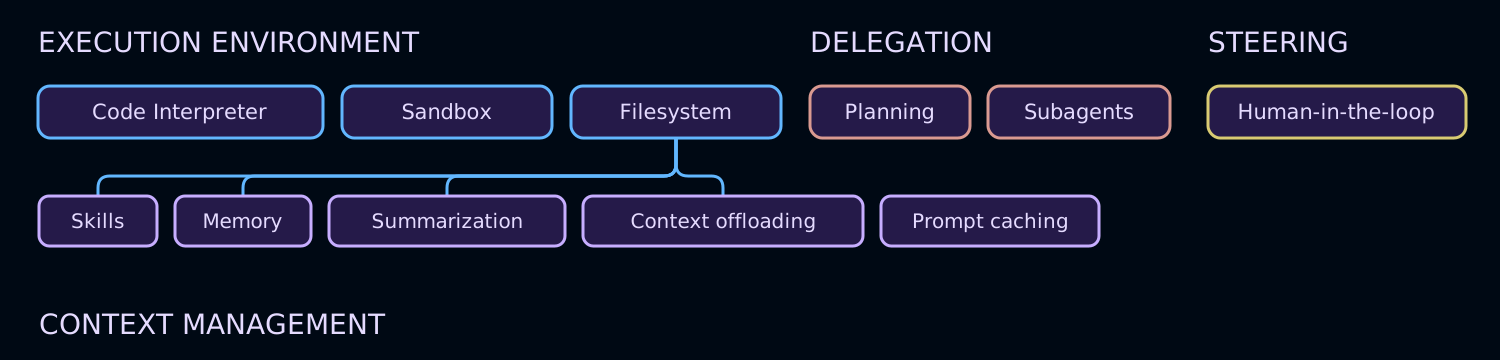
This official documentation chart shows the capability categories that Deep Agents cover as Agent Harness: execution environment, context management, task delegation, human intervention, and continuous improvement.
4.2 Relationship between Deep Agents and LangChain/LangGraph
开箱即用 Harness:默认能力、middleware、backend、profile"] --> B["LangChain
模型、工具、中间件、Agent 抽象"] B --> C["LangGraph
状态、checkpoint、streaming、interrupt、持久运行时"]
It can be understood as follows:
-LangGraph is the underlying runtime, responsible for state, streaming output, checkpoint, interrupt, etc.
-LangChain provide models, tools, middleware, and agent abstractions.
-Deep Agents preset a set of default combinations for complex tasks on the upper layer, so that developers do not need to build an Agent engineering skeleton from scratch.
4.3 Project Comes with Sample Chart: Better Harness
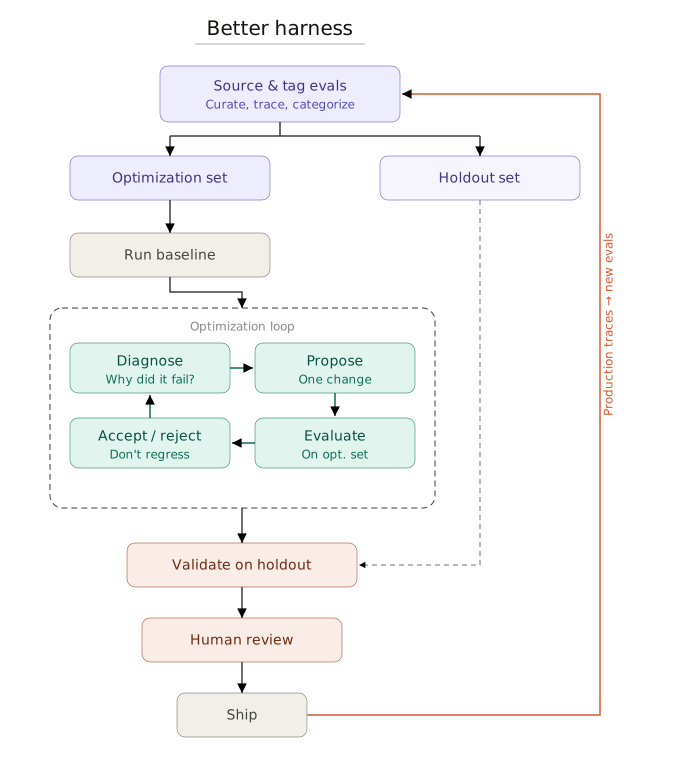
The better Harness example shows the cycle of "one deep agent optimizes the Harness of another agent": run the baseline first, then let the outer agent modify the prompt, tool, skill or middleware, and finally use train/holdout eval to determine whether to keep the modification. This is of great reference value for doing Agent automatic optimization and evaluation-driven iteration.
Sample diagram of 4.4 project: Ralph Mode
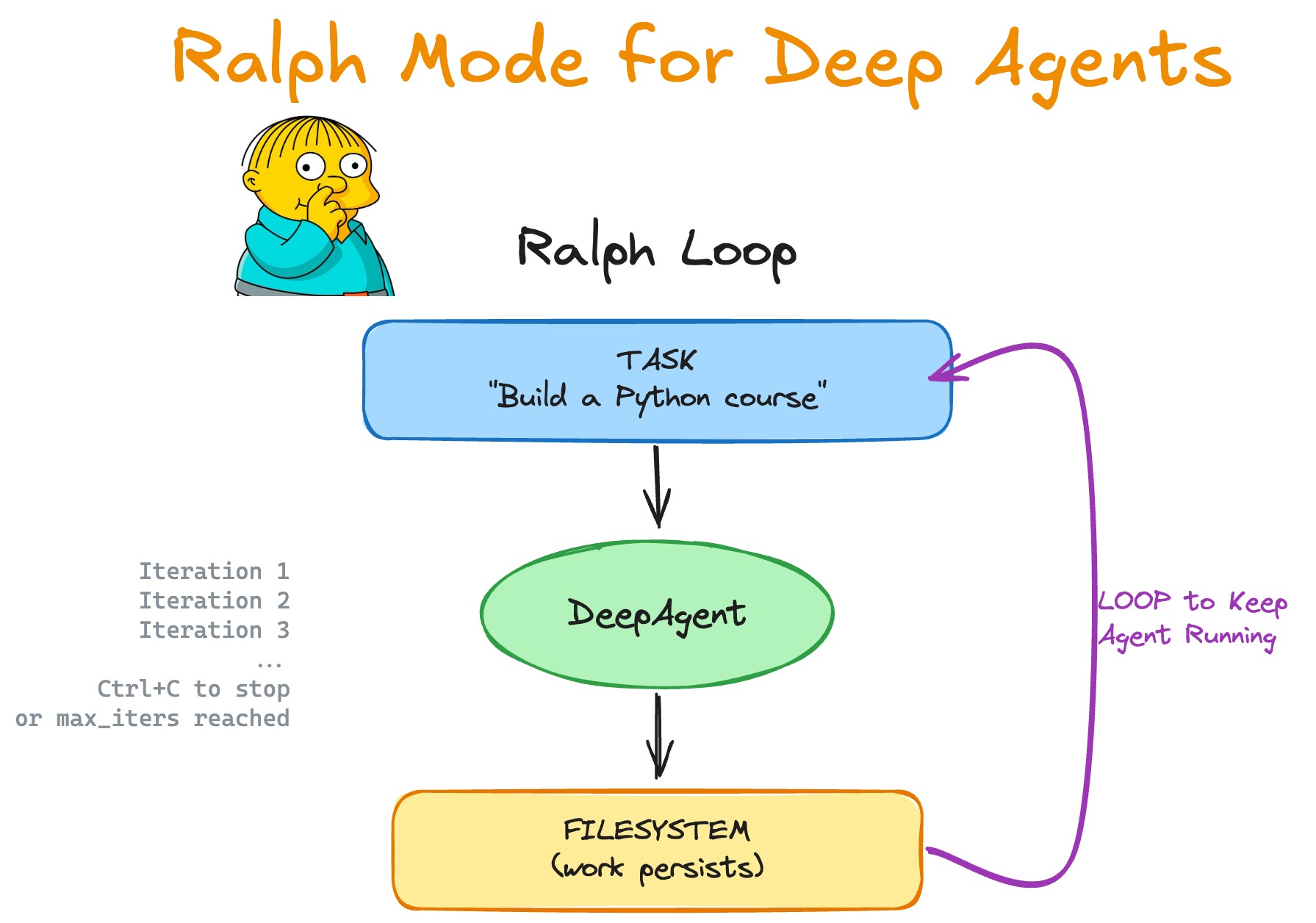
Ralph Mode is an autonomous loop mode: each round starts the agent with a new context, but the progress is preserved through the file system and Git. It emphasizes the long task mode of "context reset file system memory", which is suitable for building continuous push tasks such as courses, applications and code projects.
4.5 Project Comes with Sample Chart: Text-to-SQL LangSmith Trace
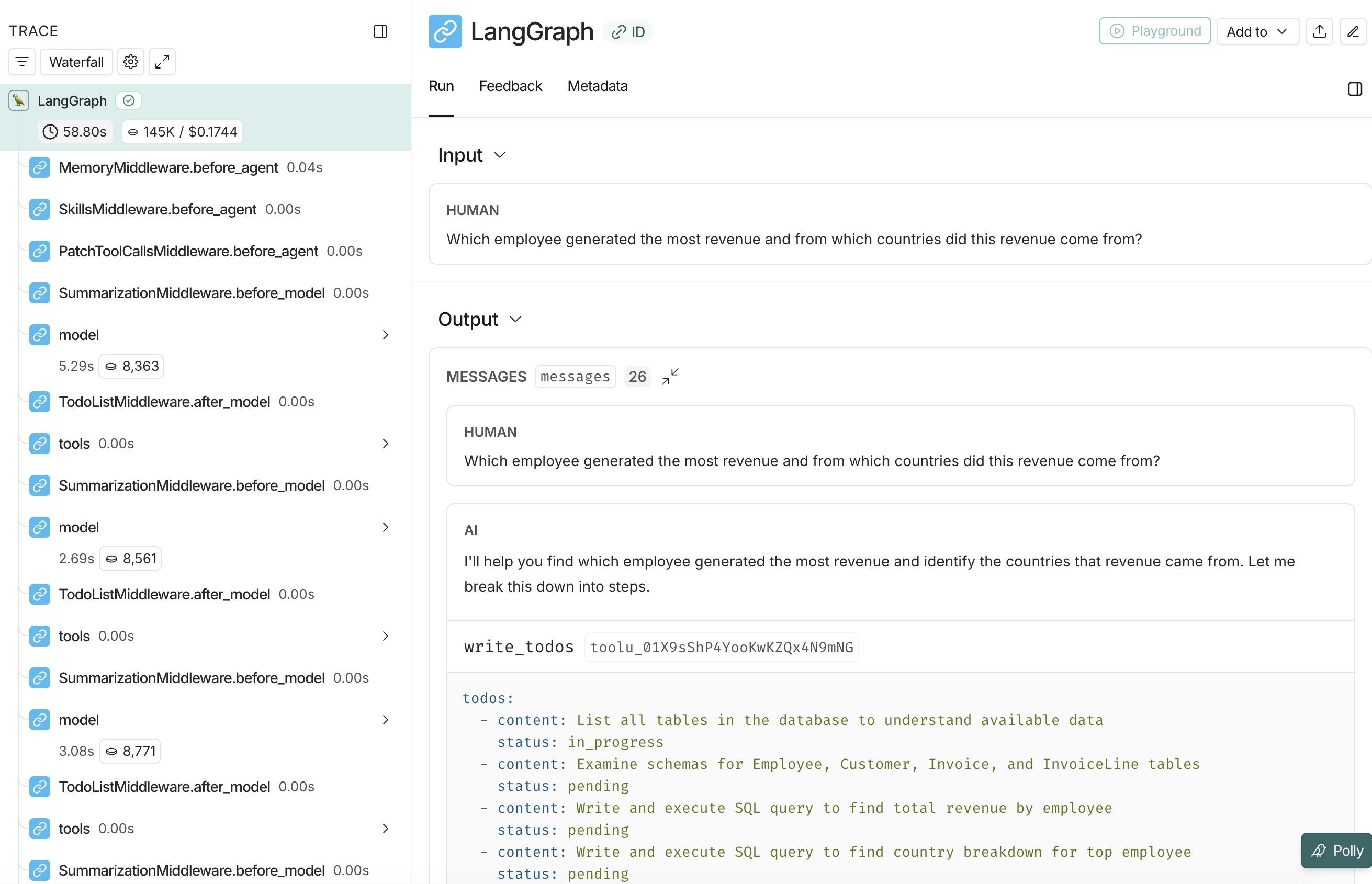
This example shows that Deep Agents can be tracing, debugged, and evaluated when combined with LangSmith, which is important for observability, problem tracking, and effect evaluation when enterprises land.
5. Applicable Scenario
5.1 Enterprise Knowledge Work Automation
Suitable for tasks:
-Industry/Competition/Policy/Technical Research
-Arrangement of bidding data
-Pre-sales plan first draft generated
-Multi-document reading, summarization, comparison and reference
-Customer data archiving and insight extraction
Customer Value:
-Automate the repetitive work of "finding materials, reading materials, sorting out structures and writing first drafts.
-Intermediate results are deposited through the file system, which can be audited and reused.
-Can be combined with manual approval to ensure final output quality.
5.2 software development and code assistant
Suitable for tasks:
-Warehouse understanding
-Bug positioning
-Small range code modifications
-Test execution and repair
-PR Summary
-Document generation
Deep Agents Code is an officially provided terminal coding agent, which is an interactive code agent such as Claude Code/Codex. For R & D customers, it can be used as a base or reference implementation of the "Enterprise Internal Code Agent.
5.3 Data Analysis and Database Q & A
Suitable for tasks:
-Text-to-SQL
-Data file analysis
-Automatic generation of analysis scripts
-Results interpretation and report output
The advantage is that the agent can connect to the database or file system through tools, and complete the query, verification and interpretation step by step in a long task.
5.4 Multi-system Process Orchestration
Suitable for tasks:
-Automatic processing of work orders
-CRM lead collation
-API call-based business processes
-Automation of internal operations
-Pre-preparation for multi-step approval
Deep Agents is suitable for "semi-automatic process agents": the agent prepares, analyzes, and generates suggestions, and then has people approve them before critical actions.
5.5 Agent Platform and Secondary Development
If customers want to build their own Agent platform instead of just making a single robot, the modular design of middleware, backend, subagent, skills, memory, permissions, etc. of Deep Agents is of reference value.
Can land direction:
-Internal Agent Harness standardization.
-Precipitation of skills by line of business.
-Access to the MCP formation tool market.
-Use LangSmith to do tracing/eval/monitoring.
6. Not quite the scene
Deep Agents is not required for all scenarios.
| Scenario | Reason |
|---|---|
| Simple FAQ/RAG | Lighter directly with RAG or LangChain 'create_agent |
| Very Low Latency Simple Q & A | Deep Agents' harness Ability May Be Heavy |
| Stronger deterministic processes | Traditional workflow engines/BPM are more controllable |
| Write operations for core businesses that require strict transaction consistency | The Agent should only be used as an assistant, and key write operations require manual approval or a rule system |
| Model with no tool calling capability | Deep Agents rely on tool calling capability to play its value |
How to use #7.
7.1 installation
uv add deepagentsOr:
pip install -U deepagentsIf you use a specific model provider, you need to install the corresponding LangChain integration package, for example:
pip install -U deepagents langchain-openai
pip install -U deepagents langchain-anthropic
pip install -U deepagents langchain-google-genai
7.2 Minimal Example
from deepagents import create_deep_agent

def get_weather(city: str) -> str:
    """Get weather for a given city."""
    return f"It's always sunny in {city}!"

agent = create_deep_agent(
    model="openai:gpt-5.5",
    tools=[get_weather],
    system_prompt="You are a helpful assistant.",
)

result = agent.invoke({
    "messages": [{"role": "user", "content": "what is the weather in sf"}]
})
7.3 Typical Access Mode for Enterprise PoC
from deepagents import create_deep_agent

agent = create_deep_agent(
    model="anthropic:claude-sonnet-4-6",
    tools=[
        search_internal_docs,
        query_crm,
        create_draft_report,
    ],
    system_prompt="""
你是企业售前助手。你需要基于客户资料、产品资料和行业资料,
生成结构化调研结论、PoC 建议和销售话术。
""",
    interrupt_on={
        "create_draft_report": True,
    },
)
7.4 using the Deep Agents Code
The deep agents code is officially provided for the code agent in the terminal:
curl -LsSf https://langch.in/dcode | bashThis kind of tool is suitable for demonstrating the end-to-end capability of "Agent reading warehouse, changing code, running tests and generating summary" to the research and development team.
8. Pre-sales value summary
Core selling points that 8.1 can convey to customers
- Deep Agents is not a simple chat box, but an Agent Harness that can perform tasks.
It has built-in engineering components for complex tasks: file system, subagents, memory, skills, permissions, approvals, context compression.
- It is built on LangGraph and naturally supports production-level capabilities such as streaming, checkpoint, and interrupt.
- It is compatible with multiple models, as long as the model supports tool calling, you can access commercial models, open source models or local models.
- It is suitable for rapid PoC to verify whether the internal Agent of the enterprise can really land to the business process.
8.2 Customer Pain Point Mapping
| Customer Pain Points | Deep Agents Corresponding Capabilities |
|---|---|
| Agents can only chat and cannot execute tasks | Tools, MCP, File System, and Code Execution |
| Long task easy to forget the context | Summarization, context offloading, memory |
| Complex tasks are difficult to disassemble | Todo planning, subagents |
| Permissions, sandbox, Human-in-the-loop | |
| result unobservable | LangGraph streaming, LangSmith tracing/eval |
| Each business needs to rewrite the Agent framework | Skills, middleware, backends, profiles |
8.3 the right type of customer to cut
-Customers who have already done RAG but want to further do "AI assistant who can act.
-Customers with extensive knowledge work, research, reporting, documentation processing needs.
-Customers whose R & D team wants to introduce AI coding agent or internal code assistant.
-Customers who want to build an enterprise-level Agent platform, tool market and MCP ecosystem.
-Customers with high requirements for Agent security, approval, tracking and evaluation.
9. PoC Recommendations
9.1 PoC Direction 1: Pre-sales Data Research Assistant
Objective: Enter the customer name, industry and several data links, and Agent will automatically generate customer profile, pain point analysis, recommendation scheme, PoC route and sales speech.
Access Tools:
-Web Crawling
-Internal knowledge base search
-Product data reading
-Markdown/Word report generation
Evaluation indicators:
-Whether to cover customer background and industry pain points
-Whether the source can be quoted
-Whether the output can be directly used sales materials
-How much manual modification is reduced
9.2 PoC Direction 2: R & D Code Assistant
Objective: To enable the Agent to complete a small range of code tasks in a real warehouse.
Task example:
-Fix a bug
-Add an API parameter
-Supplemental testing
-UPDATE README
Evaluation indicators:
-Correct understanding of warehouse structure
-Whether it can be modified in a small range without destroying irrelevant code
-Whether the test can be run
-Whether an auditable summary of changes can be output
9.3 PoC Direction 3: Database Analysis Assistant
Objective: To enter business problems in natural language, and the Agent automatically generates SQL, queries data, interprets results, and outputs analysis reports.
Access Tools:
-Database read-only account
-SQL execution tool
-Table structure description
-Visualization or report generation tools
Safety Recommendations:
-Initially only open read-only permissions.
-Set up approvals for high-cost queries.
-All SQL and results go into the audit log.
10. Risks and Precautions
10.1 projects are still evolving rapidly
The Deep Agents version is updated frequently and is suitable for quick verification, but production landing requires:
-Lock dependent version
-Build regression tests
-Clear upgrade strategy
-Focus on breaking changes
10.2 security boundaries must be borne by tools and sandboxes
The official FAQ makes it clear that what an agent can do depends on what tools and permissions you give it. cannot rely on the model "conscious security" to be achieved:
-Sandbox
-Permission rules
-Least privilege tool
-Manual approval
-Audit log
to control risk.
10.3 costs and delays need to be assessed
Long tasks, multiple subagents, and multiple tool calls result in higher token costs and delays. The PoC shall record:
-Average time spent on a single task
-Number of model calls
-token consumption
-Number of tool calls
-Number of manual interventions
10.4 integration with existing systems is key work
Deep Agents provides harness, but the real landing depends on whether the internal API, database, knowledge base, permission system and approval system of the enterprise can be connected. This part is usually the key to the success or failure of the project.
11. Competition and Alternative Perspectives
| Scenario | More suitable |
|---|---|
| LangChain 'create_agent' | Lightweight Agent, Simple Tool Call |
| LangGraph | Customizing Complex State Machines and Workflows |
| Deep Agents | Want to get the full Agent Harness quickly |
| Multi-agent frameworks such as AutoGen/CrewAI | Multi-role collaboration modeling |
| Claude Code/Codex class code agent | Terminal experience for R & D coding scenarios |
| Traditional RPA/BPM | High certainty, strong process, low intelligence decision scenarios |
Pre-sales suggestion: if the customer asks "why not do it directly with LangGraph", he can answer: when the LangGraph is running at the bottom layer, the degree of freedom is high but the engineering workload is large; Deep Agents is the default harness encapsulated on the LangGraph, which is suitable for starting PoC faster. If the customer needs a high degree of customization later, it can also sink to the LangGraph.
12. Recommend sales talk
For Business Owner
Deep Agents is suitable for advancing AI from "answering questions" to "completing tasks". It can read data, call tools, disassemble tasks, write documents, generate results, and let people approve before key actions. It is suitable for research, report, work order, operation and process assistance.
For Technical Leader
Deep Agents is an out-of-the-box Agent Harness on LangGraph with built-in file system, subagents, context management, skills, memory, permissions, and HITL. It can serve as a starting point for an enterprise agent platform, PoC, while retaining space for deep customization to the LangGraph.
For security/compliance leaders
Deep Agents by themselves are not equal to the security perimeter. Security should be achieved through tool least privileges, sandboxes, file permissions, manual approvals, and audit logs. The PoC phase is recommended to start with read-only tools, non-production environments, and manual validation processes.
13. My judgment
Deep Agents is a very noteworthy Agent engineering project. Its core advantage is not "more model capability", but the engineering components necessary for complex Agent landing are preset: plans, files, memories, skills, sub-agents, permissions, approvals, streaming output, checkpoint, and tracing.
If the customer is still in the "knowledge base question and answer", Deep Agents can be used as the demonstration base for the next stage of "executable task-based AI assistant". If the customer already has a LangChain/LangGraph foundation, it can help the team to deposit a unified Agent Harness faster. If the customer is concerned about production landing, he needs to focus on safety, evaluation, cost, audit and system integration.