1. Project Overview
| Dimension | Information |
|---|---|
| Project name | Crawl4AI |
| GitHub | https://github.com/unclecode/crawl4ai |
| Official | https://docs.crawl4ai.com/ |
| PyPI | https://pypi.org/project/crawl4ai/ |
| Locate | Open-source LLM Friendly Web Crawler & Scraper |
| Main Language | Python |
| Latest Version | v0.9.2,GitHub Release on 2026-07-15 |
| Python Requirements | Python >= 3.10;PyPI classification supports 3.10, 3.11, 3.12, 3.13 |
| License | Apache-2.0 |
| GitHub Hot | 2026-07-25 Query: About 74.9k stars, 7.7k forks, 120 open issues |
| Main installation methods | pip, Docker, CLI, Python SDK, and self-hosted API Server |
| Typical users | AI application developer, RAG platform team, data engineering team, Agent platform team, and automatic crawling team |
Crawl4AI a sentence positioning can be translated:
Web page collection and structured extraction framework for large models, RAG, agents, and data pipelines.
It solves not the problem of "how to let users search for information", but "how can AI systems reliably read web pages, clean content, extract structures, process dynamic pages, crawl sites in batches, and hand the results to LLM/RAG/data pipelines.
2. What does it mostly do?
Crawl4AI abilities can be divided into six categories.
| Capability Category | Specific Capabilities | Value to Customer |
|---|---|---|
| Web pages to Markdown | Turn HTML, dynamic pages, and document pages into clean Markdown; Support raw markdown, fit markdown, link references, and content filtering | Provide cleaner, low-noise, and chunked input for RAG and LLM |
| Structured Extraction | Supports LLM-free extraction of CSS, XPath, Regex, and LLM-based complex extraction | Extract stable JSON from web page list pages, product pages, announcement pages, and article pages |
| Dynamic page processing | Based on Playwright, supports JavaScript, button clicks, waiting conditions, scrolling, iframe, lazy loading, screenshots, etc. | Processing modern Web pages that ordinary requests cannot grasp |
| Deep crawling | BFS, DFS, BestFirst; Support max depth, max pages, filter, scorer, streaming results, breakpoint recovery, cancel task, prefetch | Batch collection of target content from document station, official website, knowledge base, blog |
| Adaptive crawling | Determine whether the information is sufficient according to query, stop based on coverage, consistency and saturation | Avoid blindly crawling the whole station, reduce resource consumption, and is suitable for research collection |
| Deployment and integration | Python SDK, CLI, Docker API Server, MCP, monitoring Dashboard, and Prometheus metrics | You can embed code, or use it as a self-hosted service to connect to an agent or workflow |
3. Key Schematic Diagram of Project
The visual materials of the project itself are mainly focused on brand maps, sample maps and dispatcher maps. The following images are from the official warehouse and are suitable for keeping in the Obsidian.
3.1 Official Pitch Chart
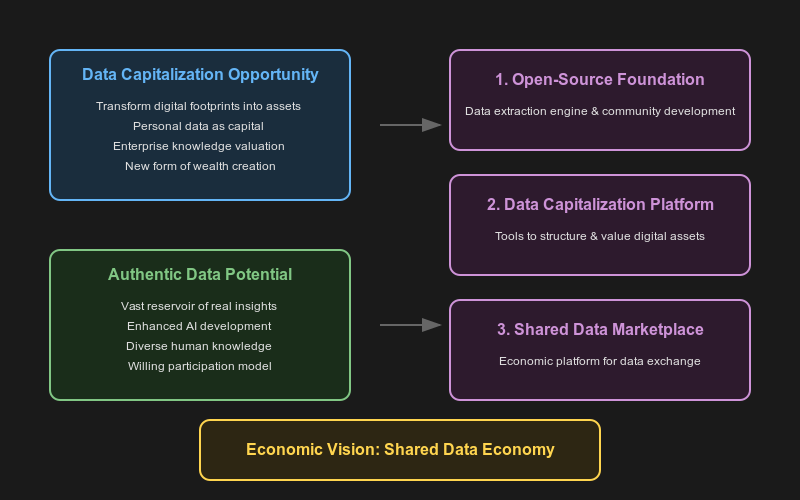
This figure is suitable as a note front page vision to illustrate the brand positioning and overall direction of the Crawl4AI.
3.2 Dispatcher Schematic Diagram
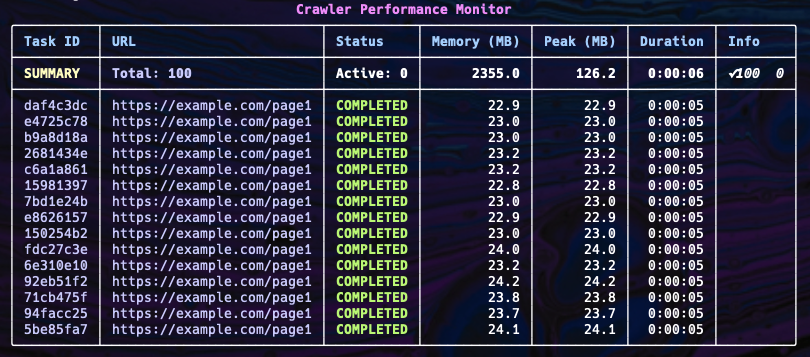
Dispatcher is a useful diagram when talking about "batch crawling, concurrency control, memory adaptation, and controllable production" before sales. Crawl4AI multi-URL crawling does not simply open many browsers at the same time, but controls concurrency and resource pressure through dispatcher.
3.3 Sample Capability Chart
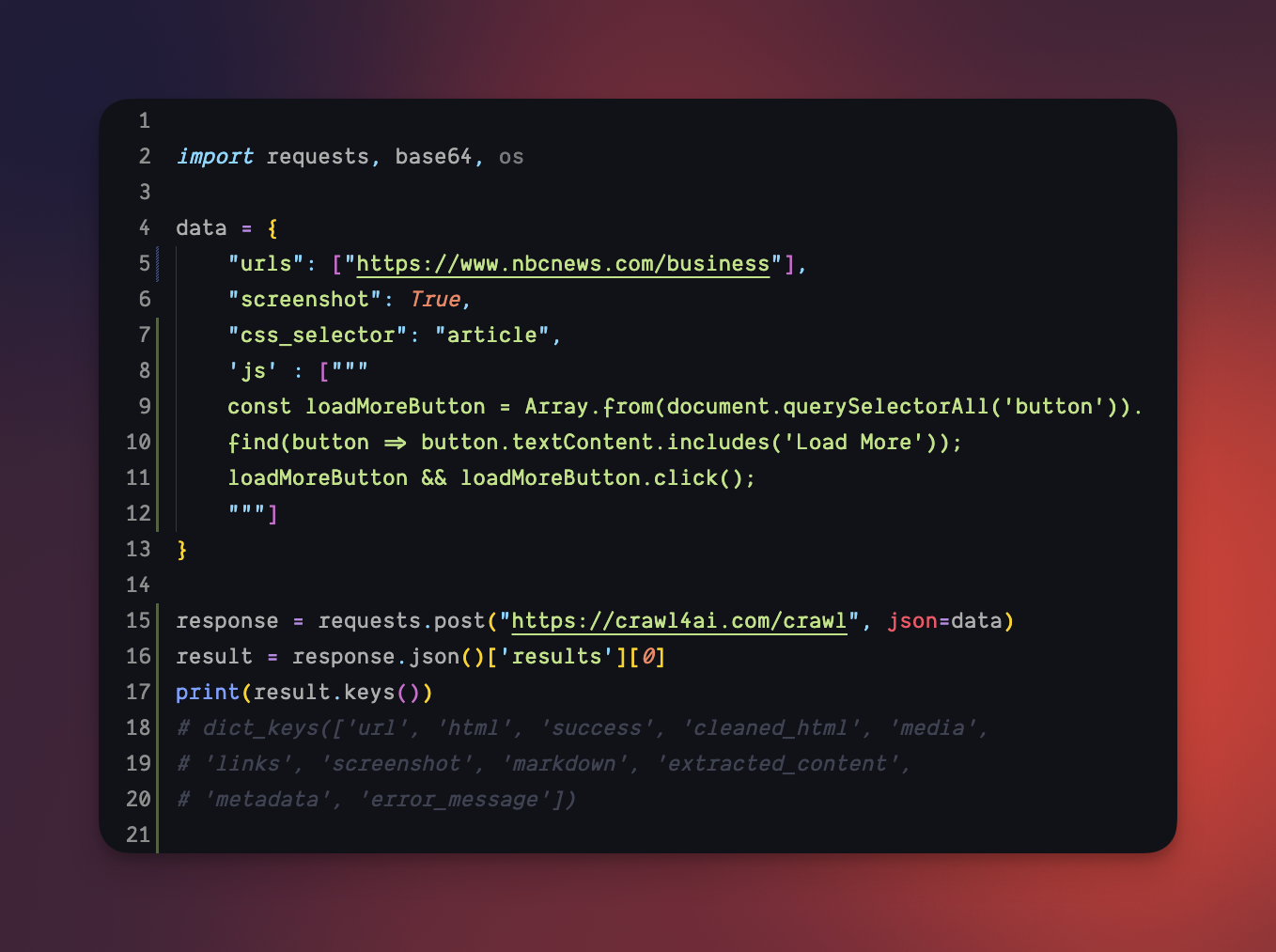
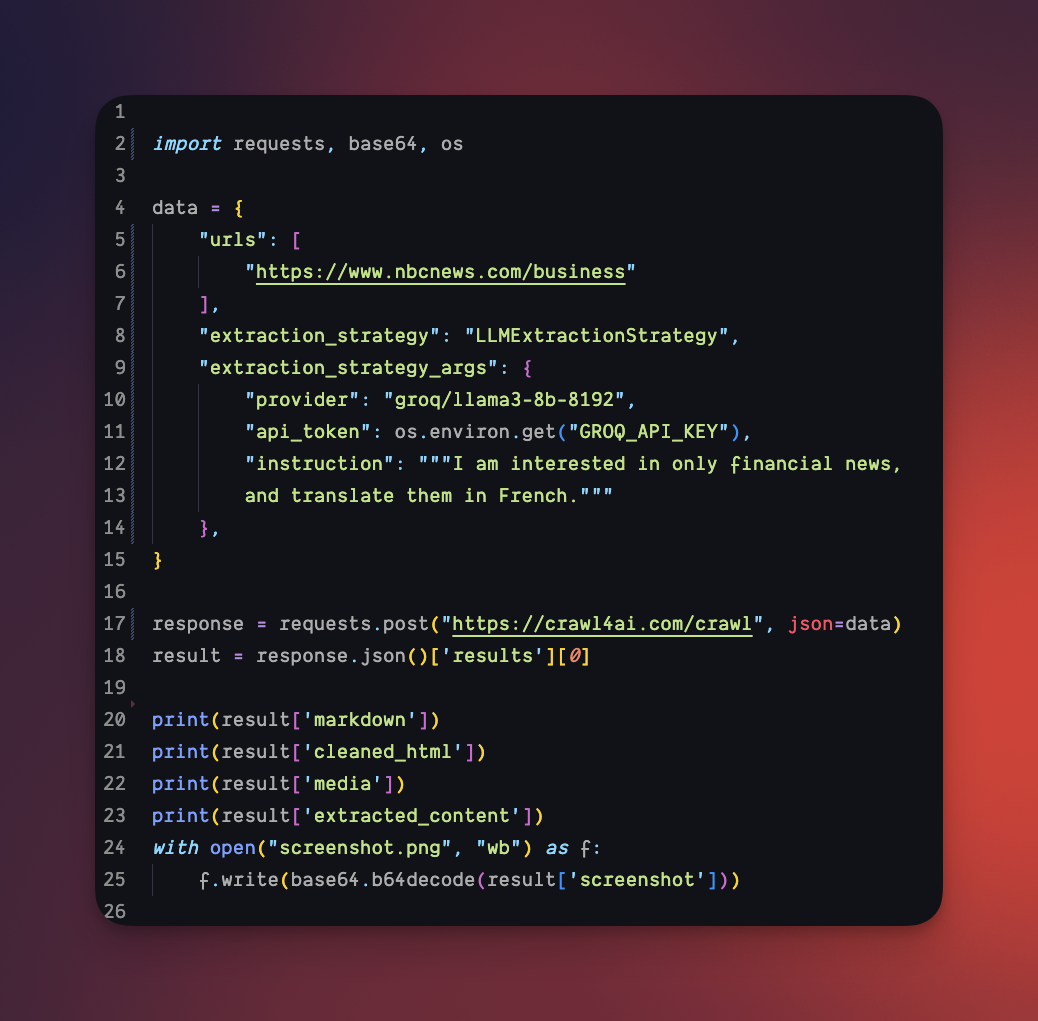
These example diagrams are suitable to assist in illustrating two types of capabilities: CSS/JS-based regularized extraction, and LLM-based processing of more complex semantic extraction.
3.4 Star History
Star History is suitable for judging community heat. However, attention should be paid to pre-sales references: stars represents attention, not equal to production maturity, nor equal to enterprise support capability.
4. Core competency dismantling
4.1 Clean Markdown: Web Page Body for RAG and LLM
The core ability of Crawl4AI is to turn web pages into LLM-ready Markdown. It will organize the web page body, title, links, tables, code blocks, etc. into text that is more suitable for model processing.
It not only has ordinary Markdown, but also provides fit markdown:
-raw markdown: relatively complete HTML-to-Markdown conversion results.
-fit markdown: Combine content filtering strategies to remove navigation, ads, footers, and irrelevant blocks as much as possible.
-PruningContentFilter: Filter page noise based on heuristic rules.
-BM25ContentFilter: filter more relevant fragments around user query.
-citations/references: Converts links into a list of references for LLM output with a sense of provenance.
Pre-sales value:
-RAG projects are often not stuck in "there is no vector library", but in "web page content is too dirty, recall a lot of noise after entering the library". Crawl4AI can be used as a web page ingestion layer.
-For the document station, help center, policy and regulation page, product description page, Markdown output can directly enter the segmentation, vectorization, index process.
-For AI Agent, it can turn the web page into a more readable, referable, and further inferable context.
4.2 structured extraction without LLM: CSS / XPath / Regex
Crawl4AI emphasizes that "if the web page structure is stable, don't use LLM first". It supports:
-'JsonCssExtractionStrategy': Extract repeating structures with CSS selector.
-XPath: Extract complex or traditional page structures with XPath.
-'RegexExtractionStrategy': Extract patterned content such as mailbox, phone number, URL, amount, date, percentage, UUID, IP, credit card format, etc.
-nested/list / nested_list: supports nested objects and repeating lists.
-baseFields: Extract attributes from the container element, such as href, data-id.
-source: Handles the page structure of "a logical object crosses sibling nodes" such as Hacker News.
Pre-sales value:
-CSS/XPath extraction is faster, cheaper and more stable than LLM for e-commerce product pages, bidding announcements, news lists, recruitment lists, product catalogs, and price pages.
-Suitable for high-volume page extraction because there is no model call cost.
-Output JSON structure is stable, easy to enter the database, BI, CRM, knowledge base or automation process.
4.3 LLM Extraction: Handling Unstructured and Semantic Tasks
When the page structure is unstable or requires semantic understanding, you Crawl4AI provide 'LLMExtractionStrategy ':
-Support multiple model vendors through LiteLLM.
-OpenAI, Anthropic, Ollama, local models, etc. may be used.
-Supports Pydantic schema and JSON schema.
-Support chunking, overlap, input_format selection.
-Support token usage statistics.
-Suitable for scenarios such as knowledge mapping, complex summaries, classification, and semantic extraction.
When expressing before sales, make it clear:
Crawl4AI not all decimation relies on LLM. CSS/XPath/Regex is preferred for regularized pages; LLM is only used for complex unstructured pages. This can reduce costs and delays, and also reduce the risk of hallucinations.
4.4 dynamic web page and browser control
Crawl4AI is based on Playwright and can handle many pages that pure HTTP crawling cannot handle:
-JavaScript rendered page.
-Tap button, Toggle Tab, Load More.
-Wait for the CSS to selector or for the network to be idle.
-Virtual scrolling, infinite scrolling, lazy loading.
-iframe content extraction.
-Screenshot, PDF, MHTML.
-session reuse, cookies, headers, proxy, user agent.
-Chromium, Firefox, WebKit multi-browser support.
-CDP/remote browser connection.
-undetected browser / stealth related ability.
The value to customers is that modern websites render a lot of content by JS, and traditional crawlers get empty shell HTML. Crawl4AI is more suitable for handling real business web pages.
4.5 Deep Crawling: From Single Page to Site-Level Acquisition
The Crawl4AI deep crawling supports three types of policies:
| Policy | Description | Suitable for scenario |
|---|---|---|
| BFS | Breadth priority, first scan shallow pages | Document station, official website, knowledge base structure is clear |
| DFS | Depth First, Down Path | When you need to explore deep directories or hierarchical content |
| BestFirst | Prioritize high-value pages based on URL/content relevance scores | Targeted collection around a topic |
It also supports:
-'max_depth control depth.
-'max_pages controls the total number of pages.
-'include_external controls whether to follow the outer chain.
-'FilterChain' combines URL pattern, domain, content type, SEO, content relevance and other filters.
-Scorers such as 'KeywordRelevanceScorer.
-stream mode while grabbing.
-crash recovery:'resume_state' and 'on_state_change' support continuous runs.
-cancellation: Support external cancellation of long tasks.
-prefetch: First find the URL quickly, then grasp it in two stages. Official documents say that the URL discovery can be 5-10x faster.
Pre-sales value:
-When customers want to grasp the document station, they do not need to write a bunch of glue codes of "find links, remove weight, limit depth, and recover from abnormalities.
-For long tasks and production tasks, breakpoint recovery, cancellation, stream, and resource control are important.
-For cost-sensitive tasks, prefetch filtering BestFirst can reduce meaningless page processing.
4.6 Adaptive Crawling: Not a full station sweep, but a stop when enough is enough
The idea of Adaptive Crawling is: around a query, start looking for information from the starting page, and automatically stop when the system judges that the information coverage is sufficient.
It uses three indicators:
-Coverage: the extent to which the collected content covers the query.
-Consistency: whether the information is consistent between different pages.
-Saturation: Continue to catch whether new pages also bring incremental information.
Strategies include:
-statistical: default strategy, fast, does not rely on external models.
-embedding: Use semantic vectors to understand query and content, suitable for conceptual and research problems, but may incur additional model/API costs.
Suitable scenarios:
-Check a topic in a technical document.
-Find a complete description of a function in the competition website.
-Help RAG build a small knowledge base for a topic.
-Research Agent stops after collecting enough context.
Not suitable:
-Full site archiving.
-Compliance retention of all pages must be caught.
-Structured extraction of known fixed list pages.
4.7 Docker API Server, MCP, and Monitoring
Crawl4AI is not just a Python library, it can also run as a self-hosted service.
The Docker service provides:
-'/crawl': submit the crawl task.
-'/crawl/stream': streaming crawl.
-'/md','/html', '/llm':Markdown/HTML/LLM processing.
-'/screenshot','/pdf': screenshots and PDFs.
-'/execute_js': Execute JS.
-'/health','/metrics': health check and Prometheus indicators.
-'/monitor': monitoring Dashboard.
-'/playground': interactive test.
-MCP SSE/WebSocket: Called to MCP clients such as Claude Code.
Available MCP tools include:
| MCP Tools | Purpose |
|---|---|
| md | Generate web page Markdown |
| html | Extract preprocessed HTML |
| screenshot | Screenshot |
| Generate PDF | |
| execute_js | Execute JavaScript |
| crawl | Multi-URL crawling |
| ask | Query Crawl4AI library context |
This allows the Crawl4AI to be deployed in-house as a "web collection service" for multiple applications, rather than having a separate Python package installed for each project.
How to use #5.
5.1 pip installation
pip install -U crawl4ai
crawl4ai-setup
crawl4ai-doctor
If there is a problem with the Playwright browser dependency, you can manually install the Chromium:
python -m playwright install --with-deps chromium5.2 Minimal Python Example
import asyncio
from crawl4ai import AsyncWebCrawler

async def main():
    async with AsyncWebCrawler() as crawler:
        result = await crawler.arun("https://example.com")
        print(result.markdown[:300])

asyncio.run(main())
5.3 CLI Example
crwl https://example.com -o markdown
crwl https://example.com -o json -v --bypass-cache
crwl https://docs.crawl4ai.com --deep-crawl bfs --max-pages 10
crwl https://www.example.com/products -q "Extract all product prices"
5.4 CSS structured extraction example
import asyncio
import json
from crawl4ai import AsyncWebCrawler, CrawlerRunConfig, JsonCssExtractionStrategy

schema = {
    "name": "Product List",
    "baseSelector": ".product-card",
    "fields": [
        {"name": "title", "selector": ".title", "type": "text"},
        {"name": "price", "selector": ".price", "type": "text"},
        {"name": "link", "selector": "a", "type": "attribute", "attribute": "href"}
    ]
}

async def main():
    config = CrawlerRunConfig(
        extraction_strategy=JsonCssExtractionStrategy(schema)
    )
    async with AsyncWebCrawler() as crawler:
        result = await crawler.arun("https://example.com/products", config=config)
        print(json.loads(result.extracted_content))

asyncio.run(main())
5.5 Docker self-hosting
docker pull unclecode/crawl4ai:latest
docker run -d \
  -p 11235:11235 \
  --name crawl4ai \
  --shm-size=1g \
  unclecode/crawl4ai:latest
After 0.9.x, the self-managed API server pays more attention to security by default. The token should be configured for production exposure:
export CRAWL4AI_API_TOKEN="$(openssl rand -hex 32)"Then use when requesting:
curl http://localhost:11235/health6. Architecture and integration approach
Crawl4AI can be placed at the ingestion layer in the AI application architecture:
Typical Integration Patterns:
| Mode | Description | Suitable for customers |
|---|---|---|
| Embedded Python SDK | Directly call Python applications, RAG pipeline, and data processing scripts | AI/RAG teams with Python engineering capabilities |
| CLI | Use 'crwl' for command line collection, testing, and scripting tasks | Data engineer, pre-sales PoC, and quick verification |
| Docker API | Deploy as a service and provide HTTP API to the outside world | Multi-team sharing, unified control, enterprise internal platform |
| MCP | AI tools such as Claude Code | AI programming assistant, agent platform, developer workflow |
| Playground/Monitor | Visual testing and O & M observation | PoC demonstration, O & M troubleshooting, and performance tuning |
7. Applicable Scenarios
Data Collection of 7.1 RAG Knowledge Base
This is Crawl4AI most direct scene.
Customer issue:
-The document station has a lot of content, but the direct HTML grab is too noisy.
-PDF/web/dynamic pages are mixed and difficult to unify into the knowledge base.
-RAG recall is of poor quality due to dirty source data, duplicate navigation, and missing text.
Crawl4AI value:
-Output Markdown, suitable for segmentation and vectorization.
-fit markdown filter irrelevant content.
-Support dynamic page, scroll loading, iframe.
-Control depth, number of pages, and filtering rules when crawling documents in depth.
7.2 Agent-AI Web Page Reading Tool
Agents need to read web pages, grab data, and extract content, but they can't let the model "browse by feeling" on its own ". Crawl4AI can be used as a tool layer for Agents:
-Agent gives URL.
-Crawl4AI return clean Markdown or JSON.
-Agent does analysis, question and answer, summary or report writing.
If MCP is connected, it can directly become an external tool for AI programming assistant or agent framework.
7.3 Competition, Market and Price Monitoring
Crawl4AI suitable for grasping:
-Competitive official website function page.
-Price page and package page.
-Release notes and changelog.
-Tender announcement.
-News listings and industry report pages.
-App/Plugin/Product Market list page.
Pre-sales value:
-Use CSS/XPath/Regex to extract structured fields such as price, product name, release date, link, etc.
-Keep the text in Markdown and leave it to the LLM for summary and interpretation of changes.
-Docker/API mode can do timed tasks.
7.4 Recruitment, Leads, Supply Chain and Open Data Collection
Crawl4AI LLM-free extraction is valuable as long as the page structure is stable:
-Job list: job name, city, salary, JD, company.
-Supplier directory: company name, product, certificate, contact information.
-Show/Conference page: agenda, guests, company, time.
-Government Bulletins: Title, Date of Issue, Attachments, Body.
The key here is: don't talk about it as a "universal crawler", but as a "low-cost extraction tool for publicly accessible, relatively stable web pages".
7.5 Document Station Migration and Content Asset Inventory
Many customers want to migrate the old official website, help center and knowledge base to the new system. Crawl4AI can be used:
-Discovery URL.
-Extract body Markdown.
-Preserves links and references.
-Generate a site content manifest.
-Identify low quality, duplicate or out-of-date pages.
8. Not suitable for the scene
| Scenario | Reason |
|---|---|
| Large-scale commercial search engine | Crawl4AI is a crawler/scraper, not a full-web index search engine |
| Strong anti-crawling, strong verification code, financial/social login status page | It may be partially processed technically, but compliance and stability cannot be promised |
| Production data sources that require official data authorization and SLA | Open source tools cannot replace official API, data authorization and enterprise SLA |
| Completely zero-code business users | It is a developer tool and requires Python/Docker/CLI/API capabilities |
| All web pages must be collected completely. | Dynamic pages, anti-crawling, network exceptions, robots and permissions will affect the collection integrity. |
| Docker API exposed without security configuration | 0.8.x had serious API security problems, 0.9.x has been reinforced, but production still needs security review |
| Want to use LLM to process large numbers of pages at low cost | LLM extraction will bring model cost and delay, and should be standardized extraction first. |
9. Difference from adjacent products/projects
| Compare objects | Position of Crawl4AI |
|---|---|
| Firecrawl | Firecrawl is more like hosting web crawling/API services; Crawl4AI is more open source self-hosting, Python SDK, depth control |
| Scrapy | Scrapy is a classic crawler framework. The Crawl4AI is more LLM/RAG-oriented, with built-in Markdown, browser, LLM extraction, MCP/API |
| Playwright | Playwright is the browser automation floor; Crawl4AI encapsulate web page cleaning, extraction, deep crawling, and AI-friendly output on it |
| BeautifulSoup/lxml | These are parsing libraries; Crawl4AI are end-to-end acquisition and extraction frameworks |
| Tavily/Exa | Tavily/Exa is more biased towards search/retrieval API;Crawl4AI is more biased towards crawling, cleaning and extraction of known URL/sites |
| Self-developed crawler platform | Crawl4AI can be used as PoC or basic component, but large-scale production may still require task scheduling, agent pool, compliance audit, queue and monitoring system |
10. What can I say before sales
10.1 Recommended Opening
many RAG and Agent projects are not lost in the model, but before the data enters the model: the web page body is not clean, the dynamic content is not grasped, the structured field is unstable, and the crawling cost is uncontrollable. Crawl4AI provides an open source web capture and AI-ready content transformation layer to turn web pages into Markdown or JSON for RAG, Agent and data pipeline use.
10.2 three core selling points
| Selling Point | Customer Language |
|---|---|
| LLM-ready Output | "The web page is not a lump of HTML, but Markdown and structured JSON that the model can read directly." |
| Low-cost extraction | "CSS/XPath/Regex for structurally stable web pages without having to call LLM on every page." |
| Self-hosted and controllable | "It can be embedded as a Python library, or Docker can be deployed as an internal API service, and the data collection link is in your own hands." |
10.3 Demo Story Line
A 20-minute presentation suitable for pre-sales:
- Use 'pip install -U crawl4ai' and 'crawl4ai-doctor to show the installation check.
- Grab a public document page and output the Markdown.
- Use CSS schema to extract JSON from a list page.
- Execute JS on a dynamic page/extract after waiting for loading.
- Do deep crawl with max_pages = 10 'for a document station.
- Show Docker '/playground' or'/monitor '.
- Finally, attention to production: token, SSRF, prevention of arbitrary JS, robots, speed limit, log and compliance.
10.4 suitable for customer portrait
High Match Customer:
-Is doing RAG knowledge base, the data source includes a large number of web pages/document stations.
-AI Agent is being done and requires web page reading and content extraction tools.
-Data engineering skills, willing to self-host or embed Python.
-Need to bulk extract structured data from public web pages.
-Sensitive to the cost and instability of calling LLM per page.
Medium Match Customer:
-The business department wants to do competition/market monitoring, but needs technical team encapsulation.
-Crawler scripts exist, but Markdown/RAG friendly output is missing.
-Want to do PoC first, and then decide whether to build a complete collection platform.
Low Match Customers:
-Just want to buy mature commercial SaaS, unwilling to maintain open source components.
-Requires official data authorizations, strong SLAs and compliance endorsements.
-No technical team to deal with crawlers, deployments and exceptions.
11. Frequently Asked Customer Questions
Is it a search engine? | No. It is mainly web crawling, cleaning, structured extraction and deep crawling tools. Usually works after a given URL or site entry. |
| Does LLM have to be used? | No. Core Markdown, CSS/XPath/Regex extraction do not rely on LLM. LLM is used only for complex semantic extraction or Q & A. |
| Can you capture dynamic pages? | Yes, the bottom layer uses Playwright and supports JS, scrolling, clicking, waiting, iframe, screenshots, etc. |
| Can you capture the page after login? | You can process part of the login status through cookies, session, browser profile, etc. However, depending on the target site and compliance requirements, you cannot promise that all login pages can be captured stably. |
| Can it be commercially available? | The Apache-2.0 license is relatively friendly, but web data collection itself still depends on the target site's terms, robots, copyright and privacy regulations. |
| Is self-hosting secure? | 0.9.x has been secured-by-default, but the production exposure API must still be configured with token, TLS, CORS, SSRF control, flow throttling and log audit. |
How to choose | and Firecrawl? | If you want to save operation and maintenance and host services, you can see Firecrawl. If you want to open source self-hosting, Python depth control, and LLM-free structured extraction, Crawl4AI is more appropriate. |
| Support for asynchronous, multiple URLs, dispatcher, caching, prefetch, browser pools, etc., but real performance depends on page complexity, JS, network, proxy, and hardware. It is recommended to use the customer real page PoC. |
12. PoC Recommendations
12.1 PoC Target
It is recommended that PoC be defined:
Verify that the Crawl4AI can serve as the Web Capture and Structured Extraction layer for the customer RAG/Agent/Data Pipeline.
Don't just test "can you catch example.com", but test the real page of the customer.
12.2 PoC Task Design
| Task | Description | Expected output |
|---|---|---|
| Document Page Transfer Markdown | Select 20 Customer Frequently Used Document Pages or Product Pages | Clean Markdown, Link References, Text Integrity |
| List page structured extraction | Select recruitment, announcement, product, price, news list page | JSON field stability, loss rate control |
| Dynamic Page Grabbing | Select Pages Requiring JS/Click/Scroll Loading | Can Stable Wait and Extract Complete Content |
| Deep Crawling | Limit collection of a document station to less than 50 pages | URL deduplication, depth control, filtering strategy |
| LLM Extraction | Abstracts/Entities/Relationships for Unstructured Pages | Cost, Accuracy, JSON Validity |
| Docker API | Start a self-hosted service and call through the API | Authentication, monitoring, metrics, error handling |
12.3 evaluation index
| Indicator | Description | |||||||||||||||||||||||||||||||||||||||||||||||||||||||||||||||||||||||||||||||||||||||||||||||||||||||||||||||||||
|---|---|---|---|---|---|---|---|---|---|---|---|---|---|---|---|---|---|---|---|---|---|---|---|---|---|---|---|---|---|---|---|---|---|---|---|---|---|---|---|---|---|---|---|---|---|---|---|---|---|---|---|---|---|---|---|---|---|---|---|---|---|---|---|---|---|---|---|---|---|---|---|---|---|---|---|---|---|---|---|---|---|---|---|---|---|---|---|---|---|---|---|---|---|---|---|---|---|---|---|---|---|---|---|---|---|---|---|---|---|---|---|---|---|---|---|---|
| Text integrity | Whether the key text is retained and whether the dynamically loaded content is missing. | |||||||||||||||||||||||||||||||||||||||||||||||||||||||||||||||||||||||||||||||||||||||||||||||||||||||||||||||||||
| Noise Ratio | Whether navigation, ads, footers, and recommended content enter the Markdown | |||||||||||||||||||||||||||||||||||||||||||||||||||||||||||||||||||||||||||||||||||||||||||||||||||||||||||||||||||
| Structured Accuracy | Whether the JSON field is correctly selected and whether it is stably adapted to multiple pages | |||||||||||||||||||||||||||||||||||||||||||||||||||||||||||||||||||||||||||||||||||||||||||||||||||||||||||||||||||
| Extraction Cost | Number of LLM calls, token cost, and rule extraction ratio | |||||||||||||||||||||||||||||||||||||||||||||||||||||||||||||||||||||||||||||||||||||||||||||||||||||||||||||||||||
| Delay | Single page, batch, deep crawl time | |||||||||||||||||||||||||||||||||||||||||||||||||||||||||||||||||||||||||||||||||||||||||||||||||||||||||||||||||||
| Concurrency stability | Memory, browser pool, failure rate under multiple URLs | |||||||||||||||||||||||||||||||||||||||||||||||||||||||||||||||||||||||||||||||||||||||||||||||||||||||||||||||||||
| Security configuration | Whether API token, CORS, SSRF, TLS, throttling, and log are configured in place | |||||||||||||||||||||||||||||||||||||||||||||||||||||||||||||||||||||||||||||||||||||||||||||||||||||||||||||||||||
| O & M complexity | Whether Docker, browser dependency, model dependency, and log monitoring are acceptable | |||||||||||||||||||||||||||||||||||||||||||||||||||||||||||||||||||||||||||||||||||||||||||||||||||||||||||||||||||
| Compliance risk | robots, website terms, personal information, copyright, data license |
12.4 suggested period
1 to 2 weeks is appropriate:
-Day 1: Install and run the Python SDK and CLI.
-Days 2 to 3: Select 20 real URLs to verify the Markdown quality.
-Days 4 to 5: Do CSS/XPath/Regex structured extraction.
-Days 6 to 7: Validate dynamic pages, deep crawl, and prefetch.
-Week 2: Docker API, security configuration, monitoring, performance and compliance assessment.
13. Risks and Considerations
13.1 Security Risks
Special attention needs to be paid to the historical security context of the Docker API Server. CHANGELOG show that 0.8.7 fixes too many serious problems, including RCE, SSRF, authentication bypass, arbitrary file writing, XSS, hard-coded JWT secret, etc. 0.9.0 is further changed to secure-by-default:
-Default authentication is on.
-Bind loopback when there is no token.
-request bodies are considered untrusted boundaries.
-Any Python hook code is replaced by declarative hooks.
-Screenshots/PDF no longer accept arbitrary output_path, but artifact id.
-The LLM base_url is no longer arbitrarily passed in by the request body.
-CORS deny-by-default.
-TLS verification turned on.
Pre-sales judgment:
This shows that the project has obvious historical baggage in safety, but it is also rapidly repairing and strengthening. PoC and production deployments must use versions after 0.9.x and do a security configuration review.
13.2 Compliance Risk
The open source license is Apache-2.0, and the code is relatively friendly to use. But web collection itself is not equal to natural compliance:
-To see the target website terms of service.
-To respect robots.txt and visit frequency.
-Avoid grabbing sensitive personal information.
-To confirm whether the collected data can be used for business analysis, training or redistribution.
-Be extra cautious about login status, pay wall, social platform and e-commerce platform.
13.3 Stability Risk
The structure of the web page changes frequently and the selector will fail; the dynamic page loading strategy will change; the anti-crawling strategy will be upgraded; the quality of the agent will affect the results. Crawl4AI can reduce development costs, but it cannot eliminate the natural instability of Web collection.
13.4 Cost Risk
No LLM extraction costs are low, but LLM extraction, embedding strategy, and schema generation may incur model call costs. Large-scale tasks must clearly design "which pages use rules and which pages use LLM.
13.5 Resource Risk
The Playwright/browser pool consumes memory and CPU. The Docker documentation recommends that the container should have at least 4GB of RAM, with more needed for heavy loads. Deep crawling and dynamic page crawling need to set concurrency, timeout, max_pages, and queue limits.
14. My Pre-Sales Judgment
Crawl4AI is a Web-to-LLM data collection project that deserves attention in the open source ecosystem. Its value lies not in "writing another crawler", but in that it makes a complete package around the data entry link of AI application: grabbing web pages, running browsers, cleaning Markdown, pumping JSON, deep crawling, adaptive stopping, CLI, Docker API, MCP, monitoring and security reinforcement.
From a pre-sales perspective, it is particularly suitable for these types of programs:
-Web data access to the Enterprise Repository/RAG.
-Agent-AI web page reading and extraction tool layer.
-Automated collection of competition, market, price, announcement, document updates.
-Low-cost public web extraction platform for data engineering teams.
The most important thing to emphasize is the "rule first, then LLM" extraction strategy: CSS/XPath/Regex for stable structures and LLM for complex semantics. This is more professional than simply saying "pumping pages with AI", and it is easier to impress customers who are sensitive to cost, stability and audibility.
But also to maintain the boundaries: Crawl4AI is not an enterprise-level full-network search, not a universal anti-crawling tool, not zero operation and maintenance SaaS. It is suitable for technical teams to use it as a base component instead of directly giving it to business users. When production is on the ground, security, compliance, proxy, scheduling, monitoring, task queuing, and exception handling still require solution design.
15. References
-GitHub repository: https://github.com/unclecode/crawl4ai
-Official documentation: https://docs.crawl4ai.com/
-PyPI:https://pypi.org/project/crawl4ai/
-README:https://github.com/unclecode/crawl4ai/blob/main/README.md
-Quick Start:https://docs.crawl4ai.com/core/quickstart/
-CLI Guide:https://docs.crawl4ai.com/core/cli/
-Deep Crawling:https://docs.crawl4ai.com/core/deep-crawling/
-Adaptive Crawling:https://docs.crawl4ai.com/core/adaptive-crawling/
-No-LLM Extraction:https://docs.crawl4ai.com/extraction/no-llm-strategies/
-LLM Extraction:https://docs.crawl4ai.com/extraction/llm-strategies/
-Self-Hosting:https://docs.crawl4ai.com/core/self-hosting/
-Docker Migration Guide:https://github.com/unclecode/crawl4ai/blob/main/deploy/docker/MIGRATION.md
-Changelog:https://github.com/unclecode/crawl4ai/blob/main/CHANGELOG.md
-Release v0.9.2:https://github.com/unclecode/crawl4ai/releases/tag/v0.9.2