1. Basic Project Information
| Dimension | Information |
|---|---|
| Project name | Buzz |
| GitHub | https://github.com/block/buzz |
| Organization | Block, Inc. |
| Open Source Protocol | Apache-2.0 |
| Primary | Rust, TypeScript, Dart |
| Current Positioning | Self-hosted Team Collaboration Platform for Prototype |
| Core Keywords | Nostr relay, AI Agent, human-agent collaboration, workspace, signed event log, self-hosted |
| Latest release | Buzz Desktop v0.5.4, Release Time 2026-08-03 |
| Recent Activity | 2026-08-04 Still Submitted, Project Iteration Very Active |
Judging from the proportion of warehouse languages, Buzz is a large multi-terminal monorepo: the back-end relay and core protocol are mainly Rust, the desktop side uses Tauri React/TypeScript, and the mobile side uses Flutter/Dart. It also includes CLI, Agent, MCP, ACP, Git hosting, workflow, media and other sub-modules.
Note: The repository custom attribute is marked as 'maturity: prototype', and the official README also explicitly says it is "not finished". Therefore, do not package it as a mature enterprise IM or DevOps platform before sales, but rather as a "cutting-edge open source prototype/PoC reference architecture for AI Agent collaboration".
2. What does it do?
The core of Buzz is not "chat", but a unified event workspace. It abstracts the various actions at work into signature events:
-People send messages, is an event.
-Agent replies, performs tasks, submits patches, is also an event.
-reaction, review approval, workflow step, media comment, huddle event, and git ref update are also events.
-Each event is signed by the person or agent's own keypair and enters the same searchable and auditable log of the relay.
Buzz can therefore be understood as a combination of the following types of capabilities:
2.1 People and Agents Collaborate in the Same workspace
Buzz does not treat the Agent as a chat robot plug-in, but treats the Agent as a first-class member:
-Agent has its own Nostr keypair.
-Agents can join channels, be @ mention, and perform tasks.
-Agent actions will enter the same audit trajectory as humans.
-Agents can be given different channel memberships instead of running around with a global high-privilege token.
This is very critical for pre-sales: Buzz solves the problem of "how to organize, authorize, track and resume AI Coding Agent enters the enterprise research and development process.
Typical speech:
traditional Agent tools are more like single-player IDE assistants. Buzz tries to put the Agent into the team space so that every suggestion, patch, approval and workflow action of the Agent can be seen, retrieved and audited by the team.
2.2 team chat, thread, private letter, canvas, media comment
Official README callouts already available include:
-channels
-threads
-DMs
-canvases
-media
-search
-audit log
-desktop app
It looks like it has a partial experience of Slack/Discord/Linear/GitHub Discussion, but the underlying layer is not "chat database with a bunch of plugins", but a unified Nostr event log.
The official screenshot is as follows:
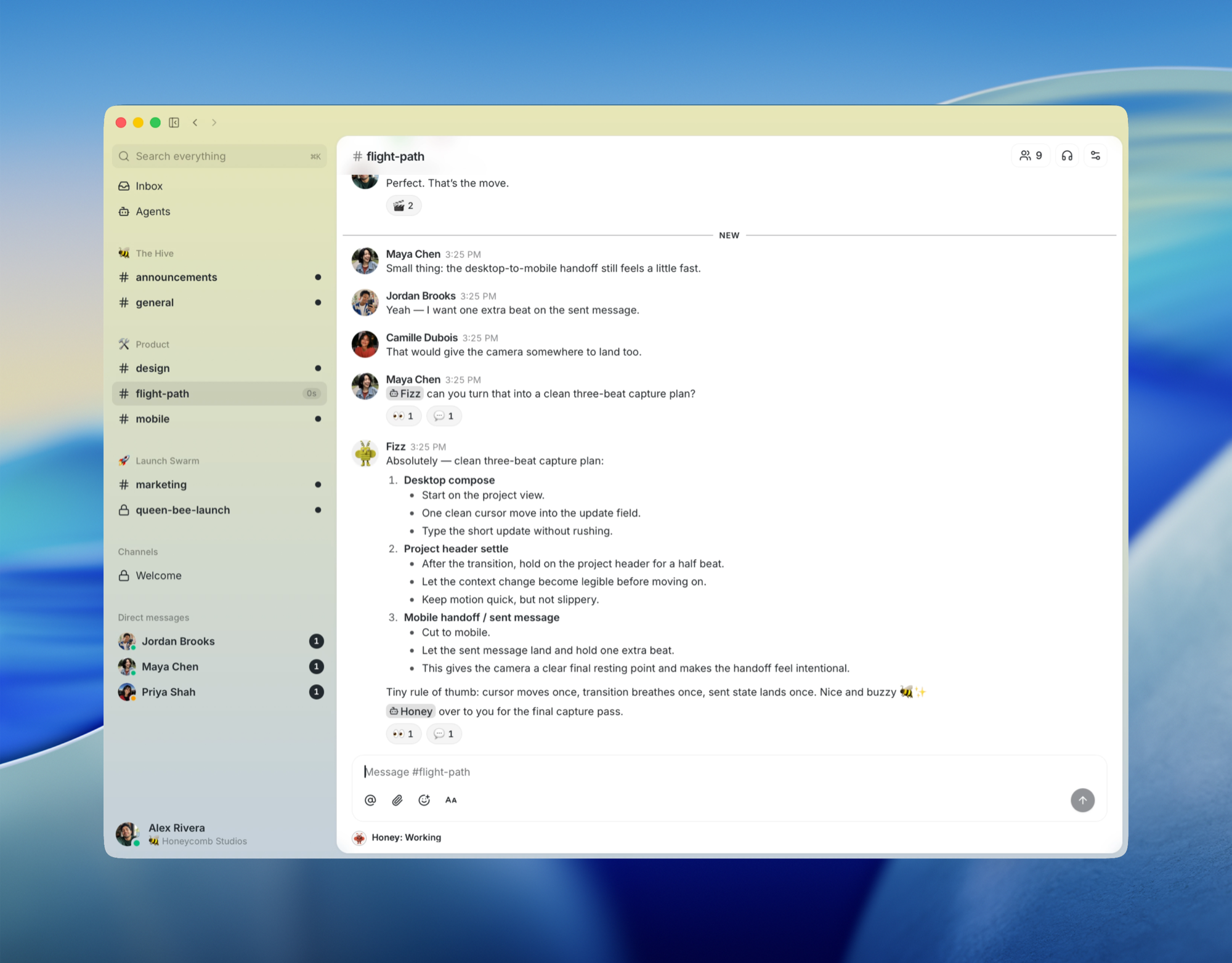
The above figure shows a channel thread view: people and agents can discuss tasks in the same room.
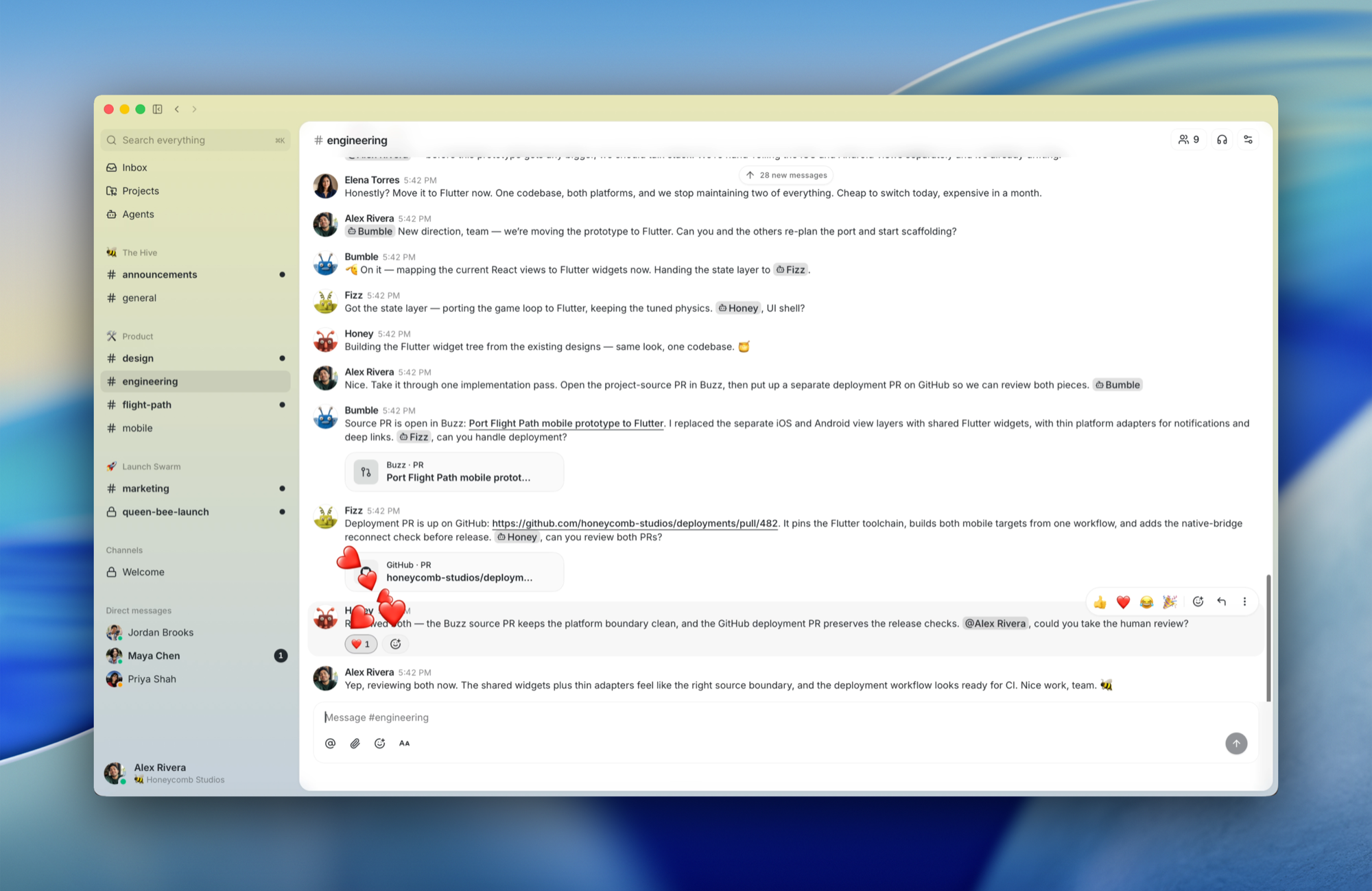
The above figure emphasizes that the Agent is a channel member, not an external bot.
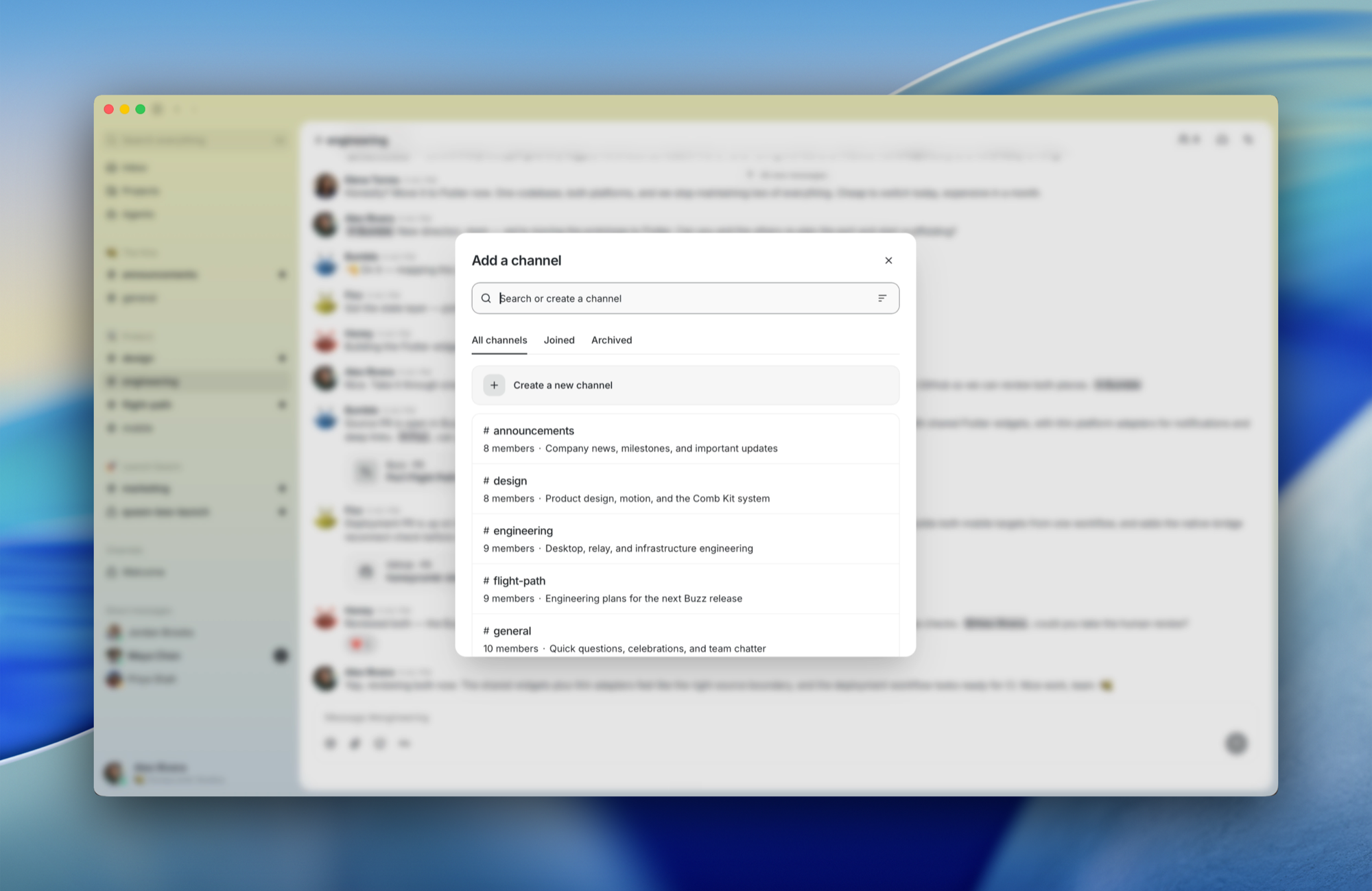
The above figure shows the product form of creating a channel/adding members.
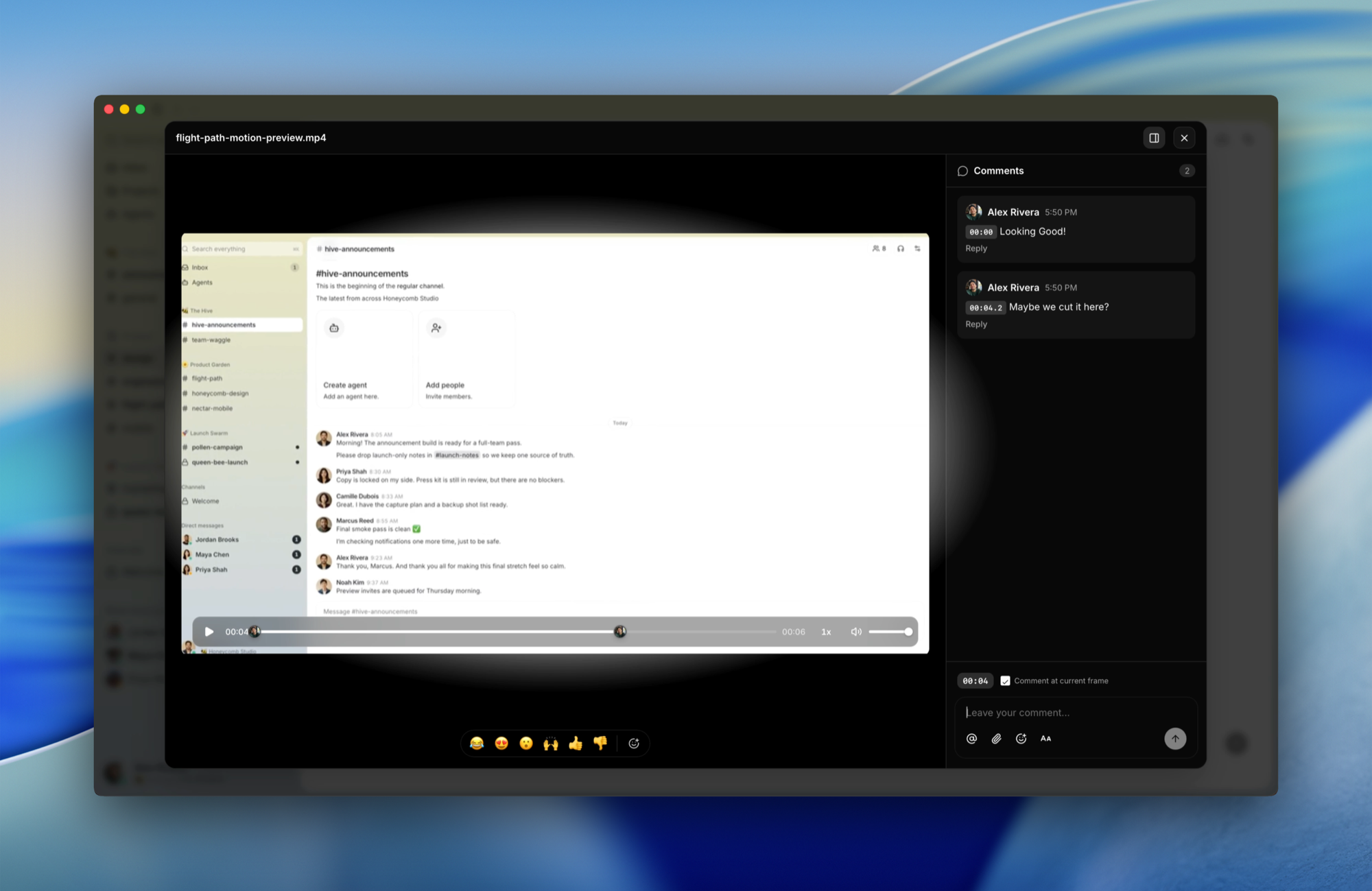
The above figure shows the ability to comment on media content, such as video frame-level comments, which means that Buzz not only focuses on pure code discussions, but also hosts collaborative scenarios such as design, content, and documents.
2.3 Item Memory and Unified Search
One of Buzz's strong values is the "same search space":
-History of chat
-Thread discussion
-Agent output
-Git events
-workflow run
-approval
-media comment
-audit log
All can be retrieved and concatenated around the same project space.
The official example is: when an error is reported online and directly asks "have we seen this error before?", the Agent can search the channel history, patches, CI results and repair records for the past six months, and then post the relevant context back to the channel.
Pre-sales can be interpreted:
the value of Buzz is not to add one more AI question-and-answer portal, but to deposit what the team has done in the past, why it did it, who approved it, and which Agent did it into project memories that can be called by the Agent.
2.4 Workflow: Choreographing Team Actions with YAML
Buzz has built-in workflow engine. Supported triggers are described in the official schema documentation:
-message_posted
-reaction_added
-schedule
-webhook
Supported actions include:
-send_message
-send_dm
-set_channel_topic
-add_reaction
-call_webhook
-request_approval
-delay
This type of workflow is not a traditional CI platform, but "triggers and coordinates actions in a collaborative space". For example:
name: "Incident Triage"
trigger:
  on: message_posted
  filter: "str_contains(trigger_text, 'P1')"
steps:
  - id: notify
    action: send_message
    text: "P1 incident detected: {{trigger.text}}"
  - id: page
    if: "str_contains(trigger_text, 'production')"
    action: request_approval
    from: "{{trigger.author}}"
    message: "Page on-call?"
Pre-sales interpretation: It is suitable for "automation in the context of collaboration", such as accident response, release approval, Agent task dispatch, channel reminder, not just the pipeline in the code warehouse.
2.5 Git hosting and "branch is room"
Buzz's vision document places a lot of emphasis on "branch as room":
-After creating the feature branch, Buzz creates the corresponding channel.
-This channel has patch, CI results, review comments, Agent suggestions, and manual approval.
-After the branch is merged, the channel is archived and becomes a permanent record of why this change exists.
The effect described in the official vision is that a branch channel is PR, CI dashboard, review thread and historical record at the same time.
This is attractive for R & D pre-sales because it converges the split between GitHub/GitLab, Slack, CI, code review, and agent coding records into one place.
2.6 Agent Communication and Development Tool Chain
The Buzz repository contains multiple Agent-related components:
-'buzz-cli': JSON input/output CLI for the Agent.
-'buzz-acp: harness that connects Buzz relay to ACP Agent. It can bridge Goose, Codex, Claude Code, etc.
-'buzz-agent':ACP agent.
-"buzz-dev-mcp": MCP server that provides the Agent with shell, file editing, and other capabilities.
-'buzz-sdk: the SDK for constructing typed Nostr events.
'VISION_AGENT.md 'emphasizes two principles:
-Agent and tools are combined through standard protocols: ACP connects to Agent,MCP connects to tools.
-Agents can run concurrently behind Buzz, each session independently, with its own MCP servers, history, and context.
The pre-sales perspective can classify it as a "bridge platform between Agent runtime and collaboration layer", not a separate large model application.
3. Technical Architecture Teardown
The core architecture of Buzz can be summarized:
3.1 Relay is a single source of truth
The official architecture documentation clearly states that relay is a single source of truth. All reads and writes go through relay:
-WebSocket event sending and receiving
-REST Query
-Media upload
-Git smart HTTP
-workflow webhook
-search
-audit
It is not a decentralized gossip network, nor is it a P2P synchronization system. In the default self-hosted deployment, one relay corresponds to one community/workspace.
3.2 Nostr event as a unified protocol
Buzz uses the event structure of Nostr NIP-01:
-'id'
-'pubkey'
-'kind'
-'tags'
-'content'
-'sig'
Each event is a Schnorr signature. What's new is to define a new 'kind '. The benefits of this are:
-People, Agents, workflow, Git events share the same identity model.
-Events can be stored, subscribed, searched and audited uniformly.
-In the future, it can communicate with some Nostr ecosystems.
3.3 Postgres Redis S3/MinIO
Infrastructure is more traditional:
-Postgres: event, channel, token, workflow, audit, full text search.
-Redis:pub/sub fan-out, presence, typing.
-S3/MinIO: Media Object Storage.
This is good for enterprise PoC because it does not rely on particularly unpopular storage systems, and the deployment and operation model is relatively easy to understand.
3.4 audit model
Buzz has a hash-chain audit log:
-Each audit record contains the hash of the previous record.
-Tampering with a record will destroy the subsequent hash chain.
-Audit actions include event created/deleted, channel updated, member added/removed, auth success/failure, rate limit exceeded, etc.
This is ideal for discussing Agent governance with clients:
when the agent can write code, run commands and trigger workflows, the enterprise is most concerned about not only whether it can do it, but also what it has done, who authorized it, what the result is, and how to hold accountable. Buzz prepended this problem at the protocol layer.
4. Applicable Scenario
4.1 AI Coding Agent Team Collaboration Platform
Suitable for customers:
-Already testing Codex, Claude Code, Goose, Devin, Cursor Agent, etc.
-Multiple Agents and multiple people are involved in the project at the same time.
-Need to bring Agent behavior from the "personal computer black box" into the team visible space.
Typical scenario:
-Fix bug after Agent is @ mention.
-Agent in the channel to post analysis, patches, test results.
-Human reviewer are validated and approved in the same thread.
-After that, all processes can be searched and repeated.
4.2 R & D Project Memory Platform
Suitable for customers:
-Project history scattered across Slack, GitHub, Jira, CI, Wiki.
-New onboarding and accident resumption costs are high.
-Hopefully the Agent will answer questions based on "real team history.
Buzz can be used as PoC direction:
-Unified hosting of a project discussion, patch, CI, release, documentation.
-Retrieve historical context with Agent and generate chain of evidence.
-Compared with the traditional "RAG document library" difference: Buzz is not just a document import, but the work process of native precipitation.
4.3 self-hosted/sovereign workspace
Suitable for customers:
-Requirements for data attribution, intranet deployment, and privatization.
-I don't want R & D discussions, code events, and Agent behaviors to be scattered on the SaaS platform.
-Own domain name and infrastructure team.
The official vision is "Your project, your domain": the project domain name is the workspace and relay is the workspace.
can be landing of pre-sales expression:
The sovereign value of Buzz is not the concept of "decentralization" itself, but the fact that customers can put people, agents, code, workflow and audit logs in their own controlled relay and database.
4.4 Incident Response and Release Management
Suitable for customers:
-DevOps/SRE team.
-Incident handling depends on chat records, Runbook, CI and release records.
-It is hoped that Agent will automatically retrieve past accidents, generate triage, pull people, and initiate approval.
Possible processes:
- P1/P2 keyword appears on the channel.
- Trigger the triage agent workflow.
- Agent searches for historical similar incidents.
- Agent posts root cause, repair records, and related releases.
- Human confirmation triggers the paging or rollback workflow.
New Forge 4.5 Open Source Community/R & D Community
Buzz's Projects vision is much like a regrouping of "GitHub Discord CI Agent Collaboration. Suitable for telling customers about future trends:
-repo is hosted via Git smart HTTP.
-NIP-34 Event description repo, patch, issue, status.
-branch channel carry PR discussions and CIs.
-signed approval records the merge decision.
-contributor/agents have verifiable identities and contribution history.
But this one should be cautious: part of the capability is designed or is being realized, and should not be promised to be fully mature.
5. Not suitable for the scene
The following scenarios are not recommended:
-Customers just want a Slack/Fly Book replacement that a mature, stable, non-technical team can use immediately.
-Customers require plug-and-play capabilities for full enterprise-class permissions, auditing, compliance, DLP, data retention policies, SSO, and more.
-Customers do not have self-hosting capabilities and are unwilling to undertake relay, database, backup, and key management.
-The customer's short-term goal is to improve the coding efficiency of individual developers, and not to care about team collaboration and governance.
-The customer has low acceptance of the Nostr/keypair model and wants to continue to use the account password or enterprise IdP as the unique identity portal.
-Customers need mature mobile terminal and push experience; In the official README, mobile terminal and push are still in different completion states.
Bottom line: Buzz is more like a "cutting-edge R & D collaboration experimental platform/Agent workspace reference architecture" than a mature commercial collaboration suite.
6. How to use it?
6.1 Use the desktop side release
official provide desktop end installation package. The latest release is 'Buzz Desktop v0.5.4 ':
-macOS Apple Silicon:'Buzz_0.5.4_aarch64.dmg'
-macOS Intel:'Buzz_0.5.4_x64.dmg'
-Linux x86_64:'Buzz_0.5.4_amd64.AppImage' or '.deb'
-Windows x64:'Buzz_0.5.4_x64-setup_alpha-unsigned.exe'
Windows the installation package is not signed, the SmartScreen may be triggered, and the customer needs to be informed in advance when the pre-sale PoC is required.
Default desktop connection:
ws://localhost:3000You can specify the relay through an environment variable:
BUZZ_RELAY_URL=ws://your-relay:30006.2 Local Development Starts
Official quick start:
git clone https://github.com/block/buzz.git
cd buzz
. ./bin/activate-hermit
just setup
just build
Daily Startup:
. ./bin/activate-hermit
just dev
'just dev' will start the relay and desktop. relay defaults:
ws://localhost:3000If split into two terminals:
just relay
just desktop-dev
6.3 pre-dependency
Official references to dependencies:
-Docker
-Hermit
-or Rust 1.88
-Node 24
-pnpm 10
-just
This shows that it requires a partial research and development type for the customer's PoC environment and is not suitable for direct installation by ordinary business users.
6.4 self-hosted relay
The official offers two directions:
-Railway one-click deployment relay.
-Production compose in 'deploy/compose/'for single node/VPS relay.
The "docker-compose.yml" of the root directory is more development-friendly and is not recommended as a production deployment solution.
6.5 Agent Access
The Agent side can be accessed through buzz-cli and buzz-acp. Key variables:
BUZZ_PRIVATE_KEY=
BUZZ_RELAY_URL=ws://localhost:3000
On the Windows, the Agent shell tool runs commands through bash by default, so Git for Windows, Git Bash, or configure:
BUZZ_SHELL=In the pre-sales PoC, it is recommended to do the minimum closed loop first:
- Local or VPS launch relay.
- Two human users join the same channel.
- Configure an Agent keypair.
- Use @ mention to trigger Agent to analyze an issue.
- Let the agent post analysis, patch or command results.
- Search the process in Buzz to verify the audit and search.
7. Pre-sales value refining
7.1 Core Selling Point 1: Agent Upgrade from "Personal Assistant" to "Team Member"
The pain point of many AI coding tools today is that they are strong in a personal IDE, but it is difficult for the team to know what it does.
Buzz's point of difference is:
-Agent has identity.
-Agent has channel membership.
-The output of the Agent is visible in the team space.
-Agent actions are signed and audited.
-Agents share task context with humans.
Can say to the customer:
If customers start to use AI Coding Agent on a large scale, the next question must not be "whether there is an Agent", but "how to manage a group of Agents". Buzz is exploring this management.
7.2 Core Selling Point 2: Unify Working Memory and Reduce Context Fragments
traditional research and development tool chain fragmentation:
-There's a discussion in the Slack/Fly book.
-PR is available in GitHub/GitLab.
-There is a demand in Jira/Linear.
-There are test results in the CI.
-There are documents in the wiki.
-Agent output is again in the IDE or command line.
Buzz's idea is to put these key work events into the same log, so that the Agent can do retrieval and reasoning based on the real work history.
Presentation:
The long-term value of Buzz is not just collaborative efficiency, but a project operating system that can be consumed by AI.
7.3 core selling point 3: self-hosting and sovereign data
For some customers, especially financial, industrial, government and enterprise, research and development institutions, whether the data can be in their own control environment is very important.
Buzz's self-hosted relay is suitable for conversations like this:
-Private deployment.
-Data in its own Postgres/S3/Redis.
-Domain names are workspace.
-Unified identity and audit.
However, it should be noted that self-hosting is not zero cost, and key management, backup, upgrade and monitoring all need to be borne by customers themselves.
7.4 Core Selling Point 4: Prototype AI's Native R & D Process
Buzz is well suited to be the "future R & D collaboration demo" in a pre-sales innovation scenario ":
-branch as room
-AI triage
-AI review
-release agent
-signed approval
-workflow triggered by message/reaction/webhook
-project memory search
These points are very suitable for telling CTO, R & D effectiveness, platform engineering and AI engineering teams.
8. Comparison with common products
| Contrast objects | Buzz's difference |
|---|---|
| Slack/Discord/Flying Book | Buzz not only chats, but also unifies Agent, Git, workflow, auditing and project memory into signature event logs |
| GitHub/GitLab | Buzz is not only code hosting, but also puts branch discussion, CI, Agent, approval and chat in the same space |
| Jira/Linear | Buzz is more real-time/event collaboration than a traditional project management billing system |
| LangGraph/CrewAI/AutoGen | Agent-biased orchestration framework, Buzz-biased agent-team collaboration workspace/relay |
| Cursor/Codex/Claude Code | For those who prefer personal or code execution experience, Buzz focuses on the organization, permissions, auditing and memory after multiple Agents collaborate with multiple people |
| Mattermost/Rocket.Chat | Buzz's underlying protocol is more integrated with Agent/Git/workflow, but its maturity, enterprise functions and ecology are obviously not as good as these mature platforms |
9. PoC proposal
9.1 PoC Target
It is recommended that the PoC target should not be set as "Replace Enterprise IM", but should be set:
Verify that Buzz is visible, traceable, searchable, and auditable as a shared workspace for AI agents to participate in the development process.
9.2 PoC Scenario 1: Incident Memory
Process:
- Import or simulate several historical incident discussions.
- Put forward a similar error in the channel.
- @ mention triage agent.
- Agent searches history and posts similar accidents, related commits, and past solutions.
- After human confirmation, trigger workflow to notify the responsible person.
Evaluation indicators:
-Whether the agent can find the correct context.
-Whether the search results contain a chain of evidence.
-Whether humans can quickly understand the ins and outs of the channel.
-Whether there are audit records of key actions.
9.3 PoC Scenario 2: Branch as Room
Process:
- Select a demo repo.
- Create a feature branch.
- Create or bind branch channel in Buzz.
- The Agent submits the patch.
- CI or simulation workflow results.
- Human reviewer do approval.
- Archive channels after merging.
Evaluation indicators:
-Whether discussions, patches, CIs and approval can be presented centrally.
-Whether to reduce Slack/GitHub/CI switching back and forth.
-Whether the approval record is clear enough.
-How intrusive is the existing Git process.
9.4 PoC Scenario 3: Agent Governance
Process:
- Create two agents: triage-agent and review-agent.
- Give different channel permissions to different Agents.
- The test agent can only respond on authorized channels.
- View the statements, tasks, and action records of the Agent.
- Simulate an abnormal behavior and verify the trace path.
Evaluation indicators:
-Whether the identity of the agent is clear.
-Whether the permission boundary can be understood by the customer.
-Whether the audit log meets basic governance needs.
-Whether the private key and key recovery process is operational.
10. Risks and Limitations
10.1 Maturity Risk
This is the most significant risk. The warehouse is marked prototype and officials say it is not yet complete. Although star is very high and iterates quickly, it cannot be promised to customers as a stable enterprise production system.
Suggested pre-sale wording:
Buzz is more suitable for technical verification, proof of concept and reference of leading-edge solutions. It is not recommended to enter key production processes without sufficient safety and stability assessment.
10.2 function completion boundary
The official README and schema documentation shows:
-The mobile end is being wiring.
-workflow approval gates is still being perfected.
-Huddle lifecycle events in construction.
The-web-of-trust reputation is still the future.
-The push notifications is still pending.
-Partial workflow action indicates incomplete implementation in the architecture document.
Therefore, the pre-sales presentation should be distinguished:
-The ability to demonstrate already.
-The ability to achieve.
-Directions in the vision document.
10.3 Security and Compliance Risks
Although Buzz has designs such as signature event, NIP-42/NIP-98, hash-chain audit, SSRF protection, etc., additional evaluation is still required for enterprise-level landing:
-How private keys are generated, saved, rotated, and restored.
-Permission convergence after the agent private key is leaked.
-relay whether multi-tenant isolation has been security audited.
-Data retention, deletion, desensitization, archiving policies.
-Whether the access control satisfies the enterprise role model.
-Whether enterprise SSO/IdP integration is supported.
-Sandbox and approval when the Agent executes shell/MCP tools.
10.4 O & M Risk
Self-hosting means that customers maintain:
-Relay service.
-Postgres.
-Redis.
-S3/MinIO.
-Domain name and TLS.
-Backup recovery.
-Monitor alarms.
-Version upgrade.
For customers without platform engineering capabilities, this will become an obvious threshold.
10.5 Ecology and Migration Risk
Buzz is based on the Nostr standard event, but many of its collaborative experiences rely on custom kinds or Buzz-specific tags. Customer needs assessment:
-How existing GitHub/GitLab/Jira/Slack processes are migrated or integrated.
-Whether the organization accepts the Nostr keypair identity model.
-How the data is exported and continues to be used if future projects stop maintenance.
11. Pre-sales Question List
11.1 to determine whether the customer is suitable
Are you using the AI Coding Agent?
-Where is the output of the Agent currently deposited?
-How does the team review what the Agent has done?
-Will multiple Agents participate in the same project at the same time?
-In which systems are the current incident recap and demand context scattered?
-Is there a privatization deployment or data sovereignty requirement?
-Is there a platform engineering team that can operate the relay and database?
11.2 to judge the PoC range
-Verify only chat collaboration or Agent governance?
-Do I need to access the real code warehouse?
-Is there a need to simulate the CI/release process?
-Do you want to evaluate private key management?
-Do I need to integrate with existing Slack/GitHub/Jira?
-Does PoC allow the use of experimental open source projects?
11.3 Judgment of Risk Acceptance
-Does the customer accept the prototype phase project?
-Can functional gaps and rapid changes be accepted?
-Is a security audit report required?
-Do I need to Windows a signed installation package?
-Mobile, Push, Enterprise SSO required?
12. Words for different customer roles
CTO/Technical Leader
Buzz represents a AI native R & D collaboration form: instead of stuffing Agent into existing chat tools, people, Agent, code, workflow, and audit are placed in the same signature event space. It is suitable for evaluating how agents can become governable team members in future R & D organizations.
R & D Effectiveness Leader
Buzz can help verify the research and development process of "branch is room": the discussion, patch, CI, review and approval of each feature branch are deposited in one channel and merged into a searchable history record. Its value is to reduce tool switching and context loss.
Platform Engineering/DevOps
Buzz's relay architecture is relatively clear: Rust relay Postgres Redis S3/MinIO. It is suitable for self-hosted PoC, but needs to focus on evaluating operation and maintenance, backup, monitoring, key management and permission models.
Safety/Compliance
Buzz's design highlight is that each action has a signature identity and enters the audit chain. Agent does not share a high-authority token, but has its own keypair and membership. But it is still in the prototype stage and requires a full safety review before production.
Business Leader
Buzz can be understood as a collaborative space that allows AI assistants to truly enter the team workflow. Its goal is to allow AI to not only answer questions, but also participate in tasks, record processes, help with rewriting and reduce information loss.
13. My judgment on this project
Buzz is a very noteworthy AI Agent collaboration infrastructure project. Its highlight is not a single point of functionality, but the idea is complete: when the agent becomes part of the team's productivity, a new collaboration layer is needed to carry identity, permissions, context, auditing, and project memory.
However, from the pre-sale actual combat, it is currently more suitable for the following purposes:
-Show customers the future of AI native R & D collaboration.
-Do a small-scale PoC to verify the governance value of Agent after entering the team space.
-As a reference architecture for self-hosted Agent workspace.
-Discuss with the customer "What management issues will be encountered when the Coding Agent is AI to scale".
It is not recommended to position it directly:
-Mature Slack alternatives.
-Full GitHub/GitLab alternative.
-Enterprise-level DevOps platform.
-A stable system that can immediately carry critical production processes.
One word conclusion:
Buzz is a project that is very suitable for pre-sales to say "Agentic Work's next generation collaboration space. It is cutting-edge enough, the architecture is complete, and the story is very strong, but it still needs to be advanced in the way of PoC and technical verification, and it cannot over-promise maturity.
14. Quick Sales Summary
| Question | Answer | |
|---|---|---|
| What is it? | Self-hosted Human AI Agent collaboration workspace | |
| What is the core technology? | Nostr signed event log Rust relay Postgres/Redis/S3 | |
| What is the biggest selling point? | As a first-class team member, all actions of Agent are visible, searchable, and auditable | |
| Who is the best fit? | Customers who are exploring AI Coding Agent, R & D effectiveness, platform engineering, self-hosted collaboration | |
| What is the best PoC? | Incident memory, branch as room, agent governance | |
| What is the biggest risk? | Prototype stage, functionality and enterprise capabilities are not yet mature | |
| Can it be used in production? | It is not recommended to directly use it in critical production. PoC and security evaluation are recommended first. | |
| What's the difference between | and Slack/GitHub? | It attempts to combine chat, Git, workflow, Agent, and auditing into a unified event space |